Department of Infectious Diseases, Peking Union Medical College Hospital, Peking Union Medical College and Chinese Academy of Medical Sciences, Beijing, China.
Tsinghua-Peking Center for Life Sciences, Beijing, China.
Aging (Albany NY). 2022 Dec 9;14(23):9647-9667. doi: 10.18632/aging.204416.
The extent of immune reconstitution in human immunodeficiency virus (HIV) infected persons receiving long-term antiretroviral therapy (ART) with controlled viral load has been controversial. We studied the extent and speed of T cell subsets retrieval after long-term antiretroviral treatment.
662 HIV-infected patients followed at least 2 years whose plasma HIV-1 RNA load <50 copies/mL were evaluated for longitudinal and functional phenotypic indices of immune restoration. Determinants of change in magnitude and importance of recovery have been evaluated using mixed linear regression models.
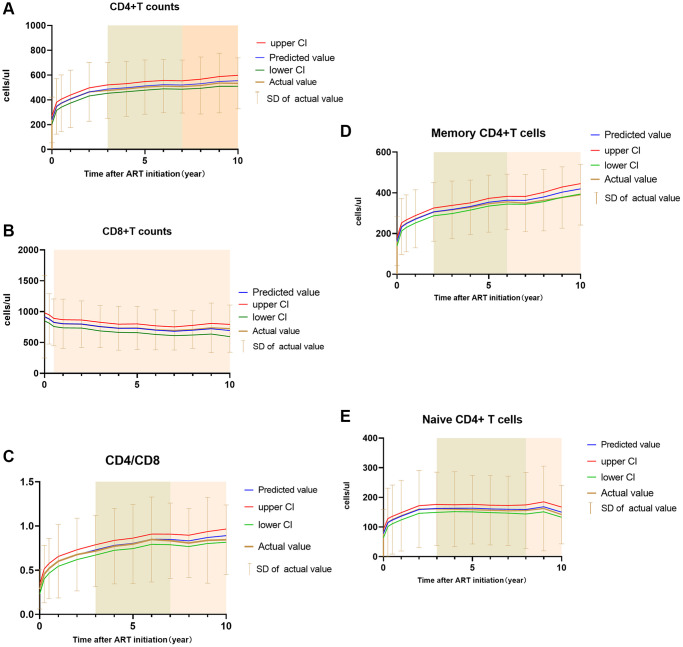
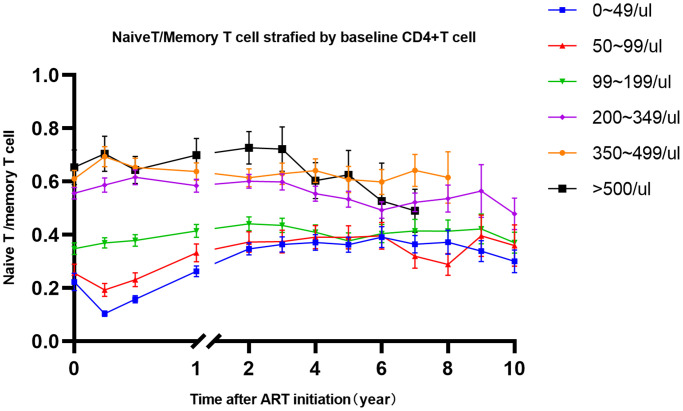
Almost all robust immune restorations achieved occurred after 2-3 years of ART. The median CD4 lymphocyte count increased 449 cells/μl (IQR 303-604) from 226 cells/μl (IQR 83-336) at baseline during the third year ( < 0.001); CD4+T lymphocyte rises during the sixth and tenth years were not significant. Naive and memory CD4+T cells'reconstitution occurred in the sixth and eighth years of ART but no significant change thereafter. The change of CD45RA+Naïve and CD45RA-memory CD4+T cell reconstitution is different in baseline CD4+T cell counts <100 cells/μl group and in baseline CD4+T cell counts >100 cells/μl group. Activation antigen expression (CD38 or HLA-DR) on CD8 lymphocytes declined mostly during the first till second year, and after 4 years, activation antigen expression on patient lymphocytes showed no significant change. The proportion of CD4 cells expressing CD28 climbed during the first years and reached normal levels in the second year.
Immune restoration was dependent on the capacity of immune system during the first 2-3 year of ART. But the significant change of CD4 and compartments of CD4+T cells could persist until 6-8 years. The pattern of CD38+CD8+, HLA-DR+CD8+, CD28+CD4+ T cells could quickly return to normal level and no significant change after sufficient time of ART. In general, the immune response compared to the baseline status may be the overall effect from the age and time of antiretroviral treatment.
在接受长期抗逆转录病毒治疗(ART)且病毒载量得到控制的人类免疫缺陷病毒(HIV)感染者中,免疫重建的程度一直存在争议。我们研究了长期抗逆转录病毒治疗后 T 细胞亚群恢复的程度和速度。
评估了 662 名至少接受了 2 年随访的 HIV 感染者的纵向和免疫恢复功能表型指标,这些患者的血浆 HIV-1 RNA 载量 <50 拷贝/ml。使用混合线性回归模型评估了变化幅度和恢复重要性的决定因素。
几乎所有实现的强大免疫恢复都发生在 ART 治疗 2-3 年后。在第 3 年,CD4 淋巴细胞计数中位数从基线时的 226 个/μl(83-336)增加了 449 个/μl(303-604)(<0.001);在第 6 和第 10 年,CD4+T 淋巴细胞的增加并不显著。在 ART 的第 6 年和第 8 年,幼稚和记忆 CD4+T 细胞得到重建,但此后没有显著变化。在基线 CD4+T 细胞计数 <100 个/μl 组和基线 CD4+T 细胞计数 >100 个/μl 组中,CD45RA+幼稚和 CD45RA-记忆 CD4+T 细胞重建的变化不同。CD8 淋巴细胞上的激活抗原表达(CD38 或 HLA-DR)主要在第 1 年到第 2 年下降,4 年后,患者淋巴细胞上的激活抗原表达没有明显变化。CD4 细胞上表达 CD28 的比例在第 1 年上升,第 2 年达到正常水平。
免疫重建依赖于 ART 治疗的前 2-3 年内免疫系统的能力。但 CD4 和 CD4+T 细胞的重要变化可能会持续到 6-8 年。CD38+CD8+、HLA-DR+CD8+、CD28+CD4+T 细胞的模式可以快速恢复到正常水平,并且在充分的 ART 治疗后没有明显变化。总的来说,与基线状态相比,免疫反应可能是抗逆转录病毒治疗的年龄和时间的综合效应。