National Medical Research Centre for Cardiology Named after Academician E.I.Chazov, 121552 Moscow, Russia.
Cell and Molecular Biotechnology Unit, Faculty of Biology and Biotechnology, National Research University Higher School of Economics, 101000 Moscow, Russia.
Cells. 2022 Nov 29;11(23):3824. doi: 10.3390/cells11233824.
Combined non-viral gene therapy (GT) of ischemia and cardiovascular disease is a promising tool for potential clinical translation. In previous studies our group has developed combined gene therapy by vascular endothelial growth factor 165 () + hepatocyte growth factor (). Our recent works have demonstrated that a bicistronic pDNA that carries both human and coding sequences has a potential for clinical application in peripheral artery disease (PAD). The present study aimed to test combined plasmid efficacy in ischemic skeletal muscle comorbid with predominant complications of PAD-impaired glucose tolerance and type 2 diabetes mellitus (T2DM).
Male C57BL mice were housed on low-fat (LFD) or high-fat diet (HFD) for 10 weeks and metabolic parameters including FBG level, ITT, and GTT were evaluated. Hindlimb ischemia induction and plasmid administration were performed at 10 weeks with 3 weeks for post-surgical follow-up. Limb blood flow was assessed by laser Doppler scanning at 7, 14, and 21 days after ischemia induction. The necrotic area of , macrophage infiltration, angio- and neuritogenesis were evaluated in tissue sections. The mitochondrial status of skeletal muscle (total mitochondria content, ETC proteins content) was assessed by Western blotting of muscle lysates.
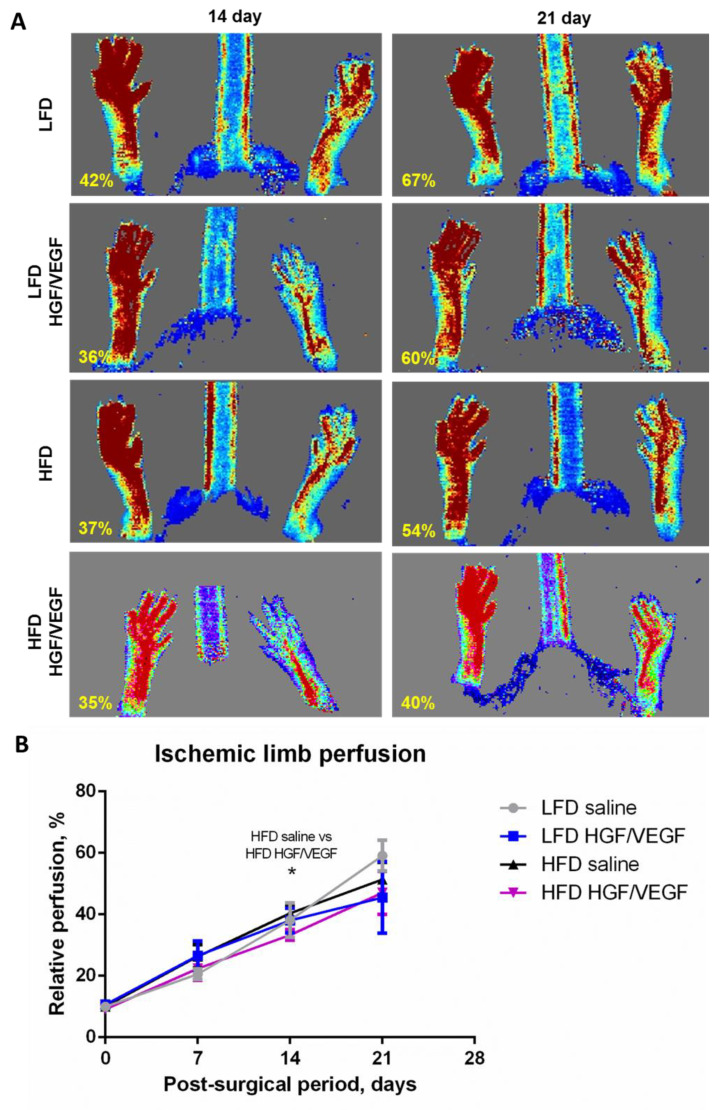
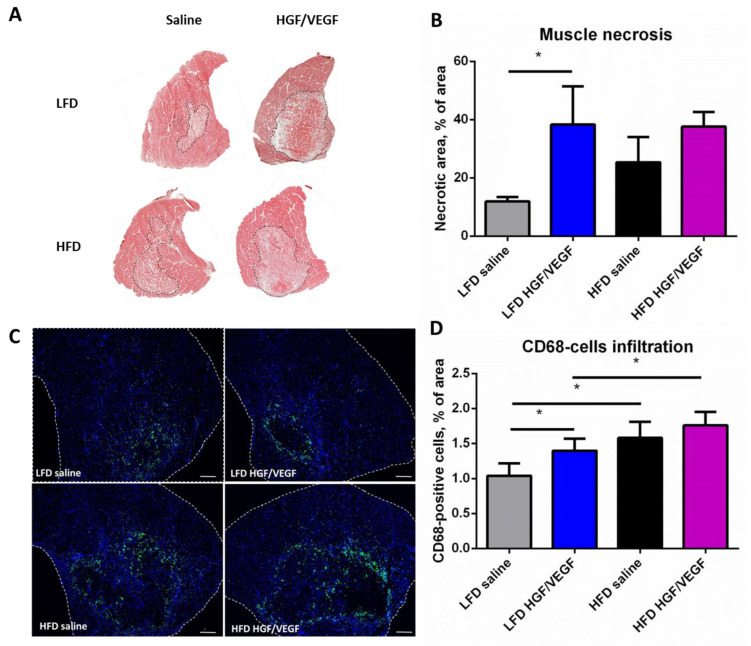
At 10 weeks, the HFD group demonstrated impaired glucose tolerance in comparison with the LFD group. plasmid injection aggravated glucose intolerance in HFD conditions. Blood flow recovery was not changed by plasmid injection either in LFD or HFD conditions. GT in LFD, but not in HFD conditions, enlarged the necrotic area and CD68+ cells infiltration. However, plasmid enhanced neuritogenesis and enlarged NF200+ area on muscle sections. In HFD conditions, plasmid injection significantly increased mitochondria content and ETC proteins content.
The current study demonstrated a significant role of dietary conditions in pre-clinical testing of non-viral GT drugs. combined plasmid demonstrated a novel aspect of potential participation in ischemic skeletal muscle regeneration, through regulation of innervation and bioenergetics of muscle. The obtained results made combined plasmid a very promising tool for PAD therapy in impaired glucose tolerance conditions.
缺血和心血管疾病的联合非病毒基因治疗(GT)是一种有前途的潜在临床转化工具。在以前的研究中,我们的小组已经开发了血管内皮生长因子 165()+肝细胞生长因子()的联合基因治疗。我们最近的工作表明,携带人编码序列和的双顺反子 pDNA 具有在周围动脉疾病(PAD)中的临床应用潜力。本研究旨在测试在缺血性骨骼肌中与 PAD 的主要并发症(葡萄糖耐量受损和 2 型糖尿病(T2DM))合并存在的情况下,联合质粒的疗效。
雄性 C57BL 小鼠在低脂(LFD)或高脂(HFD)饮食中饲养 10 周,并评估 FBG 水平、ITT 和 GTT 等代谢参数。在第 10 周进行后肢缺血诱导和质粒给药,并进行 3 周的术后随访。在缺血诱导后 7、14 和 21 天通过激光多普勒扫描评估肢体血流。在组织切片中评估坏死面积、巨噬细胞浸润、血管生成和神经生成。通过肌肉裂解物的 Western 印迹评估骨骼肌的线粒体状态(总线粒体含量、ETC 蛋白含量)。
在第 10 周时,HFD 组与 LFD 组相比表现出葡萄糖耐量受损。在 HFD 条件下,注射质粒加重了葡萄糖耐量受损。LFD 或 HFD 条件下,质粒注射均未改变血流恢复。GT 在 LFD 中,但不在 HFD 条件下,扩大了坏死面积和 CD68+细胞浸润。然而,质粒增强了神经生成并扩大了肌肉切片上的 NF200+区域。在 HFD 条件下,质粒注射显著增加了线粒体含量和 ETC 蛋白含量。
本研究表明饮食条件在非病毒 GT 药物的临床前测试中具有重要作用。联合质粒通过调节肌肉的神经支配和生物能量学,显示出参与缺血性骨骼肌再生的新方面。获得的结果使联合质粒成为葡萄糖耐量受损条件下 PAD 治疗的非常有前途的工具。