Nakagawa Ryunosuke, Izumi Kouji, Naito Renato, Kadomoto Suguru, Iwamoto Hiroaki, Yaegashi Hiroshi, Kawaguchi Shohei, Nohara Takahiro, Shigehara Kazuyoshi, Yoshida Kotaro, Kadono Yoshifumi, Mizokami Atsushi
Department of Integrative Cancer Therapy and Urology, Kanazawa University Graduate School of Medical Science, Kanazawa 920-8641, Japan.
Department of Radiology, Kanazawa University Graduate School of Medical Science, Kanazawa 920-8641, Japan.
Cancers (Basel). 2022 Nov 23;14(23):5767. doi: 10.3390/cancers14235767.
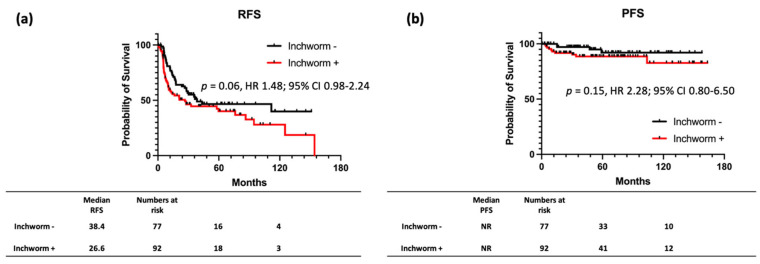
Background: Inchworm sign is considered to be a characteristic finding in non-muscle invasive bladder cancer (NMIBC). Nevertheless, pathologically diagnosed muscle invasive bladder cancers (MIBCs) are occasionally diagnosed from tissue obtained by transurethral resection of bladder tumor (TURBT) in patients with inchworm sign. Methods: We retrospectively investigated the factors related to muscle invasive status in bladder cancer associated with inchworm sign and the role of inchworm sign in tumor outcomes following TURBT. Results: Of the 109 patients with inchworm sign, 94 (86.2%) and 15 (13.8%) were NMIBC and MIBC, respectively. Non-papillary tumors (hazard ratio (HR): 9.55, 95% confidence interval (CI): 2.07−44.10; p < 0.01) and tumors located in the bladder neck (HR: 7.73, 95% CI: 1.83−32.76; p < 0.01) were significant predictors of MIBC in bladder cancer with inchworm sign. Furthermore, recurrence-free survival (RFS) and progression-free survival were compared between patients with NMIBC with and without inchworm sign; however, no significant differences were found. In patients with NMIBC with inchworm sign, positive urine cytology was a prognostic factor for RFS (HR: 1.90, 95% CI: 1.04−3.48; p = 0.04). Conclusions: In bladder cancer with inchworm sign, 86.2% were NMIBC. Even in the case of inchworm sign, the presence of a non-papillary tumor or a bladder neck tumor before TURBT should be noted because of the possibility of MIBC. In this study, the inchworm sign was not a prognostic factor in patients with NMIBC.
尺蠖征被认为是非肌层浸润性膀胱癌(NMIBC)的特征性表现。然而,在具有尺蠖征的患者中,经尿道膀胱肿瘤切除术(TURBT)获取的组织偶尔也会病理诊断为肌层浸润性膀胱癌(MIBC)。方法:我们回顾性研究了与尺蠖征相关的膀胱癌肌层浸润状态的相关因素以及尺蠖征在TURBT后肿瘤预后中的作用。结果:在109例具有尺蠖征的患者中,分别有94例(86.2%)为NMIBC和15例(13.8%)为MIBC。非乳头状肿瘤(风险比(HR):9.55,95%置信区间(CI):2.07−44.10;p<0.01)和位于膀胱颈部的肿瘤(HR:7.73,95%CI:1.83−32.76;p<0.01)是具有尺蠖征的膀胱癌中MIBC的显著预测因素。此外,比较了有和没有尺蠖征的NMIBC患者的无复发生存率(RFS)和无进展生存率;然而,未发现显著差异。在有尺蠖征的NMIBC患者中,尿细胞学阳性是RFS的一个预后因素(HR:1.90,95%CI:1.04−3.48;p = 0.04)。结论:在具有尺蠖征的膀胱癌中,86.2%为NMIBC。即使存在尺蠖征,由于存在MIBC的可能性,TURBT前非乳头状肿瘤或膀胱颈部肿瘤的存在也应予以注意。在本研究中,尺蠖征不是NMIBC患者的预后因素。