School of Economics and Management, Anhui University of Science and Technology, Huainan 232001, China.
School of Mathematics and Big Data, Anhui University of Science and Technology, Huainan 232001, China.
Int J Environ Res Public Health. 2022 Nov 30;19(23):16054. doi: 10.3390/ijerph192316054.
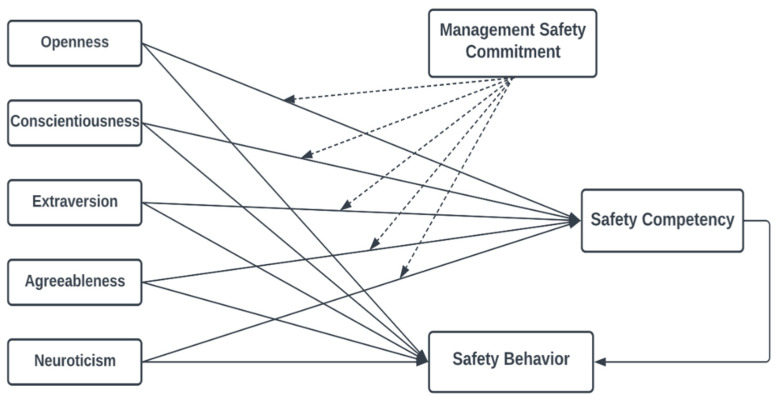
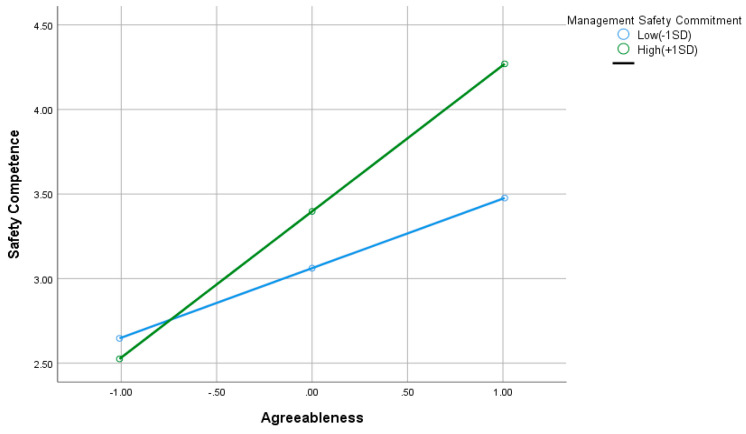
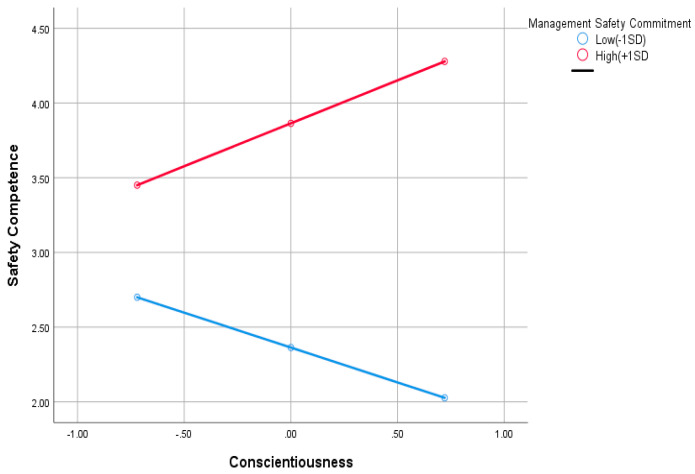
Based on prior research on the relationship between personality and safety behavior, we construct a moderated mediation model that tests the effects of each of the Big Five personality traits (openness, conscientiousness, agreeableness, extraversion, and neuroticism) on the safety behavior of gold miners in Ghana. The model included safety competency as a mediator between the five personality traits and safety behavior. Management commitment to safety was used as a moderator to test the strength of the mediation of safety competency. Data was collected from 344 individuals employed across six large-scale gold mining companies in Ghana using a questionnaire survey. Amos 26 was used to conduct confirmatory factor analysis. The hypotheses were tested using Hayes PROCESS macros models 4 and 7 on SPSS 26. Findings show that openness and extraversion have an insignificant direct influence on safety behavior. Neuroticism negatively affects safety behavior. In contrast, conscientiousness and agreeableness positively affect safety behavior. Mediation analysis revealed that safety competency partially mediates the relationships between (1) conscientiousness and safety behavior and (2) agreeableness and safety behavior. The relationship between extraversion and safety behavior is fully mediated by safety competency. Additionally, we discovered that management safety commitment has a significant conditional indirect effect (Index of moderated mediation = 0.168 95% CI = [0.122;0.222]) on the relationship between conscientiousness and safety behavior through safety competency. Management safety commitment also significantly moderated (Index of moderated mediation = 0.075 95% CI = [0.021;0.120]) the relationship between agreeableness and safety behavior through safety competency.
基于先前关于人格与安全行为之间关系的研究,我们构建了一个调节中介模型,检验了大五人格特质(开放性、尽责性、宜人性、外向性和神经质)中的每一个特质对加纳金矿工人安全行为的影响。该模型将安全能力作为五个人格特质与安全行为之间的中介变量。我们采用管理层对安全的承诺作为调节变量,以检验安全能力中介作用的强度。我们从加纳六家大型金矿公司的 344 名员工那里收集了数据,使用问卷进行了调查。Amos 26 用于进行验证性因子分析。在 SPSS 26 上,我们使用 Hayes PROCESS 宏模型 4 和 7 检验了假设。研究结果表明,开放性和外向性对安全行为没有显著的直接影响。神经质对安全行为有负面影响。相反,尽责性和宜人性对安全行为有积极影响。中介分析表明,安全能力部分中介了(1)尽责性与安全行为和(2)宜人性与安全行为之间的关系。外向性与安全行为之间的关系完全由安全能力中介。此外,我们发现管理层对安全的承诺通过安全能力对尽责性与安全行为之间的关系具有显著的条件间接效应(中介调节指数=0.168 95%置信区间=[0.122;0.222])。管理层对安全的承诺还通过安全能力显著调节了宜人性与安全行为之间的关系(中介调节指数=0.075 95%置信区间=[0.021;0.120])。