Liu Jiacheng, Chen Bowen, Wu Xiangdong, Wang Han, Zuo Xiaohai, Lei Yiting, Huang Wei
Orthopedic Laboratory of Chongqing Medical University, Department of Orthopedics, The First Affiliated Hospital of Chongqing Medical University, Chongqing 400016, China.
Department of Orthopedic Surgery, Peking Union Medical College Hospital, Chinese Academy of Medical Sciences & Peking Union Medical College, Beijing 100730, China.
J Clin Med. 2022 Nov 22;11(23):6897. doi: 10.3390/jcm11236897.
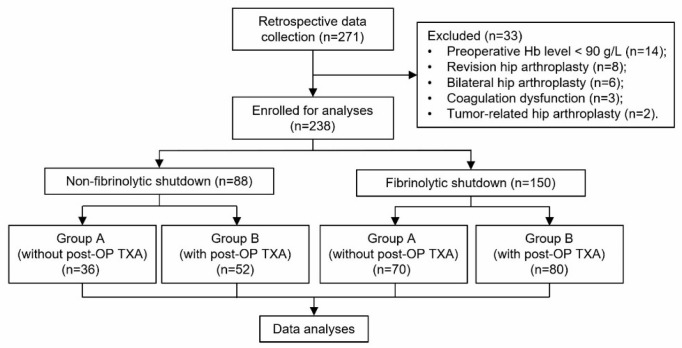
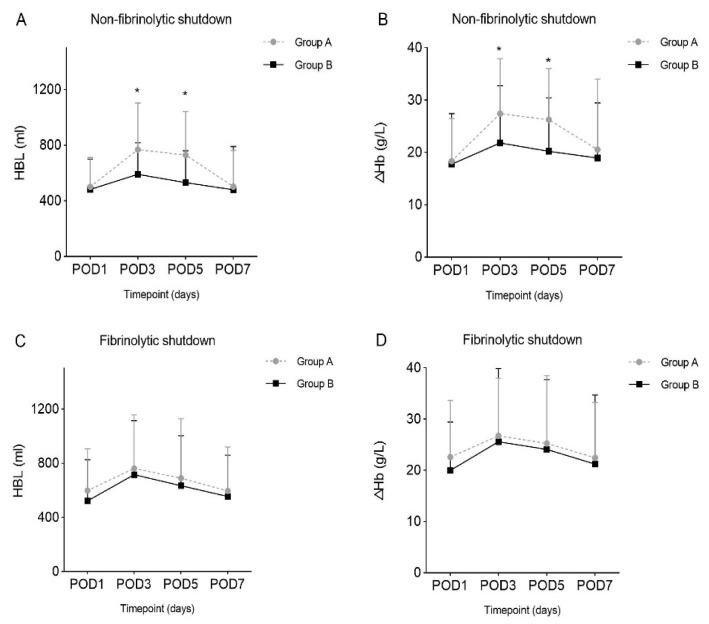
Bleeding patients exhibit different fibrinolytic phenotypes after injury, and the universal use of tranexamic acid (TXA) is doubted. We aimed to evaluate the efficacy of postoperative antifibrinolytic treatment in total hip arthroplasty (THA) patients with different fibrinolytic phenotypes. A retrospective analysis was conducted in 238 patients who underwent THA. Patients were divided into two groups by different fibrinolytic phenotypes (non-fibrinolytic shutdown and fibrinolytic shutdown), determined by the LY30 level on postoperative day 1 (POD1). The two groups were further stratified into four sub-groups based on different postoperative TXA regimens (Group A received no TXA postoperatively, while Group B did). Hidden blood loss (HBL), decline of hemoglobin (ΔHb), D-dimer (D-D), fibrinogen/fibrin degradation product (FDP), prothrombin time (PT), activated partial thromboplastin time (APTT), and demographics were collected and compared. The clinical baseline data were comparable between the studied groups. In patients who presented non-fibrinolytic shutdown postoperatively, Group B suffered significantly lower HBL and ΔHb than Group A on POD3 and POD5. In patients who presented postoperative fibrinolytic shutdown, Group B failed to benefit from the postoperative administration of TXA when compared to Group A. No difference was found in postoperative levels of D-D, FDP, PT, and APTT. Postoperative antifibrinolytic therapy is beneficial for THA patients who presented non-fibrinolytic shutdown postoperatively, while the efficacy and necessity should be considered with caution in those with fibrinolytic shutdown. LY30 is a promising parameter to distinguish different fibrinolytic phenotypes and guide TXA administration. However, further prospective studies are needed to confirm these findings.
出血患者受伤后表现出不同的纤溶表型,氨甲环酸(TXA)的普遍使用受到质疑。我们旨在评估术后抗纤溶治疗在不同纤溶表型的全髋关节置换术(THA)患者中的疗效。对238例行THA的患者进行回顾性分析。根据术后第1天(POD1)的LY30水平,将患者按不同纤溶表型分为两组(非纤溶关闭和纤溶关闭)。根据不同的术后TXA方案,将两组进一步分层为四个亚组(A组术后未接受TXA,而B组接受)。收集并比较隐性失血(HBL)、血红蛋白下降(ΔHb)、D-二聚体(D-D)、纤维蛋白原/纤维蛋白降解产物(FDP)、凝血酶原时间(PT)、活化部分凝血活酶时间(APTT)和人口统计学数据。研究组之间的临床基线数据具有可比性。术后出现非纤溶关闭的患者中,B组在POD3和POD5时的HBL和ΔHb显著低于A组。术后出现纤溶关闭的患者中,与A组相比,B组未从术后给予TXA中获益。术后D-D、FDP、PT和APTT水平无差异。术后抗纤溶治疗对术后出现非纤溶关闭的THA患者有益,而对于纤溶关闭的患者,应谨慎考虑其疗效和必要性。LY30是区分不同纤溶表型和指导TXA给药的一个有前景的参数。然而,需要进一步的前瞻性研究来证实这些发现。