Wu Xiang-Dong, Tian Mian, He Yao, Chen Yu, Tao Yu-Zhang, Shao Long, Luo Changqi, Xiao Peng-Cheng, Zhu Zheng-Lin, Liu Jia-Cheng, Huang Wei, Qiu Gui-Xing
Department of Orthopaedic Surgery, Peking Union Medical College Hospital, Chinese Academy of Medical Sciences & Peking Union Medical College, Beijing 100730, China.
Department of Orthopaedic Surgery, The First Affiliated Hospital of Chongqing Medical University, Chongqing 400016, China.
Ann Transl Med. 2020 Mar;8(6):307. doi: 10.21037/atm.2020.02.99.
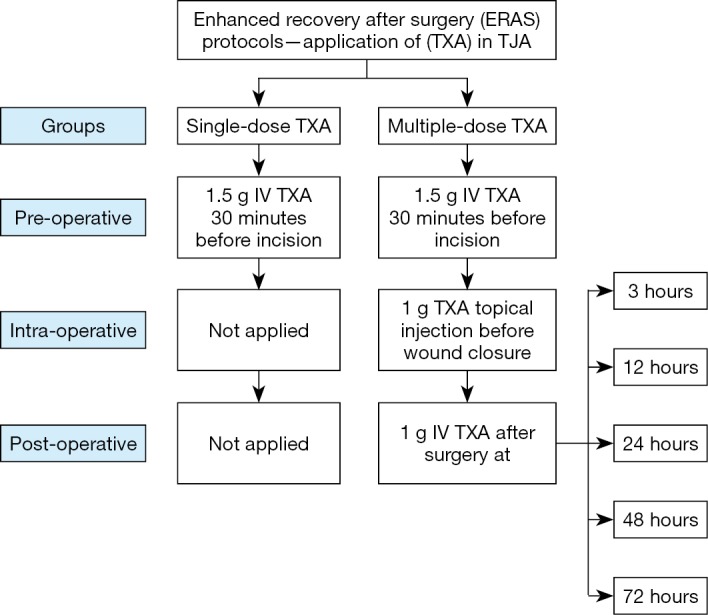
The application of tranexamic acid (TXA) in total hip arthroplasty (THA) and total knee arthroplasty (TKA) has brought momentous changes in blood management. However, the optimal regimen of TXA has not yet been identified. This study aimed to compare the efficacy of a three-day prolonged-course of multiple-dose of TXA with a single pre-operative dose of TXA in patients who undergo THA and TKA.
We retrospectively analyzed two groups of consecutive patients who received primary unilateral THA and TKA from 2015 to 2017. One group received a three-day prolonged-course of multiple-dose of TXA, while another group received a single-dose of TXA. The primary outcomes included the changes in hemoglobin (Hb), estimated total blood loss (TBL), and transfusion rate; the secondary outcomes included the platelet (PLT) counts, inflammatory markers, and fibrinolysis parameters.
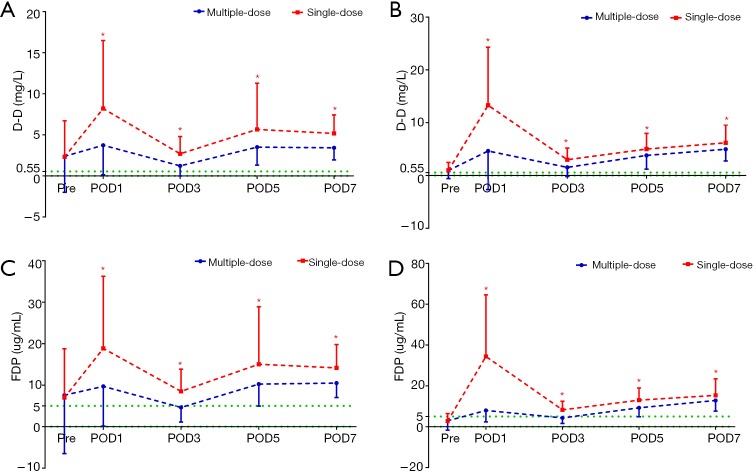
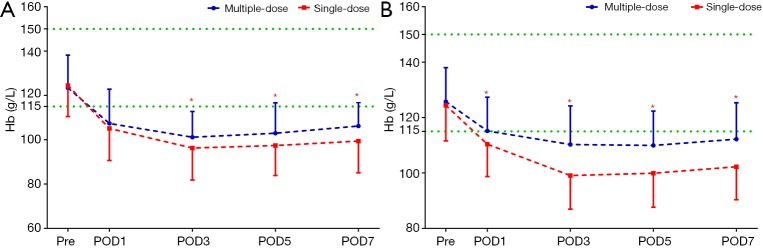
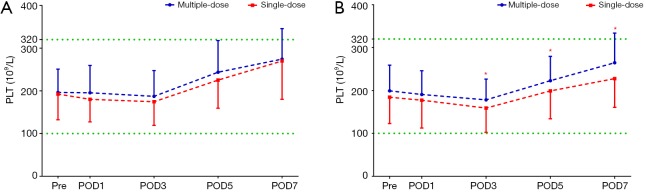
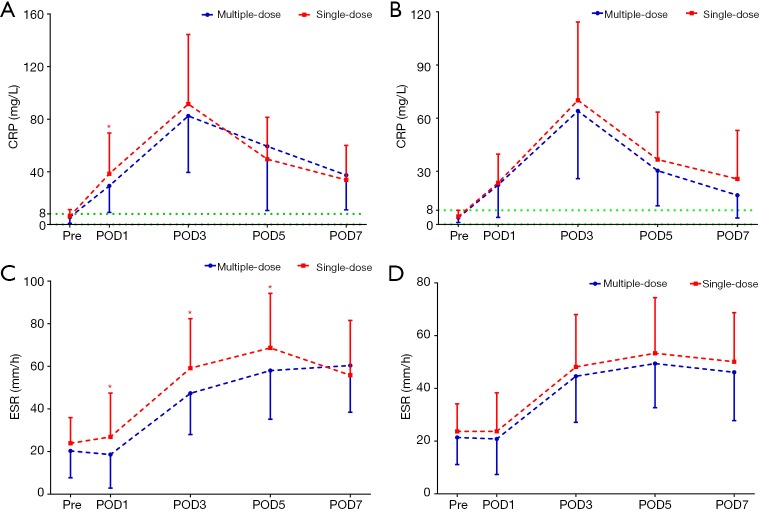
A total of 193 THA and 166 TKA procedures were included for comparison. Compared with the patients who received a single-dose of TXA, the patients who received a three-day prolonged-course of multiple-dose of TXA had smaller post-operative drops in Hb levels, which led to consistently significantly higher Hb levels in both THA and TKA. Therefore, the use of multiple-dose of TXA was associated with significantly lower maximum Hb drops and estimated TBL in both THA (24.58±11.43 30.38±11.33 g/L, P=0.001; 685.88±412.02 968.94±479.9 mL, P<0.0001) and TKA (18.04±9.75 27.24±10.99 g/L, P<0.0001; 497.35±291.03 816.51±354.38 mL, P<0.0001), and marginally reduced transfusion requirements (THA: 1/65 10/128; TKA: 0/70 2/96). The multiple-dose group also showed higher PLT counts, continuously reduced inflammatory responses, and significantly and durably attenuated fibrinolytic responses.
A three-day prolonged-course of multiple-dose of TXA was consistently effective in reducing post-operative Hb drops, estimated TBL, inflammatory responses, and fibrinolytic responses, which could be recommended for clinical practice. However, these findings need to be confirmed by prospective studies.
氨甲环酸(TXA)在全髋关节置换术(THA)和全膝关节置换术(TKA)中的应用给血液管理带来了重大变革。然而,TXA的最佳用药方案尚未确定。本研究旨在比较接受THA和TKA的患者中,三日多剂量延长疗程TXA与术前单剂量TXA的疗效。
我们回顾性分析了2015年至2017年接受初次单侧THA和TKA的两组连续患者。一组接受三日多剂量延长疗程的TXA,另一组接受单剂量TXA。主要结局包括血红蛋白(Hb)变化、估计总失血量(TBL)和输血率;次要结局包括血小板(PLT)计数、炎症标志物和纤溶参数。
共纳入193例THA和166例TKA手术进行比较。与接受单剂量TXA的患者相比,接受三日多剂量延长疗程TXA的患者术后Hb水平下降幅度较小,这使得THA和TKA患者术后Hb水平持续显著更高。因此,多剂量TXA的使用与THA(24.58±11.43对30.38±11.33 g/L,P = 0.001;685.88±412.02对968.94±479.9 mL,P < 0.0001)和TKA(18.04±9.75对27.24±10.99 g/L,P < 0.0001;497.35±291.03对816.51±354.38 mL,P < 0.0001)中显著更低的最大Hb下降幅度和估计TBL相关,且输血需求略有减少(THA:1/65对10/128;TKA:0/70对2/96)。多剂量组还显示出更高的PLT计数、持续降低的炎症反应以及显著且持久减弱的纤溶反应。
三日多剂量延长疗程的TXA在减少术后Hb下降、估计TBL、炎症反应和纤溶反应方面始终有效,可推荐用于临床实践。然而,这些发现需要前瞻性研究予以证实。