Sabage Luís Expedito, Sun Young Joo, Wolf Julian, Sabage Josmar, Mazzo Alessandra, Santos Carlos Ferreira, Mahajan Vinit B, Manzoni Lourençone Luiz Fernando
Bauru School of Dentistry, University of São Paulo, Bauru 17012-901, SP, Brazil.
Molecular Surgery Laboratory, Byers Eye Institute, Department of Ophthalmology, Stanford University, Palo Alto, CA 94304, USA.
J Clin Med. 2022 Nov 24;11(23):6929. doi: 10.3390/jcm11236929.
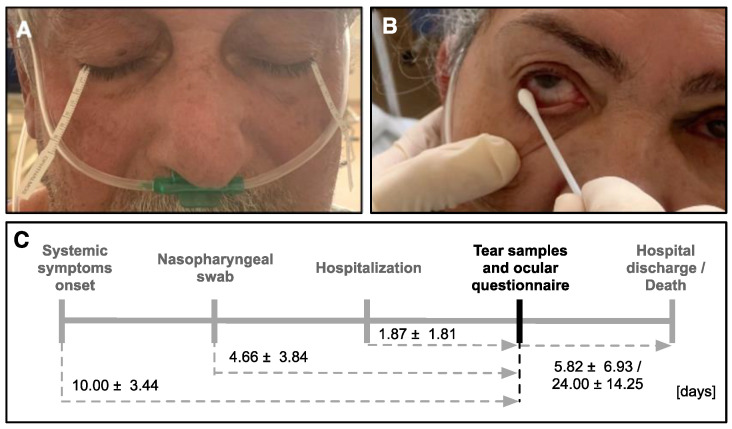
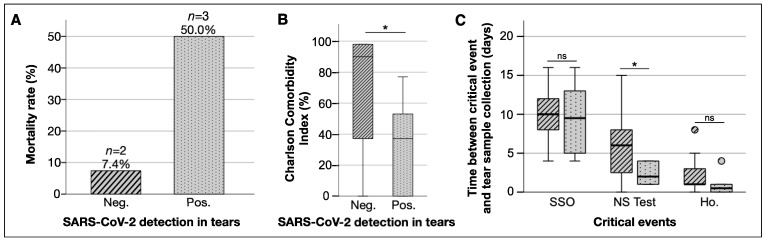
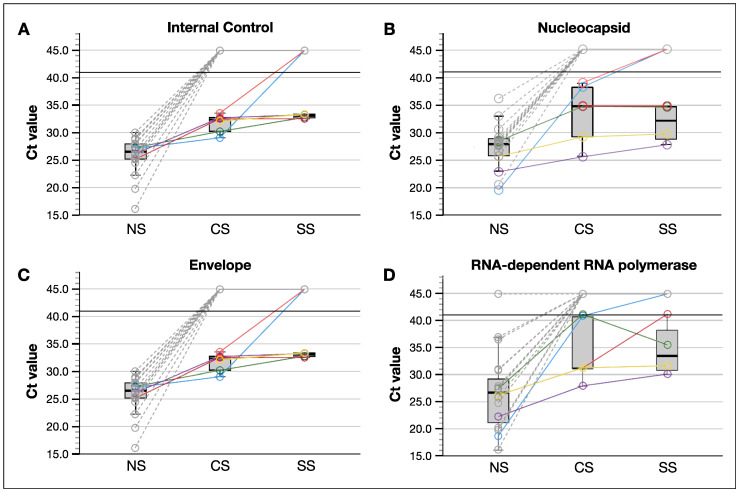
Purpose: To determine the prevalence of SARS-CoV-2 in tear samples and to investigate whether it correlates with ocular findings and patients’ prognosis in Brazil. Methods: Tears were collected using Schirmer strips (SS) and conjunctival swabs (CS) from patients hospitalized with laboratory-confirmed SARS-CoV-2 infection. Samples were analyzed using qRT-PCR. Demographic and clinical data, ocular symptoms, and Schirmer tests (ST) were collected from patients. Charlson Comorbidity Index (CCI) was used to rate comorbidities, and patients were monitored until hospital discharge or death. Results: There were 61 hospitalized patients, 33 of which were diagnosed with COVID-19. Within the confirmed COVID-19 patients, SARS-CoV-2 was detected in 18.2% (n = 6) of CS and 12.1% (n = 4) of SS samples. Subjective and objective parameters for dry eye syndrome (e.g., ST COVID-19: 8.3 ± 6.4mm, non-COVID-19: 8.9 ± 6.6mm, p > 0.05) were comparable between COVID-19 (n = 33) and non-COVID-19 patients (n = 28). Among the 16 COVID-19 patients exhibiting ocular symptoms, only tearing was reported significantly more frequently when tear samples were positive for SARS-CoV-2 (p < 0.05). Strikingly, patients whose tears tested positive for SARS-CoV-2 had significantly inferior CCI (pos.: 34.0 ± 31.8%, neg.: 67.6 ± 36.4%, p < 0.05) and higher mortality rates (pos.: 50.0%, neg.: 7.4%, p < 0.01). Conclusions: SARS-CoV-2 was detected with a prevalence of 18.2% on the ocular surface. Decreased CCI and increased mortality rate in the positive tear group suggests that viral detection may relate to prognosis and highlight the need of personal protective measures for healthcare professionals. Most of the patients, regardless of COVID-19 diagnosis, had low tear production and eye discomfort, possibly pointing to the need for artificial tear use during hospitalization.
确定巴西泪液样本中严重急性呼吸综合征冠状病毒2(SARS-CoV-2)的流行率,并调查其是否与眼部表现及患者预后相关。方法:从实验室确诊感染SARS-CoV-2的住院患者中,使用泪液试纸条(SS)和结膜拭子(CS)采集泪液。样本采用定量逆转录聚合酶链反应(qRT-PCR)进行分析。收集患者的人口统计学和临床数据、眼部症状及泪液分泌试验(ST)结果。采用查尔森合并症指数(CCI)对合并症进行评分,并对患者进行监测直至出院或死亡。结果:共有61名住院患者,其中33例被诊断为新型冠状病毒肺炎(COVID-19)。在确诊的COVID-19患者中,CS样本中SARS-CoV-2的检出率为18.2%(n = 6),SS样本中为12.1%(n = 4)。COVID-19患者(n = 33)和非COVID-19患者(n = 28)之间,干眼综合征的主观和客观参数(如ST:COVID-19组为8.3±6.4mm,非COVID-19组为8.9±6.6mm,p>0.05)具有可比性。在出现眼部症状的16例COVID-19患者中,仅当泪液样本SARS-CoV-2呈阳性时,流泪症状报告更为频繁(p<0.05)。令人惊讶的是,泪液SARS-CoV-2检测呈阳性的患者CCI显著更低(阳性:34.0±31.8%,阴性:67.6±36.4%,p<0.05),死亡率更高(阳性:50.0%,阴性:7.4%,p<0.01)。结论:眼表SARS-CoV-2的检出率为18.2%。阳性泪液组中CCI降低和死亡率增加表明病毒检测可能与预后相关,并凸显了医护人员采取个人防护措施的必要性。大多数患者,无论是否诊断为COVID-19,泪液分泌量均较低且有眼部不适,这可能表明住院期间需要使用人工泪液。