Vaghefinazari Bahram, Wierzbicka Ewa, Visser Peter, Posner Ralf, Arrabal Raúl, Matykina Endzhe, Mohedano Marta, Blawert Carsten, Zheludkevich Mikhail L, Lamaka Sviatlana V
Institute of Surface Science, Helmholtz-Zentrum Hereon, 21502 Geesthacht, Germany.
Departamento de Ingeniería Química y de Materiales, Facultad de Ciencias Químicas, Universidad Complutense de Madrid, 28040 Madrid, Spain.
Materials (Basel). 2022 Nov 28;15(23):8489. doi: 10.3390/ma15238489.
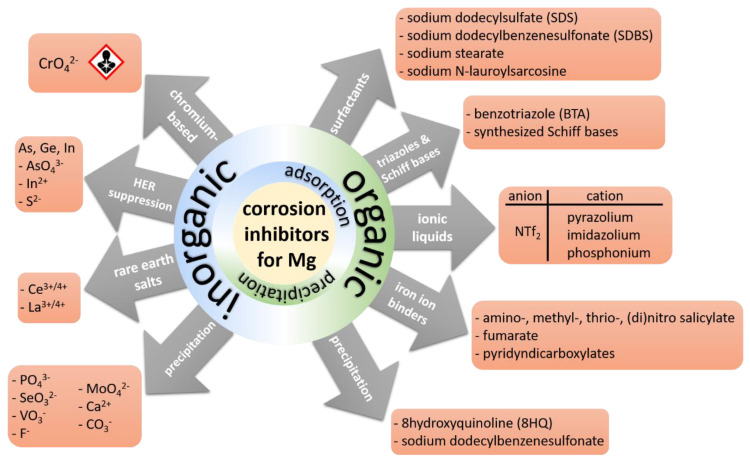
Owing to the unique active corrosion protection characteristic of hexavalent chromium-based systems, they have been projected to be highly effective solutions against the corrosion of many engineering metals. However, hexavalent chromium, rendered a highly toxic and carcinogenic substance, is being phased out of industrial applications. Thus, over the past few years, extensive and concerted efforts have been made to develop environmentally friendly alternative technologies with comparable or better corrosion protection performance to that of hexavalent chromium-based technologies. The introduction of corrosion inhibitors to a coating system on magnesium surface is a cost-effective approach not only for improving the overall corrosion protection performance, but also for imparting active inhibition during the service life of the magnesium part. Therefore, in an attempt to resemble the unique active corrosion protection characteristic of the hexavalent chromium-based systems, the incorporation of inhibitors to barrier coatings on magnesium alloys has been extensively investigated. In Part III of the Review, several types of corrosion inhibitors for magnesium and its alloys are reviewed. A discussion of the state-of-the-art inhibitor systems, such as iron-binding inhibitors and inhibitor mixtures, is presented, and perspective directions of research are outlined, including or computational screening of corrosion inhibitors. Finally, the combination of corrosion inhibitors with other corrosion protection strategies is reviewed. Several reported highly protective coatings with active inhibition capabilities stemming from the on-demand activation of incorporated inhibitors can be considered a promising replacement for hexavalent chromium-based technologies, as long as their deployment is adequately addressed.
由于六价铬基体系具有独特的主动腐蚀防护特性,它们被认为是解决许多工程金属腐蚀问题的高效解决方案。然而,六价铬是一种剧毒且致癌的物质,正逐渐被淘汰出工业应用领域。因此,在过去几年中,人们付出了广泛而一致的努力,来开发具有与六价铬基技术相当或更好的腐蚀防护性能的环保替代技术。在镁表面的涂层体系中引入缓蚀剂,不仅是提高整体腐蚀防护性能的一种经济有效的方法,而且还能在镁部件的使用寿命期间起到主动抑制作用。因此,为了模拟六价铬基体系独特的主动腐蚀防护特性,在镁合金的阻挡涂层中加入缓蚀剂的研究已经广泛开展。在本综述的第三部分,对几种镁及其合金的缓蚀剂进行了综述。讨论了诸如铁结合型缓蚀剂和缓蚀剂混合物等先进的缓蚀剂体系,并概述了研究的未来方向,包括缓蚀剂的筛选或计算筛选。最后,对缓蚀剂与其他腐蚀防护策略的结合进行了综述。只要其应用问题得到充分解决,一些报道的具有主动抑制能力的高防护涂层,因其所含缓蚀剂的按需激活作用,可被视为六价铬基技术的有前途的替代品。