Center for Stem Cell and Regenerative Medicine, Tokyo Medical and Dental University (TMDU), 1-5-45 Yushima, Bunkyo-ku, Tokyo, 113-8510, Japan.
Research Core, Tokyo Medical and Dental University (TMDU), Tokyo, Japan.
BMC Mol Cell Biol. 2022 Dec 12;23(1):53. doi: 10.1186/s12860-022-00456-z.
Placement of a cultured synovial mesenchymal stem cell (MSC) suspension on a repaired meniscus for 10 min accelerated meniscus repair. Upon placement of the MSC suspension on the meniscus, microspikes projecting from the MSC surface trap meniscus fibers and promote MSC adhesion. Thawed cryopreserved MSCs are preferred materials for meniscus repair, as they can be transplanted without additional culture. However, the adhesion ability of thawed cryopreserved MSCs is unknown. Here, we compared the proportion of cultured versus thawed MSCs adhering to a porcine meniscus immediately and 10 min after placement. We also investigated the relationship between adhesion and the number of microspikes on the synovial MSCs.
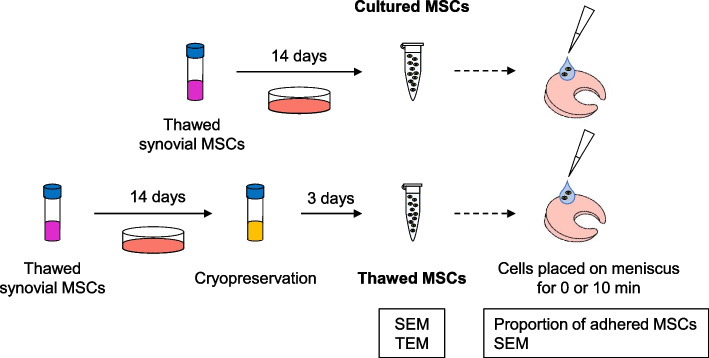
Synovial MSCs were prepared from the knees of four donors with osteoarthritis. The "cultured MSCs" were thawed MSCs that were re-cultured and suspended in PBS for transplantation. A similarly prepared suspension was cryopreserved, thawed again, suspended in PBS, and used without further culture as the "thawed MSCs." MSCs with at least three microspikes in SEM images were defined as microspike-positive MSCs. Porcine meniscus surfaces were abraded, cut into a cylindrical shape, and treated with MSC suspension. Non-adherent cells were counted immediately and again 10 min after placement to calculate the adhesion proportion.
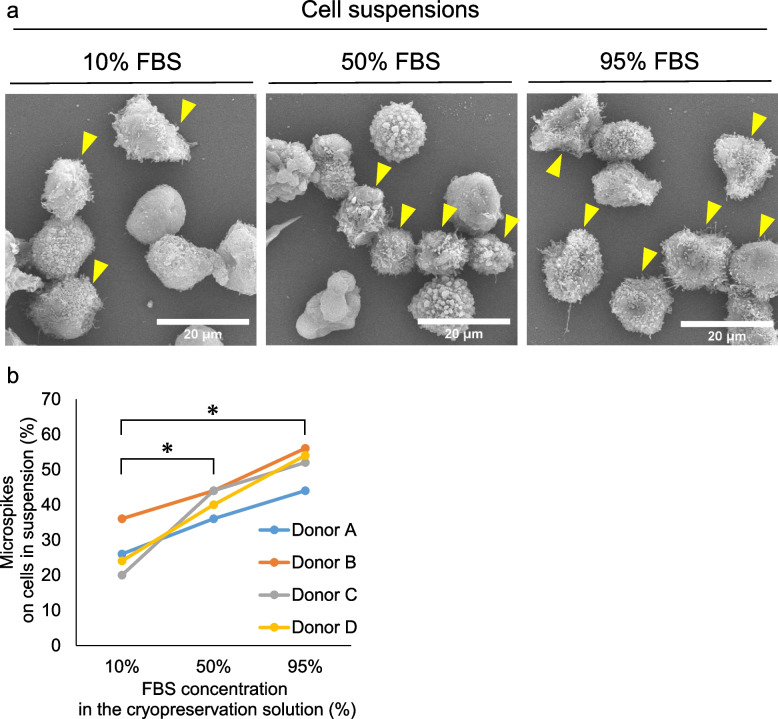
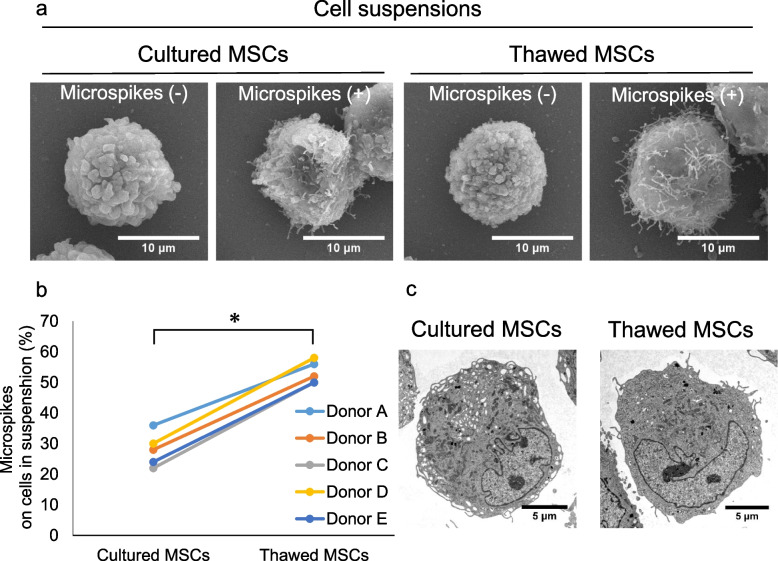
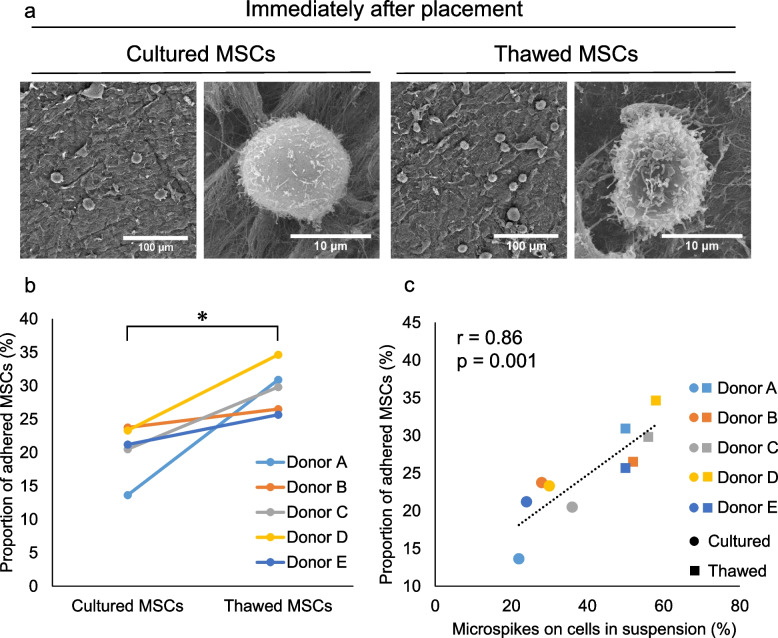
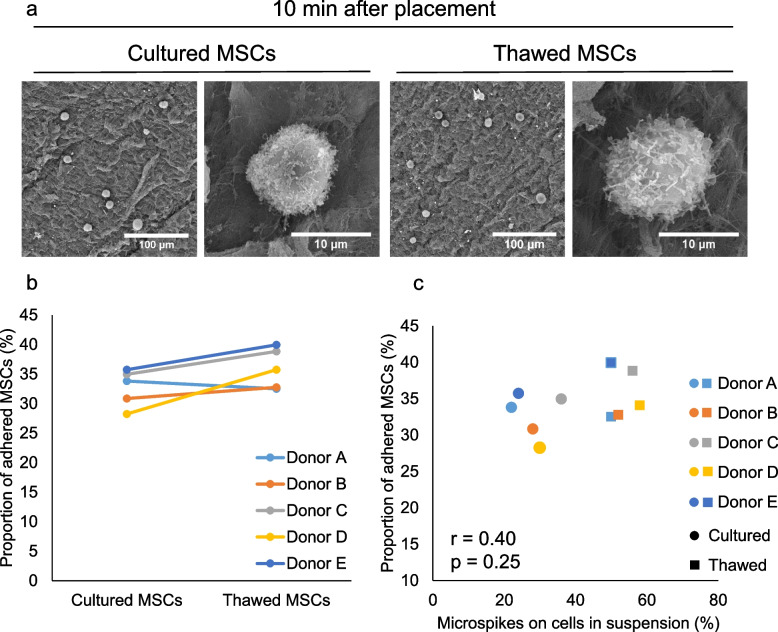
The proportion of microspike-positive MSCs was significantly higher in thawed (53 ± 3%) than in cultured (28 ± 5%) MSC suspensions. MSC adhesion to the meniscus was significantly better for the thawed than for the cultured MSC suspensions immediately after placement on the meniscus, but no differences were detected after 10 min. The proportion of MSCs with microspikes in the cell suspension was significantly correlated with the proportion of adhered MSCs immediately after the placement, but not 10 min later. Addition of FBS to the cryopreservation medium promoted a concentration-dependent increase in the proportion of microspike-positive cells.
Thawed MSCs adhered better than cultured MSCs immediately after placement, but adhesion was similar for both MSC preparations after 10 min. Immediately after placement, the presence of microspikes was associated with better adhesion of synovial MSCs to the meniscus.
将培养的滑膜间充质干细胞(MSC)悬液置于修复后的半月板上 10 分钟可加速半月板修复。将 MSC 悬液置于半月板上时,MSC 表面突出的微刺会捕获半月板纤维并促进 MSC 黏附。解冻的冷冻保存 MSC 是半月板修复的首选材料,因为它们可以在无需进一步培养的情况下进行移植。然而,解冻冷冻保存 MSC 的黏附能力尚不清楚。在这里,我们比较了培养的 MSC 和解冻的 MSC 在放置后即刻和 10 分钟黏附于猪半月板的比例。我们还研究了黏附与滑膜 MSC 上微刺数量之间的关系。
滑膜 MSC 从 4 名骨关节炎患者的膝关节中提取。“培养的 MSC”是解冻的 MSC,经重新培养并悬浮在 PBS 中用于移植。同样制备的悬浮液被冷冻保存,再次解冻,悬浮在 PBS 中,无需进一步培养即可作为“解冻的 MSC”使用。在 SEM 图像中至少有 3 个微刺的 MSC 被定义为微刺阳性 MSC。猪半月板表面被研磨、切割成圆柱形,并进行 MSC 悬液处理。立即和放置 10 分钟后分别计数非黏附细胞,计算黏附比例。
解冻的 MSC(53±3%)中微刺阳性 MSC 的比例明显高于培养的 MSC(28±5%)。解冻的 MSC 悬液立即黏附于半月板的效果明显优于培养的 MSC 悬液,但放置 10 分钟后无差异。细胞悬液中带微刺的 MSC 比例与放置后即刻黏附的 MSC 比例显著相关,但放置 10 分钟后则无相关性。在冷冻保存培养基中添加 FBS 可促进微刺阳性细胞比例呈浓度依赖性增加。
解冻的 MSC 立即放置后黏附效果优于培养的 MSC,但 10 分钟后两种 MSC 制剂的黏附效果相似。放置后即刻,微刺的存在与滑膜 MSC 对半月板的更好黏附有关。