International Institute for Population Sciences, Mumbai, 400088, India.
BMC Womens Health. 2022 Dec 12;22(1):514. doi: 10.1186/s12905-022-02072-7.
There is limited evidence of hysterectomy in India because of a lack of data in large-scale, nationally representative health surveys. In 2015-16, the fourth National Family Health Survey (NFHS-4)-a cross-sectional survey-collected for the first-time direct information on hysterectomy and self-reported reasons for undergoing the procedure among women in the reproductive age group. The current study evaluates the prevalence, determinants, and choice of hospitalization (Public vs. Private) for conducting hysterectomy in India among women aged 15-49 years in 29 states and seven union territories (UTs) based on the new large-scale population-based nationally representative dataset (NFHS 5).
Cross-tabulations and percentage distributions were utilized to analyse the prevalence of hysterectomy and the choice of hospitalization (public vs. private) across different socioeconomic backgrounds and reasons for undergoing hysterectomy. A multivariate binary logistic regression model was also used to find statistically significant determinants of hysterectomy.
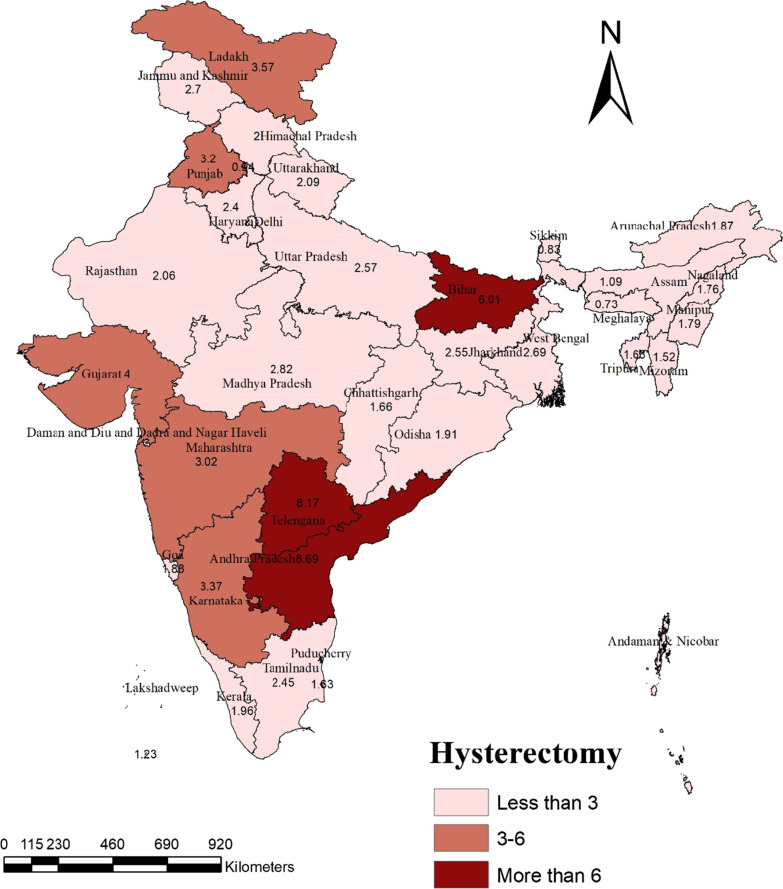
In India as a whole, 3.3% of women aged 15-49 years had undergone a hysterectomy. The percentage of women who had undergone the procedure was found to vary considerably across the states and the UTs. The southern region stands out for the considerably higher prevalence of hysterectomy; particularly in the states of Andhra Pradesh (8.7%) and Telangana (8.2%), the prevalence was very high followed by Bihar (6%) and Gujrat (4%). On the other hand, the North-eastern region had the lowest prevalence of hysterectomy (1.2%). A noticeable fact that emerged was that the majority of the hysterectomies were performed in the private sector (69.6%) in India. But the scenario was quite different in north-eastern region as in this region more hysterectomies were performed in public health facilities (73%) rather than private health facilities (26.7%). Age, place of residence, religion, caste, level of education, geographic region, wealth quintiles, parity, age at first cohabitation of women were found to be the socio-demographic determinants statistically associated with hysterectomy in India. The likelihood of hysterectomy was higher among women living in rural areas (AOR: 1.3, CI: 1.23-1.35), in the richest wealth quintile (AOR 2.6; CI 2.37-2.76) and in the southern region (AOR 1.6; CI 1.47-1.66). The reasons frequently reported for hysterectomy were excessive menstrual bleeding/pain, followed by fibroids/cysts.
This study has attempted to analyse hysterectomy prevalence and its socio-economic determinants using the latest fifth round of NFHS data of all the states and covering 21 states and union territories of India, which gives wider coverage of hysterectomy and more recent with accurate data. More research is needed therefore to unravel the complex dynamics of hysterectomy in India (and elsewhere) which could be used to help women make more informed choices and in turn advance their reproductive health and rights.
由于缺乏大规模、具有代表性的卫生调查数据,印度的子宫切除术证据有限。2015-16 年,第四次全国家庭健康调查(NFHS-4)——一项横断面调查——首次收集了生殖年龄段妇女接受子宫切除术的直接信息和自述手术原因。本研究根据新的大规模基于人群的全国代表性数据集(NFHS5),评估了印度 15-49 岁妇女中子宫切除术的流行率、决定因素以及住院治疗(公立与私立)的选择。
利用交叉表和百分比分布来分析不同社会经济背景下子宫切除术的流行率和住院治疗(公立与私立)的选择,以及子宫切除术的原因。还使用了多变量二元逻辑回归模型来确定子宫切除术的统计学显著决定因素。
在印度,15-49 岁的妇女中有 3.3%接受了子宫切除术。发现各州和联邦属地之间的手术比例差异很大。南部地区的子宫切除术比例明显较高;特别是安得拉邦(8.7%)和特兰甘纳邦(8.2%),这一比例非常高,其次是比哈尔邦(6%)和古吉拉特邦(4%)。另一方面,东北地区的子宫切除术比例最低(1.2%)。一个引人注目的事实是,印度大多数子宫切除术是在私营部门(69.6%)进行的。但东北地区的情况却大不相同,因为在这个地区,更多的子宫切除术是在公共卫生机构(73%)而不是私人卫生机构(26.7%)进行的。年龄、居住地、宗教、种姓、教育程度、地理区域、财富五分位数、生育次数、首次同居年龄等因素被发现是与印度子宫切除术相关的社会人口统计学决定因素。与城市地区相比,农村地区的妇女(AOR:1.3,CI:1.23-1.35)、最富裕的五分位数(AOR 2.6;CI 2.37-2.76)和南部地区(AOR 1.6;CI 1.47-1.66)接受子宫切除术的可能性更高。子宫切除术的常见原因是月经过多/疼痛,其次是肌瘤/囊肿。
本研究试图利用所有邦的第五轮最新 NFHS 数据,对印度的子宫切除术流行率及其社会经济决定因素进行分析,涵盖了印度的 21 个邦和联邦属地,这提供了更广泛的子宫切除术覆盖范围和更准确的数据。因此,需要进一步研究来揭示印度(和其他地方)子宫切除术的复杂动态,这可以用来帮助妇女做出更明智的选择,并进而促进她们的生殖健康和权利。