Department of Public Health and Clinical Medicine, Sustainable Health, SE-901 87 Umeå University, Sweden.
Scand J Work Environ Health. 2023 Mar 1;49(2):156-163. doi: 10.5271/sjweh.4075. Epub 2022 Dec 12.
The aim of this study was to assess the association between occupational biomechanical exposures and the occurrence of surgical treatment for subacromial impingement syndrome (SIS).
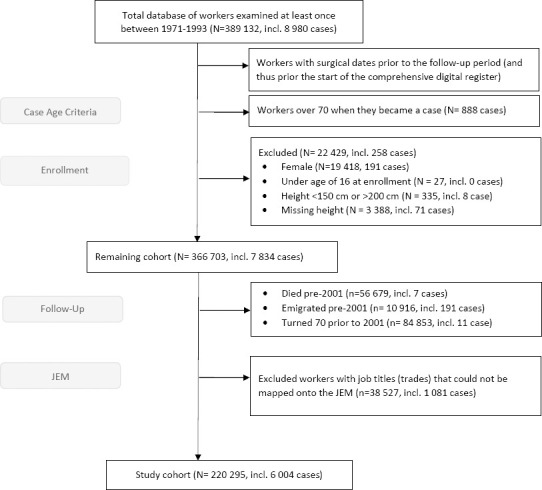
A cohort of 220 295 male constructions workers who participated in a national occupational health surveillance program (1971-1993) were examined prospectively over a 16-year follow-up period (2001-2016) for surgically treated SIS. Worker job title, smoking status, height, weight, and age were registered on health examination. Job titles were mapped to 21 occupational groups based on tasks and training. A job exposure matrix (JEM) was developed with exposure estimates for each occupational group. Surgical cases were determined through linkage with the Swedish national in- and outpatient registers. Poisson regression was used to assess the relative risks (RR) for each biomechanical exposure.
The total incidence rate of surgically treated SIS over the 16-year observation period was 201.1 cases per 100 000 person-years. Increased risk was evident for workers exposed to upper-extremity loading (push/pull/lift) (RR 1.45-2.30), high hand grip force (RR 1.47-2.23), using handheld tools (RR 1.52-2.09), frequent work with hands above shoulders (RR 1.62-2.11), static work (RR 1.77-2.26), and hand-arm vibration (RR 1.78-2.13). There was an increased risk for SIS surgery for all occupational groups (construction trades) compared with white-collar workers (RR 1.56-2.61).
Occupational upper-extremity load and posture exposures were associated with increased risk for surgical treatment of SIS, which underlines the need for reducing workplace exposures and early symptom detection in highly exposed occupational groups.
本研究旨在评估职业生物力学暴露与肩峰下撞击综合征(SIS)手术治疗发生之间的关联。
对参加全国职业健康监测计划(1971-1993 年)的 220295 名男性建筑工人队列进行前瞻性随访 16 年(2001-2016 年),以确定手术治疗的 SIS。工人的工作职称、吸烟状况、身高、体重和年龄在健康检查时进行登记。工作职称根据任务和培训映射到 21 个职业群体。根据每个职业群体的任务和培训,制定了职业暴露矩阵(JEM)。通过与瑞典国内和门诊登记处的链接确定手术病例。使用泊松回归评估每个生物力学暴露的相对风险(RR)。
在 16 年的观察期内,手术治疗的 SIS 的总发生率为每 100000 人年 201.1 例。上肢负荷(推/拉/举)(RR 1.45-2.30)、高握力(RR 1.47-2.23)、使用手持工具(RR 1.52-2.09)、频繁举高手臂超过肩部(RR 1.62-2.11)、静态工作(RR 1.77-2.26)和手臂振动(RR 1.78-2.13)暴露的工人发生 SIS 的风险增加。与白领工人相比,所有职业群体(建筑行业)发生 SIS 手术的风险增加(RR 1.56-2.61)。
职业上肢负荷和姿势暴露与 SIS 手术治疗的风险增加相关,这强调了减少工作场所暴露和早期发现高暴露职业群体症状的必要性。