Meucci Rodrigo Dalke, Fassa Anaclaudia Gastal, Faria Neice Muller Xavier
Faculdade de Medicina, Universidade Federal do Rio Grande, Rio Grande, RS, Brasil.
Universidade Federal de Pelotas, Pelotas, RS, Brasil.
Rev Saude Publica. 2015;49:1. doi: 10.1590/S0034-8910.2015049005874. Epub 2015 Oct 20.
To estimate worldwide prevalence of chronic low back pain according to age and sex.
We consulted Medline (PubMed), LILACS and EMBASE electronic databases. The search strategy used the following descriptors and combinations: back pain, prevalence, musculoskeletal diseases, chronic musculoskeletal pain, rheumatic, low back pain, musculoskeletal disorders and chronic low back pain. We selected cross-sectional population-based or cohort studies that assessed chronic low back pain as an outcome. We also assessed the quality of the selected studies as well as the chronic low back pain prevalence according to age and sex.
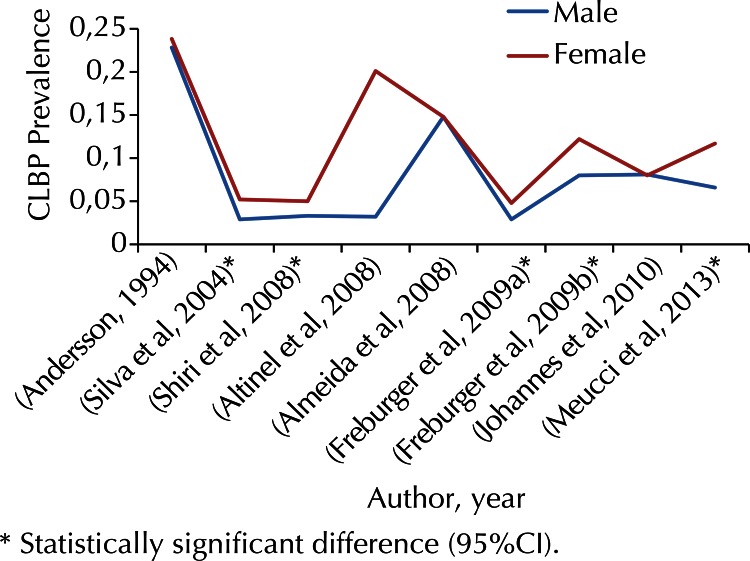
The review included 28 studies. Based on our qualitative evaluation, around one third of the studies had low scores, mainly due to high non-response rates. Chronic low back pain prevalence was 4.2% in individuals aged between 24 and 39 years old and 19.6% in those aged between 20 and 59. Of nine studies with individuals aged 18 and above, six reported chronic low back pain between 3.9% and 10.2% and three, prevalence between 13.1% and 20.3%. In the Brazilian older population, chronic low back pain prevalence was 25.4%.
Chronic low back pain prevalence increases linearly from the third decade of life on, until the 60 years of age, being more prevalent in women. Methodological approaches aiming to reduce high heterogeneity in case definitions of chronic low back pain are essential to consistency and comparative analysis between studies. A standard chronic low back pain definition should include the precise description of the anatomical area, pain duration and limitation level.
根据年龄和性别估算全球慢性下腰痛的患病率。
我们查阅了医学期刊数据库(PubMed)、拉丁美洲和加勒比地区健康科学数据库(LILACS)以及荷兰医学文摘数据库(EMBASE)电子数据库。检索策略使用了以下描述词及组合:背痛、患病率、肌肉骨骼疾病、慢性肌肉骨骼疼痛、风湿病、下腰痛、肌肉骨骼障碍和慢性下腰痛。我们选择了以人群为基础的横断面研究或队列研究,这些研究将慢性下腰痛作为一项结果进行评估。我们还评估了所选研究的质量以及按年龄和性别划分的慢性下腰痛患病率。
该综述纳入了28项研究。根据我们的定性评估,约三分之一的研究得分较低,主要原因是无应答率较高。24至39岁个体的慢性下腰痛患病率为4.2%,20至59岁个体的患病率为19.6%。在9项针对18岁及以上个体的研究中,6项报告的慢性下腰痛患病率在3.9%至10.2%之间,3项报告的患病率在13.1%至20.3%之间。在巴西老年人群中,慢性下腰痛患病率为25.4%。
慢性下腰痛患病率从生命的第三个十年开始直至60岁呈线性上升,在女性中更为普遍。旨在减少慢性下腰痛病例定义中高度异质性的方法学途径对于研究之间的一致性和比较分析至关重要。标准的慢性下腰痛定义应包括对解剖区域、疼痛持续时间和受限程度的精确描述。