Qiao Hui, Chen Jing, Lv Peipei, Ye Zhou, Lu Yu, Li Wenxian, Jia Jie
Department of Anesthesiology, Eye & ENT Hospital, Fudan University, Shanghai, China.
Transl Pediatr. 2022 Nov;11(11):1751-1758. doi: 10.21037/tp-22-161.
To alleviate anxiety before surgery is a significant concern for the pediatric anesthesiologist. Midazolam has been generally used as a premedication, and compelling data regarding effective dose to mitigate anxiety is lacking. The current trial addressed the comparable efficacy of intravenous midazolam with different doses regarding the anxiety state, ease of child-parental separation, and mask compliance as premedication in pediatric patients undergoing tonsillectomy.
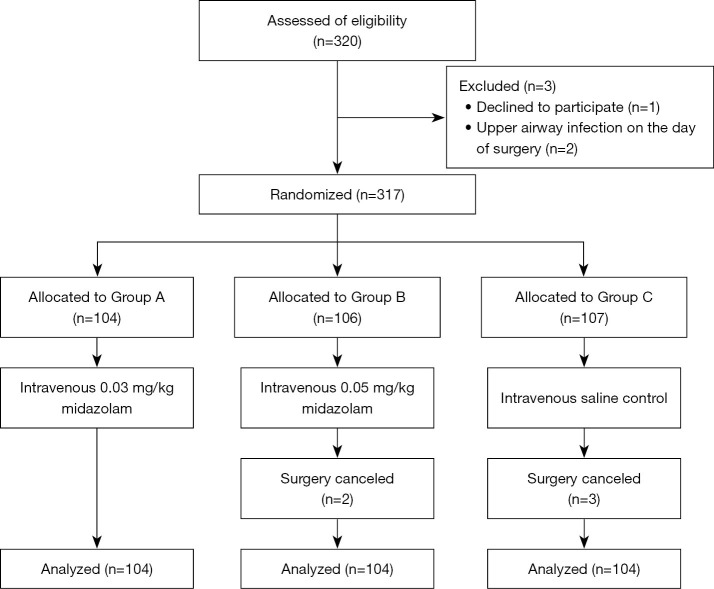
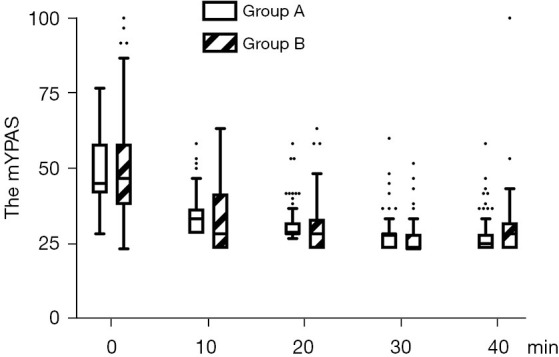
Three hundred and twelve children aged 2-8 years were randomly assigned, 104 per group, to receive intravenous 0.03 mg/kg midazolam (group A), 0.05 mg/kg midazolam (group B), or saline control (group C), 40 minutes before surgery. We assessed the anxiety state every 10 min after premedication with modified Yale preoperative anxiety scale (mYPAS), evaluated the emotional state during separation with parental separation anxiety scale (PSAS), and compared their compliance to mask oxygen supply with mask acceptance score (MAS).
Children premedicated with 0.05 mg/kg midazolam achieved a sedated state more rapidly than those who received 0.03 mg/kg midazolam (5.9±2.3 . 7.0±3.9, P=0.02). The proportion of satisfactory parental separation and compliance to mask ventilation was not different between midazolam groups, which was superior to saline control. The children receiving 0.05 mg/kg midazolam stayed longer in postoperative care unit than those receiving 0.03 mg/kg midazolam and saline. The incidence of postoperative adverse events was rare and comparable among groups.
Intravenous administration of a single dose of midazolam 0.05 and 0.03 mg/kg produces similar effects on sedation status, parental separation, and mask induction acceptance, except for rapid-onset and long sedation duration in pediatric patients premedicated with 0.05 mg/kg midazolam.
ClinicalTrials.gov NCT04266340.
减轻术前焦虑是儿科麻醉医生的一项重要关注点。咪达唑仑一直被普遍用作术前用药,但缺乏关于减轻焦虑有效剂量的令人信服的数据。当前试验探讨了不同剂量静脉注射咪达唑仑在接受扁桃体切除术的儿科患者中作为术前用药时,在焦虑状态、亲子分离难易程度和面罩配合度方面的疗效是否相当。
312名2至8岁儿童被随机分组,每组104名,在手术前40分钟分别接受静脉注射0.03mg/kg咪达唑仑(A组)、0.05mg/kg咪达唑仑(B组)或生理盐水对照(C组)。用药后每10分钟用改良耶鲁术前焦虑量表(mYPAS)评估焦虑状态,用亲子分离焦虑量表(PSAS)评估分离期间的情绪状态,并通过面罩接受评分(MAS)比较他们对面罩吸氧的配合度。
用0.05mg/kg咪达唑仑进行术前用药的儿童比接受0.03mg/kg咪达唑仑的儿童更快进入镇静状态(5.9±2.3对7.0±3.9,P=0.02)。咪达唑仑组之间亲子分离满意度和面罩通气配合度的比例没有差异,且优于生理盐水对照组。接受0.05mg/kg咪达唑仑的儿童在术后护理单元停留的时间比接受0.03mg/kg咪达唑仑和生理盐水的儿童更长。术后不良事件发生率很低,且各组之间相当。
静脉注射单剂量0.05mg/kg和0.03mg/kg咪达唑仑对镇静状态、亲子分离和面罩诱导接受度产生相似的效果,除了接受0.05mg/kg咪达唑仑进行术前用药的儿科患者起效更快且镇静持续时间更长。
ClinicalTrials.gov NCT04266340。