Christian Doppler Laboratory for Metabolic Crosstalk, Medical University Innsbruck, Innsbruck, Austria.
Department of Internal Medicine I, Medical University Innsbruck, Innsbruck, Austria.
Diabetologia. 2023 Apr;66(4):754-767. doi: 10.1007/s00125-022-05851-x. Epub 2022 Dec 16.
AIMS/HYPOTHESIS: Sodium-glucose cotransporter 2 (SGLT2) inhibitors are widely used in the treatment of type 2 diabetes, heart failure and chronic kidney disease. Their role in the prevention of diet-induced metabolic deteriorations, such as obesity, insulin resistance and fatty liver disease, has not been defined yet. In this study we set out to test whether empagliflozin prevents weight gain and metabolic dysfunction in a mouse model of diet-induced obesity and insulin resistance.
C57Bl/6 mice were fed a western-type diet supplemented with empagliflozin (WDE) or without empagliflozin (WD) for 10 weeks. A standard control diet (CD) without or with empagliflozin (CDE) was used to control for diet-specific effects. Metabolic phenotyping included assessment of body weight, food and water intake, body composition, hepatic energy metabolism, skeletal muscle mitochondria and measurement of insulin sensitivity using hyperinsulinaemic-euglycaemic clamps.
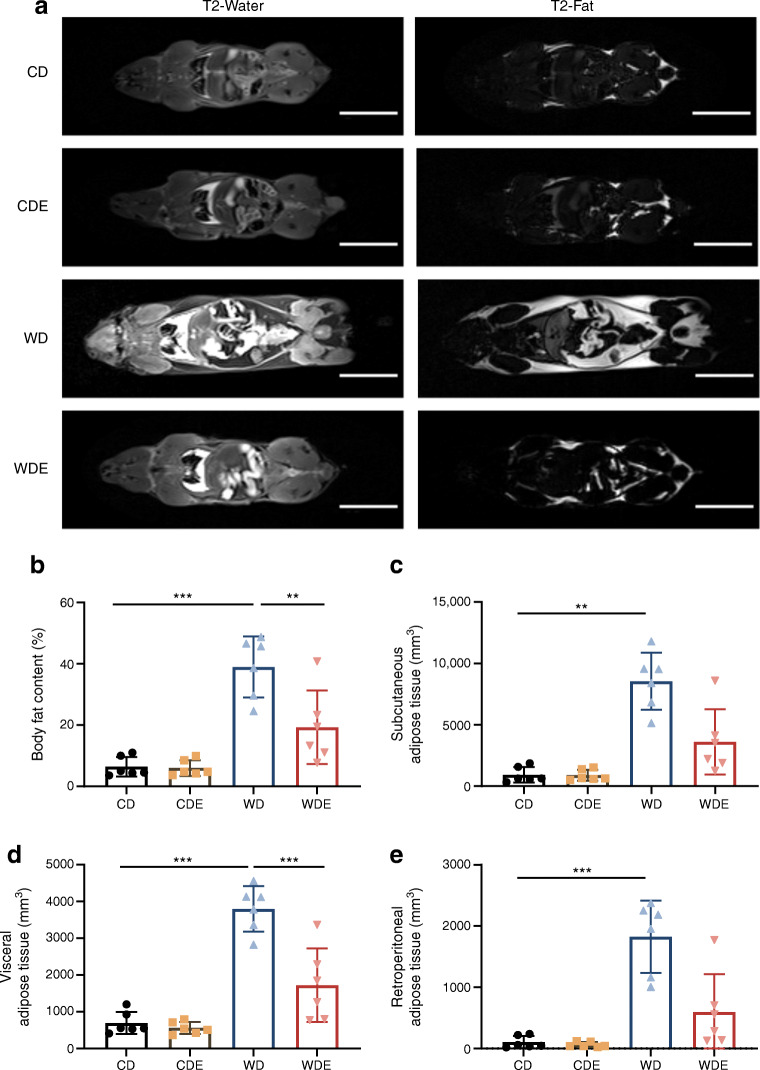
Mice fed the WD were overweight, hyperglycaemic, hyperinsulinaemic and insulin resistant after 10 weeks. Supplementation of the WD with empagliflozin prevented these metabolic alterations. While water intake was significantly increased by empagliflozin supplementation, food intake was similar in WDE- and WD-fed mice. Adipose tissue depots measured by MRI were significantly smaller in WDE-fed mice than in WD-fed mice. Additionally, empagliflozin supplementation prevented significant steatosis found in WD-fed mice. Accordingly, hepatic insulin signalling was deteriorated in WD-fed mice but not in WDE-fed mice. Empagliflozin supplementation positively affected size and morphology of mitochondria in skeletal muscle in both CD- and WD-fed mice.
CONCLUSIONS/INTERPRETATION: Empagliflozin protects mice from diet-induced weight gain, insulin resistance and hepatic steatosis in a preventative setting and improves muscle mitochondrial morphology independent of the type of diet.
目的/假设:钠-葡萄糖共转运蛋白 2(SGLT2)抑制剂广泛用于治疗 2 型糖尿病、心力衰竭和慢性肾病。它们在预防饮食引起的代谢恶化方面的作用,如肥胖、胰岛素抵抗和脂肪肝疾病,尚未确定。在这项研究中,我们旨在测试依帕列净是否可以预防饮食诱导肥胖和胰岛素抵抗的小鼠模型中的体重增加和代谢功能障碍。
C57Bl/6 小鼠喂食添加依帕列净的西方饮食(WDE)或不添加依帕列净的西方饮食(WD)10 周。使用不含或含依帕列净的标准对照饮食(CDE)来控制饮食特异性影响。代谢表型评估包括体重、食物和水摄入量、身体成分、肝能量代谢、骨骼肌线粒体和使用高胰岛素-正常血糖钳夹测量胰岛素敏感性。
10 周后,喂食 WD 的小鼠体重增加、血糖升高、高胰岛素血症和胰岛素抵抗。WD 中添加依帕列净可预防这些代谢变化。尽管依帕列净的补充显著增加了水的摄入量,但 WDE-和 WD-喂养的小鼠的食物摄入量相似。通过 MRI 测量的脂肪组织沉积在 WDE 喂养的小鼠中明显小于 WD 喂养的小鼠。此外,依帕列净的补充可预防 WD 喂养的小鼠中发现的明显脂肪变性。相应地,WD 喂养的小鼠的肝胰岛素信号转导受损,但 WDE 喂养的小鼠没有。依帕列净的补充可改善 CD 和 WD 喂养的小鼠的骨骼肌中线粒体的大小和形态。
结论/解释:依帕列净可在预防饮食诱导的体重增加、胰岛素抵抗和肝脂肪变性方面保护小鼠,并且独立于饮食类型改善肌肉线粒体形态。