Herthum Helge, Hetzer Stefan, Kreft Bernhard, Tzschätzsch Heiko, Shahryari Mehrgan, Meyer Tom, Görner Steffen, Neubauer Hennes, Guo Jing, Braun Jürgen, Sack Ingolf
Berlin Center for Advanced Neuroimaging, Charité-Universitätsmedizin Berlin, Corporate Member of Freie Universität Berlin, Berlin Institute of Health, Humboldt-Universität zu Berlin, Berlin, Germany.
Bernstein Center for Computational Neuroscience, Charité-Universitätsmedizin Berlin, Corporate Member of Freie Universität Berlin, Berlin Institute of Health, Humboldt-Universität zu Berlin, Berlin, Germany.
Front Bioeng Biotechnol. 2022 Dec 2;10:1056131. doi: 10.3389/fbioe.2022.1056131. eCollection 2022.
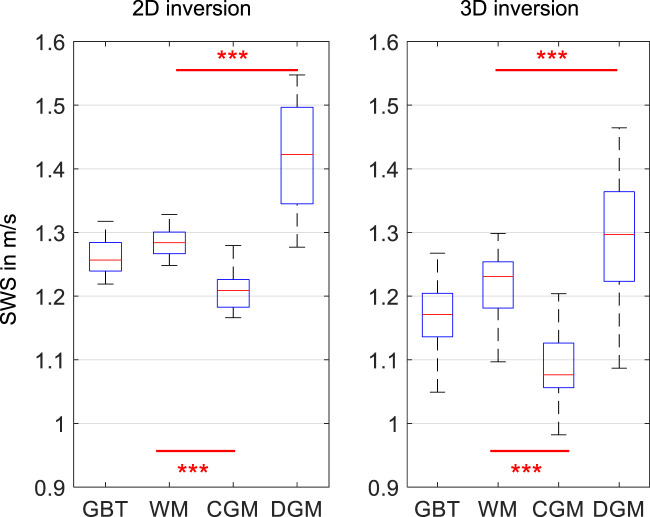
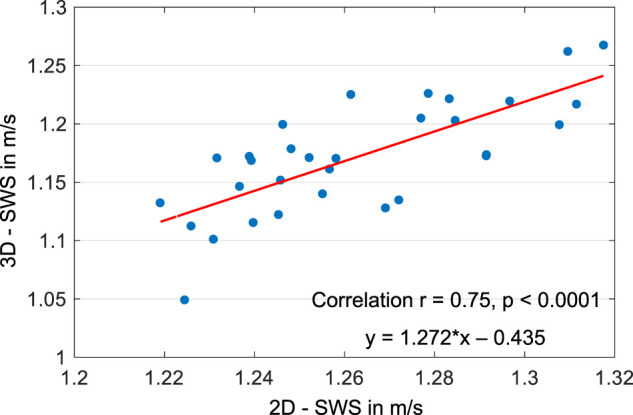
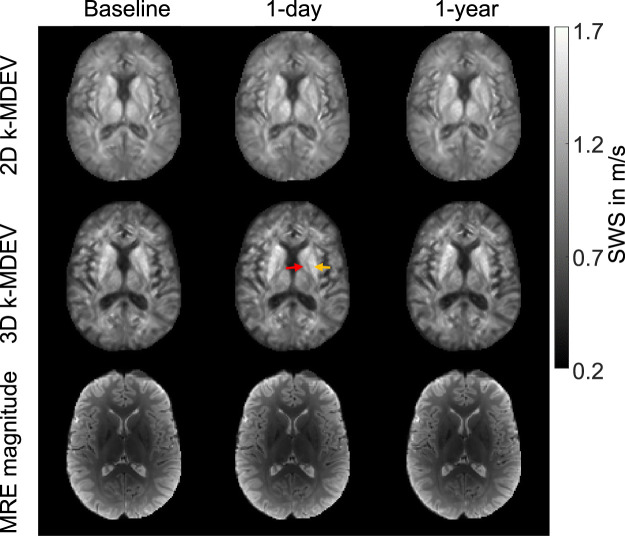
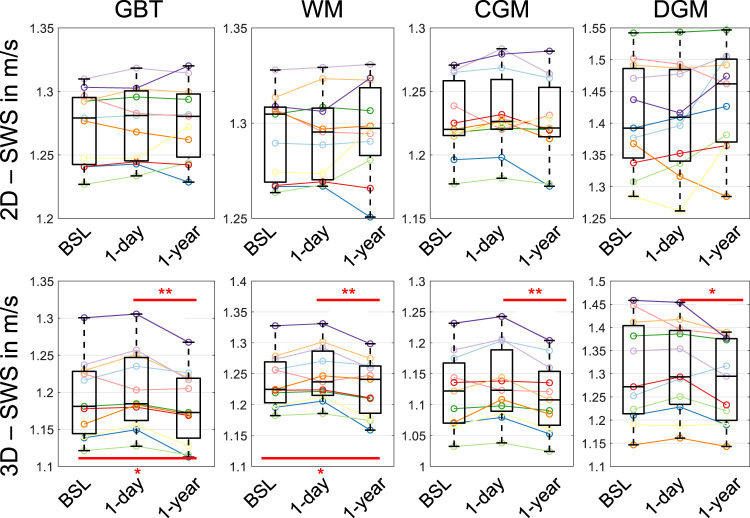
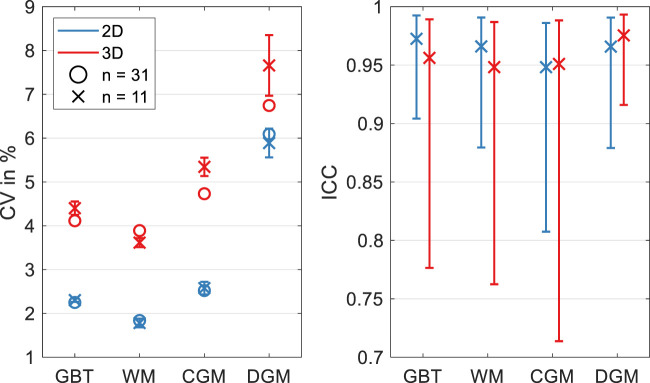
Magnetic resonance elastography (MRE) generates quantitative maps of the mechanical properties of biological soft tissues. However, published values obtained by brain MRE vary largely and lack detail resolution, due to either true biological effects or technical challenges. We here introduce cerebral tomoelastography in two and three dimensions for improved data consistency and detail resolution while considering aging, brain parenchymal fraction (BPF), systolic blood pressure, and body mass index (BMI). Multifrequency MRE with 2D- and 3D-tomoelastography postprocessing was applied to the brains of 31 volunteers (age range: 22-61 years) for analyzing the coefficient of variation (CV) and effects of biological factors. Eleven volunteers were rescanned after 1 day and 1 year to determine intraclass correlation coefficient (ICC) and identify possible long-term changes. White matter shear wave speed (SWS) was slightly higher in 2D-MRE (1.28 ± 0.02 m/s) than 3D-MRE (1.22 ± 0.05 m/s, < 0.0001), with less variation after 1 day in 2D (0.33 ± 0.32%) than in 3D (0.96 ± 0.66%, = 0.004), which was also reflected in a slightly lower CV and higher ICC in 2D (1.84%, 0.97 [0.88-0.99]) than in 3D (3.89%, 0.95 [0.76-0.99]). Remarkably, 3D-MRE was sensitive to a decrease in white matter SWS within only 1 year, whereas no change in white matter volume was observed during this follow-up period. Across volunteers, stiffness correlated with age and BPF, but not with blood pressure and BMI. Cerebral tomoelastography provides high-resolution viscoelasticity maps with excellent consistency. Brain MRE in 2D shows less variation across volunteers in shorter scan times than 3D-MRE, while 3D-MRE appears to be more sensitive to subtle biological effects such as aging.
磁共振弹性成像(MRE)可生成生物软组织力学特性的定量图谱。然而,由于真实的生物学效应或技术挑战,脑MRE获得的已发表值差异很大且缺乏细节分辨率。我们在此引入二维和三维脑断层弹性成像技术,以提高数据的一致性和细节分辨率,同时考虑年龄、脑实质分数(BPF)、收缩压和体重指数(BMI)。将具有二维和三维断层弹性成像后处理功能的多频MRE应用于31名志愿者(年龄范围:22 - 61岁)的大脑,以分析变异系数(CV)和生物学因素的影响。11名志愿者在1天和1年后进行了重新扫描,以确定组内相关系数(ICC)并识别可能的长期变化。二维MRE中的白质剪切波速度(SWS)(1.28±0.02米/秒)略高于三维MRE(1.22±0.05米/秒,<0.0001),二维扫描1天后的变化(0.33±0.32%)小于三维(0.96±0.66%,=0.004),这也反映在二维的CV略低和ICC略高(1.84%,0.97[0.88 - 0.99]),而三维分别为(3.89%,0.95[0.76 - 0.99])。值得注意的是,三维MRE仅在1年内就对白质SWS的降低敏感,而在此随访期间未观察到白质体积的变化。在所有志愿者中,硬度与年龄和BPF相关,但与血压和BMI无关。脑断层弹性成像提供了具有出色一致性的高分辨率粘弹性图谱。二维脑MRE在较短扫描时间内,志愿者之间的变化比三维MRE小,而三维MRE似乎对诸如衰老等细微生物学效应更敏感。