Nigro Ersilia, Polito Rita, Babino Graziella, Mattera Edi, Fulgione Elisabetta, Ragozzino Giovanni, D'Esposito Vittoria, Cabaro Serena, Signoriello Giuseppe, Formisano Pietro, Argenziano Giuseppe, Daniele Aurora
Dipartimento di Scienze e Tecnologie Ambientali, Biologiche e Farmaceutiche, Università degli Studi della Campania "Luigi Vanvitelli", Caserta, Italy.
CEINGE-Biotecnologie avanzate, Naples, Italy.
Dermatol Pract Concept. 2022 Oct 1;12(4):e2022157. doi: 10.5826/dpc.1204a157. eCollection 2022 Nov.
Hidradenitis suppurativa (HS) is a severe chronic skin disease. Although the pathogenesis remains unclear, at the basis of HS there is an enhancement of the immune and inflammatory response together with a susceptibility to environmental factors. Cytokine dysregulation is crucial in HS severity and progression.
The aim of this study was to analyze serum levels of different cytokines focusing on adiponectin concentration and its oligomers in HS patients compared to both obese and healthy subjects.
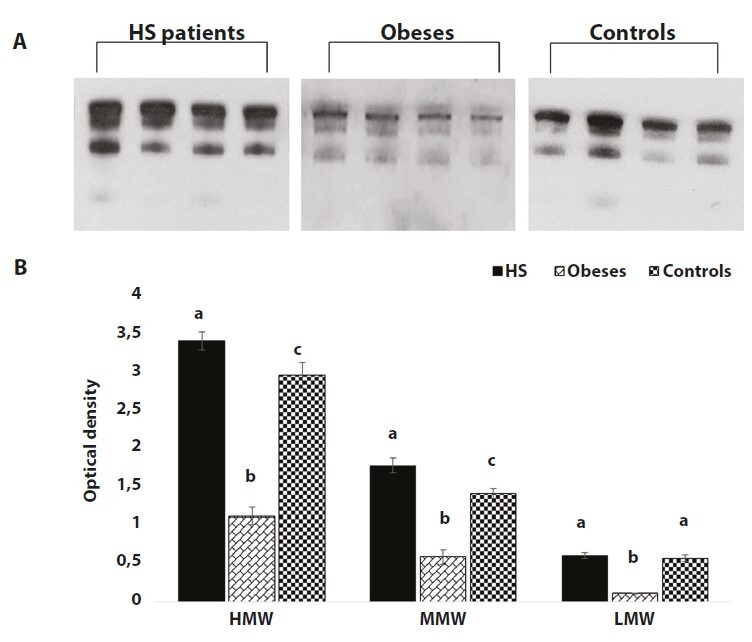
The concentrations of adiponectin and cytokines were measured using enzyme-linked immunosorbent assay (ELISA); the oligomeric distribution of adiponectin (low molecular weight (LMW), medium molecular weight (MMW) and high molecular weight (HMW) oligomers)was evaluated through Western Blotting analysis.
Total adiponectin is statistically higher in HS patients compared to matched controls and obese subjects. Interestingly, Adiponectin oligomerization state is altered in HS, with an increase of HMW oligomers. Serum levels of PDGF-BB, IL-1β, IL-5, Il-6, IL12, IL13, IL15, IL-17, GMCSF, INFγ, VEGF and MCP-1 are statistically higher while IL-1ra and RANTES levels are statistically lower in HS patients compared to healthy controls. Interestingly, adiponectin positively correlates with PDGF-BB, and IL-13.
Our data confirmed that the complex network that links metabolism to immune homeostasis is dysregulated in HS and that adiponectin and its HMW oligomers are actively involved in this disease. In addition, the correlation between adiponectin and PDGF-BB, and IL-13 extends the role of this adipokine in modulation of the immune response, in particular regulating the innate immune system rather that the adaptive one. Further researches are needed to clarify the complex inflammatory milieu that characterizes HS syndrome.
化脓性汗腺炎(HS)是一种严重的慢性皮肤病。尽管其发病机制尚不清楚,但HS的基础是免疫和炎症反应增强以及对环境因素的易感性。细胞因子失调在HS的严重程度和进展中起关键作用。
本研究的目的是分析HS患者与肥胖和健康受试者相比,不同细胞因子的血清水平,重点关注脂联素浓度及其寡聚体。
使用酶联免疫吸附测定(ELISA)测量脂联素和细胞因子的浓度;通过蛋白质印迹分析评估脂联素的寡聚体分布(低分子量(LMW)、中分子量(MMW)和高分子量(HMW)寡聚体)。
与匹配的对照组和肥胖受试者相比,HS患者的总脂联素在统计学上更高。有趣的是,HS中脂联素的寡聚化状态发生改变,HMW寡聚体增加。与健康对照组相比,HS患者血清中血小板衍生生长因子BB(PDGF-BB)、白细胞介素-1β(IL-1β)、白细胞介素-5(IL-5)、白细胞介素-6(Il-6)、白细胞介素12(IL12)、白细胞介素13(IL13)、白细胞介素15(IL15)、白细胞介素-17(IL-17)、粒细胞-巨噬细胞集落刺激因子(GMCSF)、干扰素γ(INFγ)、血管内皮生长因子(VEGF)和单核细胞趋化蛋白-1(MCP-1)水平在统计学上更高,而白细胞介素-1受体拮抗剂(IL-1ra)和调节激活正常T细胞表达和分泌因子(RANTES)水平在统计学上更低。有趣的是,脂联素与PDGF-BB和IL-13呈正相关。
我们的数据证实,在HS中,将代谢与免疫稳态联系起来的复杂网络失调,脂联素及其HMW寡聚体积极参与了这种疾病。此外,脂联素与PDGF-BB和IL-13之间的相关性扩展了这种脂肪因子在调节免疫反应中的作用,特别是调节先天性免疫系统而非适应性免疫系统。需要进一步研究以阐明HS综合征所特有的复杂炎症环境。