Medical Oncology Unit, Department of Oncology and Hematology, Central Hospital of Belcolle, Strada Sammartinese Snc, 01100, Viterbo, Italy.
Biostatistics Unit, Scientific Directorate, IRCCS, Fondazione Policlinico Universitario A. Gemelli, Rome, Italy.
Sci Rep. 2022 Dec 19;12(1):21908. doi: 10.1038/s41598-022-25558-8.
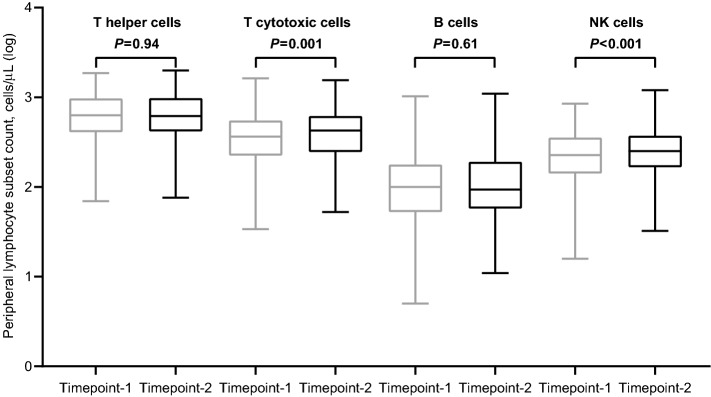
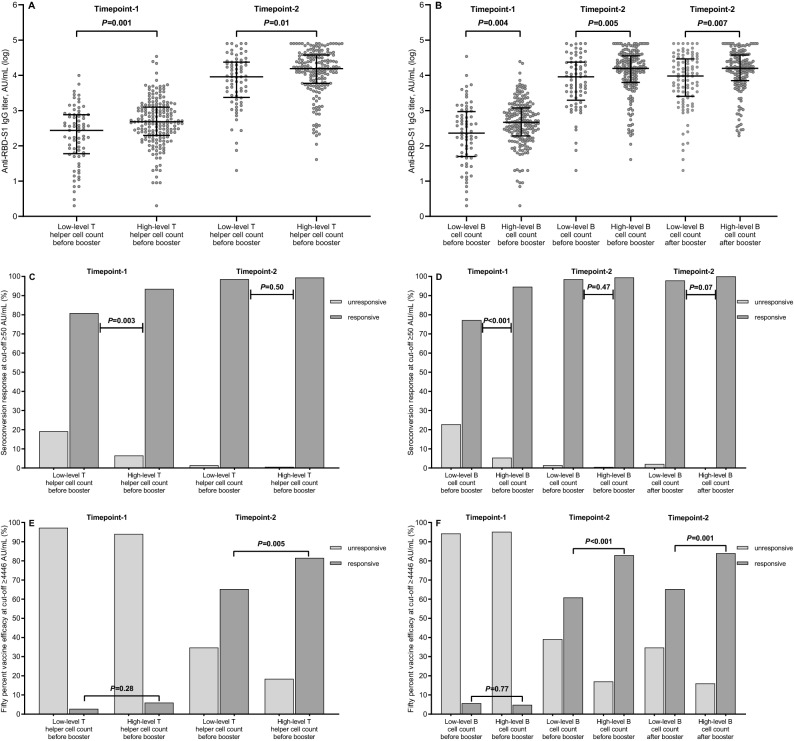
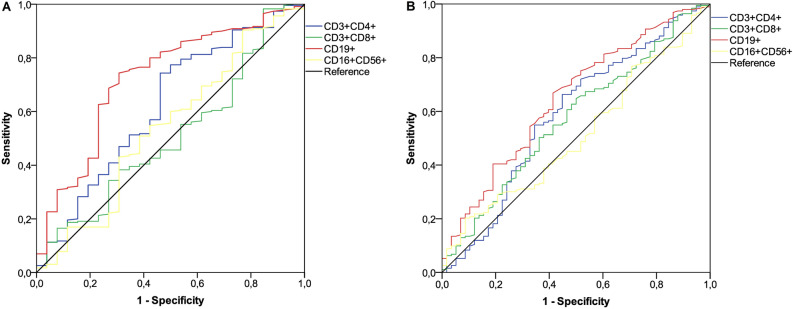
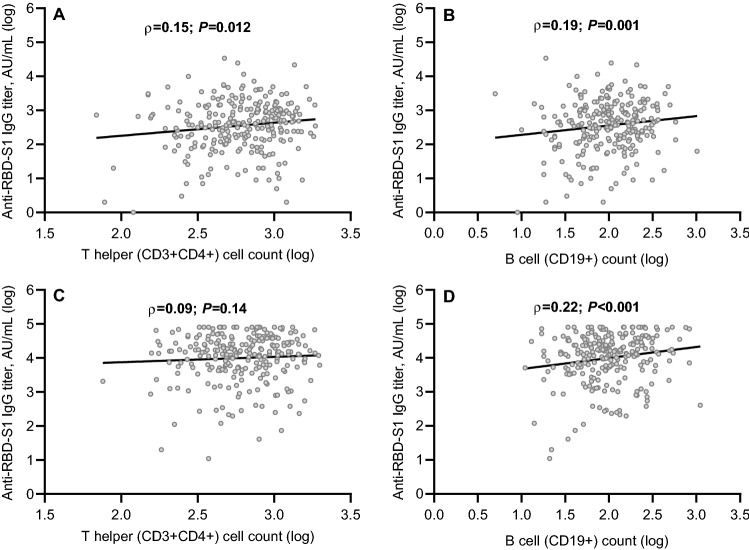
The aim of this study was to evaluate the association of circulating lymphocytes profiling with antibody response in cancer patients receiving the third dose of COVID-19 mRNA-BNT162b2 vaccine. Immunophenotyping of peripheral blood was used to determine absolute counts of lymphocyte subsets, alongside detection of IgG antibodies against receptor-binding-domain (RBD) of the SARS-CoV-2 Spike protein (S1) before booster dosing (timepoint-1) and four weeks afterward (timepoint-2). An IgG titer ≥ 50 AU/mL defined a positive seroconversion response. An IgG titer ≥ 4446 AU/mL was assumed as a correlate of 50% vaccine efficacy against symptomatic infections. A total of 258 patients on active treatment within the previous six months were enrolled between September 23 and October 7, 2021. The third dose resulted in an exponential increase in median anti-RBD-S1 IgG titer (P < 0.001), seroconversion rates (P < 0.001), and 50% vaccine efficacy rates (P < 0.001). According to ROC curve analysis, T helper and B cells were significantly associated with seroconversion responses at timepoint-1, whereas only B cells were relevant to 50% vaccine efficacy rates at timepoint-2. A positive linear correlation was shown between anti-RBD-S1 IgG titers and these lymphocyte subset counts. Multivariate analysis ruled out a potential role of T helper cells but confirmed a significant interaction between higher B cell levels and improved antibody response. These findings suggest that peripheral counts of B cells correlate with humoral response to the third dose of mRNA-BNT162b2 vaccine in actively treated cancer patients and could provide insights into a more comprehensive assessment of vaccination efficacy.
本研究旨在评估循环淋巴细胞谱与癌症患者接受第三剂 COVID-19 mRNA-BNT162b2 疫苗后抗体反应的相关性。在加强剂接种前(时间点 1)和四周后(时间点 2),采用外周血免疫表型分析来确定淋巴细胞亚群的绝对计数,以及检测针对 SARS-CoV-2 刺突蛋白(S1)受体结合域(RBD)的 IgG 抗体。IgG 滴度≥50 AU/mL 定义为阳性血清转换反应。假设 IgG 滴度≥4446 AU/mL 与针对有症状感染的 50%疫苗效力相关。2021 年 9 月 23 日至 10 月 7 日期间,共招募了 258 名在过去六个月内正在接受积极治疗的患者。第三剂疫苗接种导致抗-RBD-S1 IgG 滴度(P<0.001)、血清转化率(P<0.001)和 50%疫苗效力率(P<0.001)呈指数增长。根据 ROC 曲线分析,T 辅助和 B 细胞在时间点 1 与血清转化率显著相关,而只有 B 细胞在时间点 2 与 50%疫苗效力率相关。抗-RBD-S1 IgG 滴度与这些淋巴细胞亚群计数呈正线性相关。多变量分析排除了 T 辅助细胞的潜在作用,但证实了 B 细胞水平升高与抗体反应改善之间存在显著的相互作用。这些发现表明,在积极治疗的癌症患者中,外周 B 细胞计数与 mRNA-BNT162b2 疫苗第三剂的体液反应相关,并为更全面评估疫苗效力提供了思路。