School of Biological Sciences, University of East Anglia, Norwich, UK.
Department of Biology, Lund University, Lund, Sweden.
J Evol Biol. 2023 Feb;36(2):480-494. doi: 10.1111/jeb.14130. Epub 2022 Dec 20.
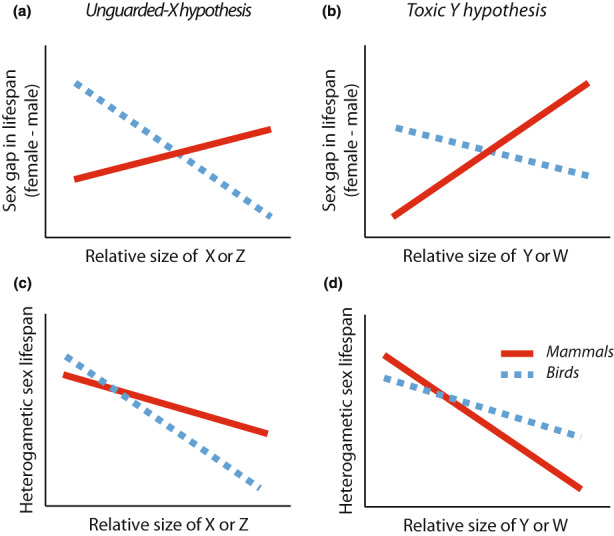
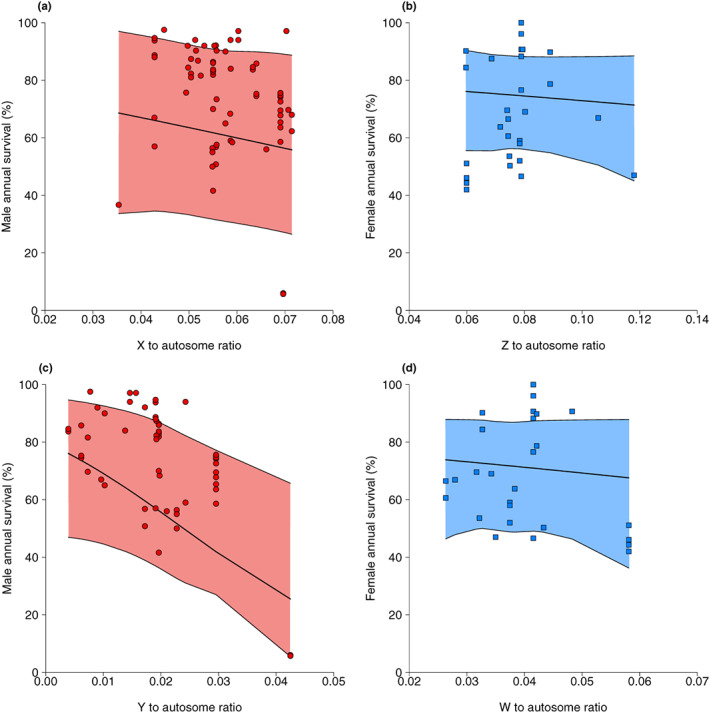
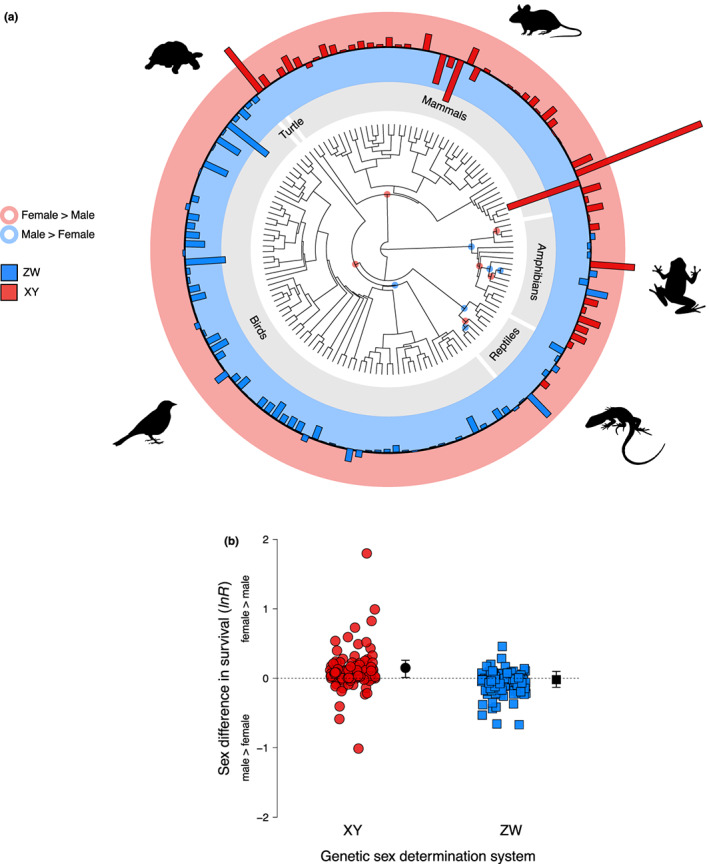
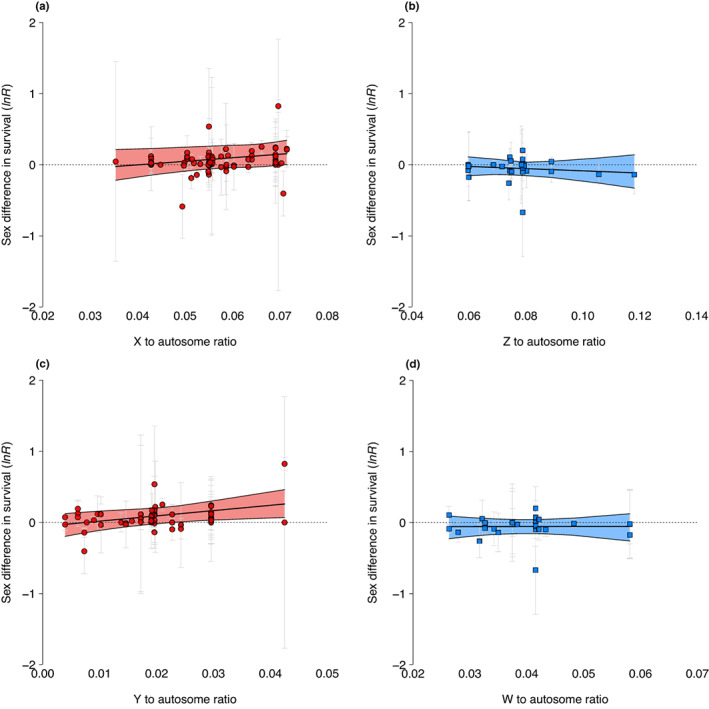
Sex differences in lifespan are ubiquitous across the tree of life and exhibit broad taxonomic patterns that remain a puzzle, such as males living longer than females in birds and vice versa in mammals. The prevailing unguarded X hypothesis explains sex differences in lifespan by differential expression of recessive mutations on the X or Z chromosome of the heterogametic sex, but has only received indirect support to date. An alternative hypothesis is that the accumulation of deleterious mutations and repetitive elements on the Y or W chromosome might lower the survival of the heterogametic sex ('toxic Y' hypothesis). Here, we use a new database to report lower survival of the heterogametic relative to the homogametic sex across 136 species of birds, mammals, reptiles and amphibians, as expected if sex chromosomes shape sex-specific lifespans, and consistent with previous findings. We also found that the relative sizes of both the X and the Y chromosomes in mammals (but not the Z or the W chromosomes in birds) are associated with sex differences in lifespan, as predicted by the unguarded X and the 'toxic Y'. Furthermore, we report that the relative size of the Y is negatively associated with male lifespan in mammals, so that small Y size correlates with increased male lifespan. In theory, toxic Y effects are expected to be particularly strong in mammals, and we did not find similar effects in birds. Our results confirm the role of sex chromosomes in explaining sex differences in lifespan across tetrapods and further suggest that, at least in mammals, 'toxic Y' effects may play an important part in this role.
寿命的性别差异在整个生命之树上普遍存在,并表现出广泛的分类模式,这些模式仍然是一个谜,例如鸟类中雄性的寿命比雌性长,而哺乳动物则相反。流行的无保护 X 假说通过异配性别 X 或 Z 染色体上隐性突变的差异表达来解释寿命的性别差异,但迄今为止只得到了间接支持。另一种假说认为,Y 或 W 染色体上有害突变和重复元件的积累可能会降低异配性别(“有毒 Y”假说)的存活率。在这里,我们使用一个新的数据库报告了 136 种鸟类、哺乳动物、爬行动物和两栖动物中异配性别相对于同配性别存活率较低的情况,如果性染色体决定了性别特异性的寿命,这是可以预期的,并且与之前的发现一致。我们还发现,哺乳动物中 X 染色体和 Y 染色体的相对大小(而不是鸟类中的 Z 染色体或 W 染色体)与寿命的性别差异有关,这与无保护 X 和“有毒 Y”的预测一致。此外,我们报告说,Y 染色体的相对大小与哺乳动物中雄性的寿命呈负相关,因此 Y 染色体越小,雄性的寿命就越长。从理论上讲,有毒 Y 的影响预计在哺乳动物中更为强烈,而我们在鸟类中没有发现类似的影响。我们的结果证实了性染色体在解释四足动物寿命性别差异中的作用,并进一步表明,至少在哺乳动物中,“有毒 Y”的影响可能在这一作用中起着重要作用。