Centre for Ocean and Atmospheric Sciences, School of Environmental Sciences, University of East Anglia, Norwich, UK.
Earth Science and Observation Center, Cooperative Institute for Research in Environmental Sciences, University of Colorado Boulder, Boulder, CO, USA.
Nat Commun. 2022 Dec 21;13(1):7840. doi: 10.1038/s41467-022-35499-5.
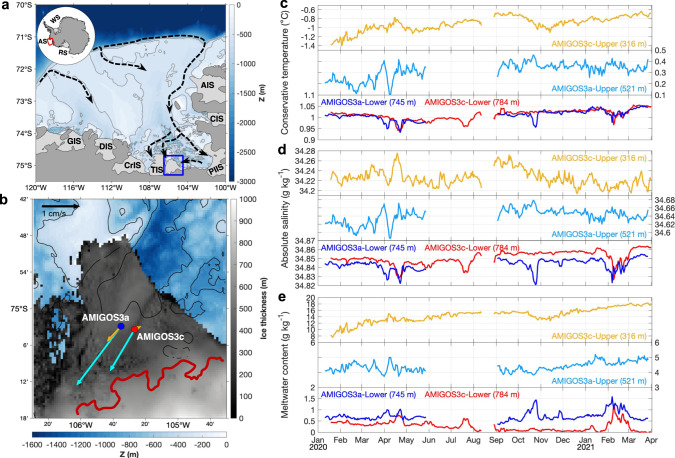
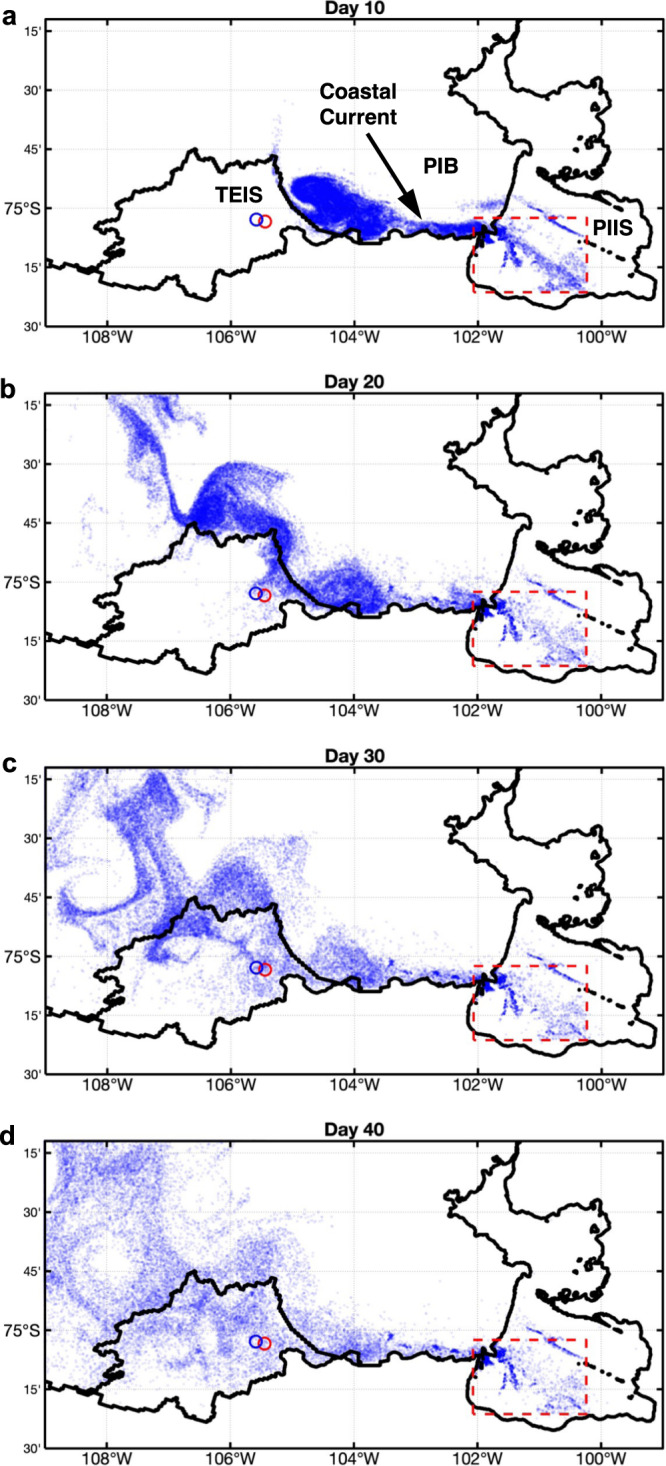
West Antarctic ice-shelf thinning is primarily caused by ocean-driven basal melting. Here we assess ocean variability below Thwaites Eastern Ice Shelf (TEIS) and reveal the importance of local ocean circulation and sea-ice. Measurements obtained from two sub-ice-shelf moorings, spanning January 2020 to March 2021, show warming of the ice-shelf cavity and an increase in meltwater fraction of the upper sub-ice layer. Combined with ocean modelling results, our observations suggest that meltwater from Pine Island Ice Shelf feeds into the TEIS cavity, adding to horizontal heat transport there. We propose that a weakening of the Pine Island Bay gyre caused by prolonged sea-ice cover from April 2020 to March 2021 allowed meltwater-enriched waters to enter the TEIS cavity, which increased the temperature of the upper layer. Our study highlights the sensitivity of ocean circulation beneath ice shelves to local atmosphere-sea-ice-ocean forcing in neighbouring open oceans.
西南极冰架变薄主要是由海洋驱动的基底融化造成的。在这里,我们评估了斯怀特西斯东冰架(TEIS)下方的海洋变化,并揭示了当地海洋环流和海冰的重要性。从两个冰下系泊点获得的测量结果,跨越 2020 年 1 月至 2021 年 3 月,显示了冰架腔的变暖以及上亚冰层中融化水分数的增加。结合海洋模拟结果,我们的观测结果表明,来自松岛冰架的融水流入 TEIS 腔,增加了那里的水平热输送。我们提出,由于 2020 年 4 月至 2021 年 3 月期间海冰覆盖时间延长,导致松岛湾环流减弱,使富含融水的水进入 TEIS 腔,从而提高了上层温度。我们的研究强调了海洋环流对邻近开阔海洋中当地大气-海洋-冰-海洋强迫的敏感性。