Mühlbauer Lina Kaya, Harpole William Stanley, Clark Adam Thomas
Institute of Biology University of Graz Graz Austria.
Department of Physiological Diversity Helmholtz Centre for Environmental Research (UFZ) Leipzig Germany.
Ecol Evol. 2022 Dec 18;12(12):e9638. doi: 10.1002/ece3.9638. eCollection 2022 Dec.
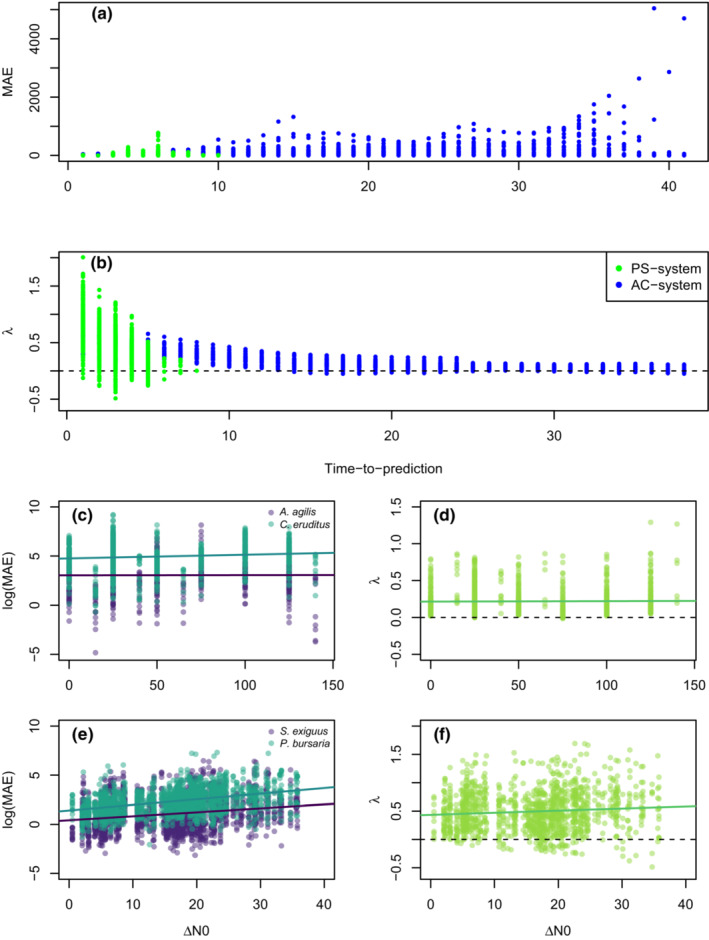
Improved understanding of complex dynamics has revealed insights across many facets of ecology, and has enabled improved forecasts and management of future ecosystem states. However, an enduring challenge in forecasting complex dynamics remains the differentiation between complexity and stochasticity, that is, to determine whether declines in predictability are caused by stochasticity, nonlinearity, or chaos. Here, we show how to quantify the relative contributions of these factors to prediction error using Georgii Gause's iconic predator-prey microcosm experiments, which, critically, include experimental replicates that differ from one another only in initial abundances. We show that these differences in initial abundances interact with stochasticity, nonlinearity, and chaos in unique ways, allowing us to identify the impacts of these factors on prediction error. Our results suggest that jointly analyzing replicate time series across multiple, distinct starting points may be necessary for understanding and predicting the wide range of potential dynamic types in complex ecological systems.
对复杂动态的深入理解揭示了生态学诸多方面的见解,并有助于改进对未来生态系统状态的预测和管理。然而,预测复杂动态的一个长期挑战仍然是区分复杂性和随机性,即确定可预测性的下降是由随机性、非线性还是混沌引起的。在这里,我们展示了如何使用格奥尔基·高斯标志性的捕食者 - 猎物微观世界实验来量化这些因素对预测误差的相对贡献,至关重要的是,这些实验包括仅在初始丰度上彼此不同的实验重复。我们表明,初始丰度的这些差异以独特的方式与随机性、非线性和混沌相互作用,使我们能够识别这些因素对预测误差的影响。我们的结果表明,联合分析多个不同起点的重复时间序列对于理解和预测复杂生态系统中广泛的潜在动态类型可能是必要的。