Uitrakul Suriyon, Aksonnam Krittika, Srivichai Pimchanok, Wicheannarat Sorawit, Incomenoy Supatcha
Department of Pharmaceutical Care, Walailak University, Tha Sala, Nakhon Si Thammarat 80160, Thailand.
Medicines (Basel). 2022 Nov 22;9(12):59. doi: 10.3390/medicines9120059.
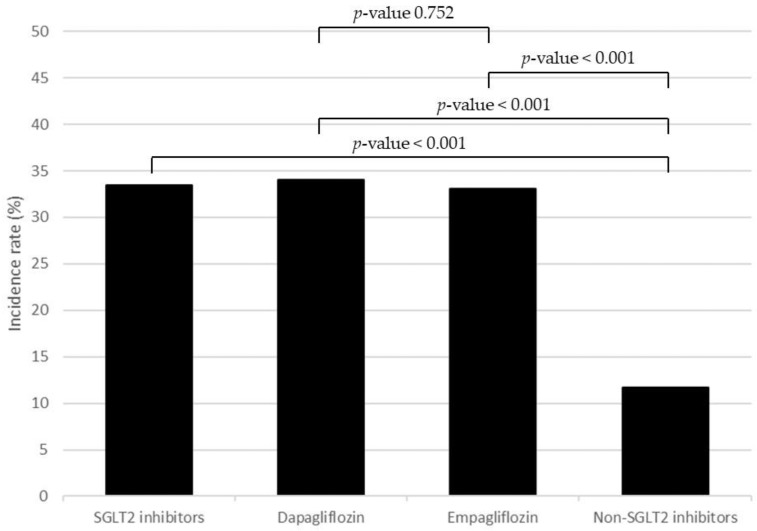
: The incidence and risk of urinary tract infection (UTI) in patients with type 2 diabetes mellitus (T2DM) who use sodium glucose co-transporter-2 (SGLT2) inhibitors are still controversial. Therefore, this study aimed to investigate the incidence and risk factors of using SGLT2 inhibitors, particularly in Thai patients. : Electronic medication records of all patients, who started the treatment of T2DM between 1 January 2019 and 30 June 2021 at a tertiary hospital in Thailand, were reviewed. The patients were divided into SGLT2 inhibitor and non-SGLT2 inhibitor groups to compare the incidence of UTI. The overall incidence rate of UTI was 33.49% in the SGLT2 inhibitor group and 11.72% in the non-SGLT2 inhibitor group. The incidence rates of UTI were not different between dapagliflozin and empagliflozin treatment (34.00% and 33.03%, respectively). Patients treated with SGLT2 inhibitors had a 3.70 higher risk of UTI compared with those treated with non-SGLT2 inhibitors (95%CI 2.60-5.29). Moreover, the significant risk factors for UTI found in this study were gender, age, and occupation. This study highlighted the high incidence of UTI in patients using dapagliflozin and empagliflozin compared with non-SGLT2 inhibitors. Additionally, patients of female gender and older age had a significantly higher risk of UTI when treated with SGLT2 inhibitors, whereas those with permanent jobs had a lower risk.
使用钠-葡萄糖协同转运蛋白2(SGLT2)抑制剂的2型糖尿病(T2DM)患者发生尿路感染(UTI)的发生率和风险仍存在争议。因此,本研究旨在调查使用SGLT2抑制剂的发生率和危险因素,尤其是泰国患者。:回顾了2019年1月1日至2021年6月30日在泰国一家三级医院开始治疗T2DM的所有患者的电子用药记录。将患者分为SGLT2抑制剂组和非SGLT2抑制剂组,以比较UTI的发生率。SGLT2抑制剂组UTI的总发生率为33.49%,非SGLT2抑制剂组为11.72%。达格列净和恩格列净治疗的UTI发生率无差异(分别为34.00%和33.03%)。与使用非SGLT2抑制剂的患者相比,使用SGLT2抑制剂治疗的患者发生UTI的风险高3.70倍(95%CI 2.60-5.29)。此外,本研究中发现的UTI的重要危险因素是性别、年龄和职业。本研究强调,与非SGLT2抑制剂相比,使用达格列净和恩格列净的患者UTI发生率较高。此外,女性和老年患者使用SGLT2抑制剂治疗时发生UTI的风险显著更高,而有固定工作的患者风险较低。