School of Natural Sciences, Bangor University, Bangor, Gwynedd, UK.
School of Ocean Sciences, Bangor University, Bangor, Gwynedd, UK.
Sci Rep. 2022 Dec 22;12(1):22008. doi: 10.1038/s41598-022-25334-8.
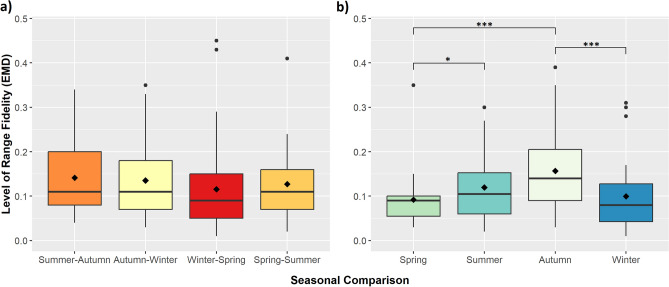
For large herbivores living in highly dynamic environments, maintaining range fidelity has the potential to facilitate the exploitation of predictable resources while minimising energy expenditure. We evaluate this expectation by examining how the seasonal range fidelity of African elephants (Loxodonta africana) in the Kruger National Park, South Africa is affected by spatiotemporal variation in environmental conditions (vegetation quality, temperature, rainfall, and fire). Eight-years of GPS collar data were used to analyse the similarity in seasonal utilisation distributions for thirteen family groups. Elephants exhibited remarkable consistency in their seasonal range fidelity across the study with rainfall emerging as a key driver of space-use. Within years, high range fidelity from summer to autumn and from autumn to winter was driven by increased rainfall and the retention of high-quality vegetation. Across years, sequential autumn seasons demonstrated the lowest levels of range fidelity due to inter-annual variability in the wet to dry season transition, resulting in unpredictable resource availability. Understanding seasonal space use is important for determining the effects of future variability in environmental conditions on elephant populations, particularly when it comes to management interventions. Indeed, over the coming decades climate change is predicted to drive greater variability in rainfall and elevated temperatures in African savanna ecosystems. The impacts of climate change also present particular challenges for elephants living in fragmented or human-transformed habitats where the opportunity for seasonal range shifts are greatly constrained.
对于生活在高度动态环境中的大型食草动物来说,保持活动范围的稳定性有可能促进对可预测资源的利用,同时最大限度地减少能量消耗。我们通过研究南非克鲁格国家公园的非洲象(Loxodonta africana)的季节性活动范围稳定性如何受到环境条件(植被质量、温度、降雨和火灾)的时空变化的影响来评估这一预期。我们使用了八年的 GPS 项圈数据来分析十三个家族群体的季节性利用分布的相似性。大象在整个研究中表现出了对季节性活动范围稳定性的显著一致性,降雨是空间利用的关键驱动因素。在年内,夏季到秋季和秋季到冬季的高活动范围稳定性是由降雨量增加和高质量植被的保留驱动的。跨年度来看,由于干湿季过渡的年际变化导致资源可用性不可预测,因此连续的秋季活动范围稳定性最低。了解季节性空间利用对于确定未来环境条件变化对大象种群的影响非常重要,特别是在管理干预方面。事实上,未来几十年预计气候变化将导致非洲热带稀树草原生态系统的降雨量和温度升高的变化更大。气候变化的影响也给生活在碎片化或人为改造的栖息地中的大象带来了特殊挑战,因为它们进行季节性活动范围转变的机会受到了极大的限制。