Rivas Serna Irma Magaly, Beveridge Michelle, Wilke Michaelann, Ryan Edmond A, Clandinin Michael Thomas, Mazurak Vera Christine
Division of Human Nutrition, Department of Agricultural, Food and Nutritional Science, Li Ka Shing Centre for Health Research Innovation, University of Alberta, Edmonton, AB T6G 2P5, Canada.
Department of Medicine, University of Alberta, Edmonton, AB T6G 2R7, Canada.
Biomedicines. 2022 Dec 6;10(12):3141. doi: 10.3390/biomedicines10123141.
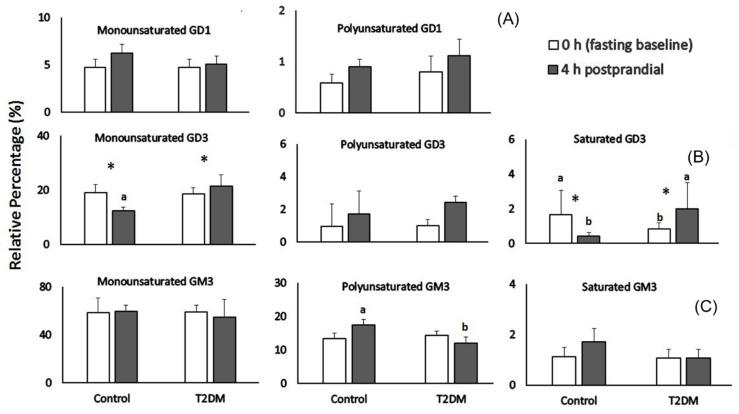
GM3 is implicated in cell signaling, inflammation and insulin resistance. The intestinal mucosa metabolizes ganglioside and provides gangliosides for uptake by peripheral tissues. Gangliosides downregulate acute and chronic inflammatory signals. It is likely that transport of intestinal derived gangliosides to other tissues impact the same signals characteristic of inflammatory change in other chronic conditions such as Type 2 Diabetes (T2DM). The postprandial ceramide composition of GM3 and other gangliosides in plasma and chylomicrons has not been examined in T2DM. The present study assessed if diet or T2DM alters ganglioside components in plasma and chylomicrons secreted from the intestinal mucosa after a meal. GD1, GD3, and GM3 content of chylomicrons and plasma was determined by LC/triple quad MS in non-diabetic (control) and T2DM individuals in the fasting and postprandial state after 2 days of consuming a low or high fat diet in a randomized blinded crossover design. Diet fat level did not alter baseline plasma or chylomicron ganglioside levels. Four hours after the test meal, plasma monounsaturated GD3 was 75% higher, plasma saturated GD3 was 140% higher and plasma polyunsaturated GM3 30% lower in diabetic subjects compared to control subjects. At 4 h, chylomicron GD1 was 50% lower in T2DM compared to controls. The proportion of d34:1 in GD3 was more abundant and d36:1 in GD1 less abundant in T2DM compared to control subjects at 4 h. The present study indicates that T2DM alters ceramide composition of ganglioside available for uptake by peripheral tissues.
GM3与细胞信号传导、炎症和胰岛素抵抗有关。肠黏膜可代谢神经节苷脂,并为外周组织摄取神经节苷脂提供来源。神经节苷脂可下调急性和慢性炎症信号。肠道来源的神经节苷脂向其他组织的转运可能会影响其他慢性疾病(如2型糖尿病,T2DM)中炎症变化的相同信号特征。目前尚未在T2DM患者中研究餐后血浆和乳糜微粒中GM3及其他神经节苷脂的神经酰胺组成。本研究评估了饮食或T2DM是否会改变餐后肠黏膜分泌的血浆和乳糜微粒中的神经节苷脂成分。采用随机双盲交叉设计,让非糖尿病(对照)个体和T2DM个体在食用低脂或高脂饮食2天后,于空腹和餐后状态下,通过液相色谱/三重四极杆质谱法测定乳糜微粒和血浆中GD1、GD3和GM3的含量。饮食脂肪水平未改变基线血浆或乳糜微粒神经节苷脂水平。与对照受试者相比,糖尿病受试者在测试餐后4小时,血浆单不饱和GD3升高75%,血浆饱和GD3升高140%,血浆多不饱和GM3降低30%。在4小时时,与对照组相比,T2DM患者乳糜微粒中的GD1降低了50%。在4小时时,与对照受试者相比,T2DM患者GD3中d34:1的比例更丰富,而GD1中d36:1的比例则较少。本研究表明,T2DM会改变外周组织可摄取的神经节苷脂的神经酰胺组成。