Bliemsrieder Kathrin, Weiss Elisabeth Margarete, Fischer Rainald, Brugger Hermann, Sperner-Unterweger Barbara, Hüfner Katharina
University Hospital of Psychiatry II, Department of Psychiatry, Psychotherapy, Psychosomatics and Medical Psychology, Innsbruck Medical University, 6020 Innsbruck, Austria.
Department of Psychology, University of Innsbruck, 6020 Innsbruck, Austria.
Brain Sci. 2022 Dec 19;12(12):1736. doi: 10.3390/brainsci12121736.
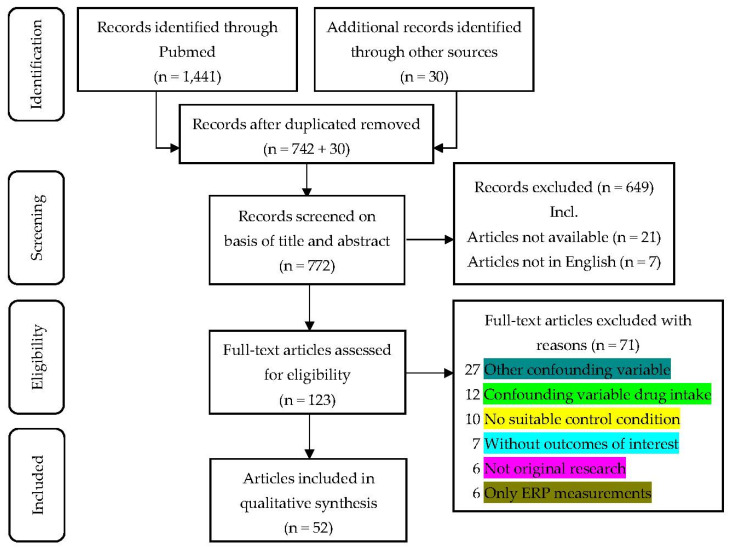
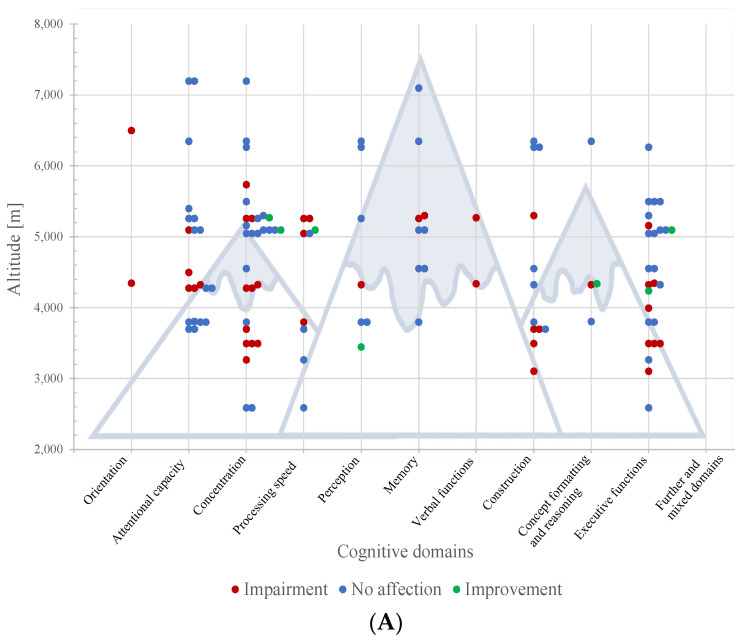
High-altitude (HA) exposure affects cognitive functions, but studies have found inconsistent results. The aim of this systematic review was to evaluate the effects of HA exposure on cognitive functions in healthy subjects. A structural overview of the applied neuropsychological tests was provided with a classification of superordinate cognitive domains. A literature search was performed using PubMed up to October 2021 according to PRISMA guidelines. Eligibility criteria included a healthy human cohort exposed to altitude in the field (at minimum 2440 m [8000 ft]) or in a hypoxic environment in a laboratory, and an assessment of cognitive domains. The literature search identified 52 studies (29 of these were field studies; altitude range: 2440 m-8848 m [8000-29,029 ft]). Researchers applied 112 different neuropsychological tests. Attentional capacity, concentration, and executive functions were the most frequently studied. In the laboratory, the ratio of altitude-induced impairments (64.7%) was twice as high compared to results showing no change or improved results (35.3%), but altitudes studied were similar in the chamber compared to field studies. In the field, the opposite results were found (66.4 % no change or improvements, 33.6% impairments). Since better acclimatization can be assumed in the field studies, the findings support the hypothesis that sufficient acclimatization has beneficial effects on cognitive functions at HA. However, it also becomes apparent that research in this area would benefit most if a consensus could be reached on a standardized framework of freely available neurocognitive tests.
高原(HA)暴露会影响认知功能,但研究结果并不一致。本系统评价的目的是评估HA暴露对健康受试者认知功能的影响。通过对上级认知领域进行分类,提供了所应用神经心理学测试的结构概述。根据PRISMA指南,截至2021年10月使用PubMed进行了文献检索。纳入标准包括在野外(至少2440米[8000英尺])或实验室低氧环境中暴露于高原的健康人群队列,以及对认知领域的评估。文献检索确定了52项研究(其中29项为野外研究;海拔范围:2440米 - 8848米[8000 - 29,029英尺])。研究人员应用了112种不同的神经心理学测试。注意力、专注力和执行功能是研究最频繁的方面。在实验室中,与无变化或结果改善的情况(35.3%)相比,高原诱导损伤的比例(64.7%)高出两倍,但与野外研究相比,实验室研究的海拔高度相似。在野外,结果相反(66.4%无变化或改善,33.6%有损伤)。由于在野外研究中可以假定有更好的适应性,这些发现支持了这样的假设,即充分的适应性对高原地区的认知功能有有益影响。然而,同样明显的是,如果能就免费提供的神经认知测试的标准化框架达成共识,该领域的研究将受益最大。