Medenica Sanja, Zivanovic Dusan, Batkoska Ljubica, Marinelli Susanna, Basile Giuseppe, Perino Antonio, Cucinella Gaspare, Gullo Giuseppe, Zaami Simona
Department of Endocrinology, Internal Medicine Clinic, Clinical Center of Montenegro, School of Medicine, University of Montenegro, 81000 Podgorica, Montenegro.
Clinic of Endocrinology, Diabetes and Metabolic Disorders, University Clinical Center of Serbia, 11000 Belgrade, Serbia.
Diagnostics (Basel). 2022 Nov 28;12(12):2979. doi: 10.3390/diagnostics12122979.
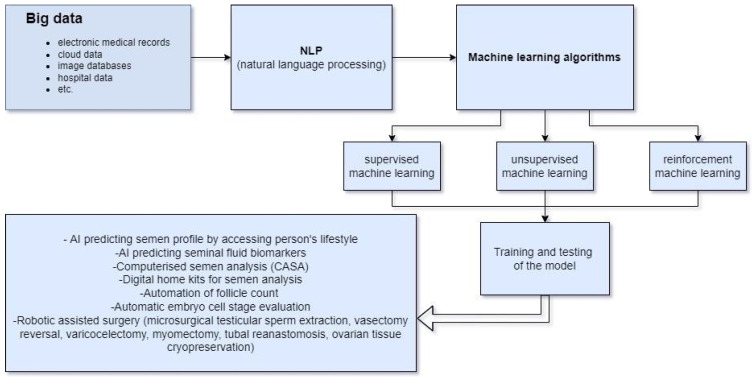
Infertility is a global health issue affecting women and men of reproductive age with increasing incidence worldwide, in part due to greater awareness and better diagnosis. Assisted reproduction technologies (ART) are considered the ultimate step in the treatment of infertility. Recently, artificial intelligence (AI) has been progressively used in the many fields of medicine, integrating knowledge and computer science through machine learning algorithms. AI has the potential to improve infertility diagnosis and ART outcomes estimated as pregnancy and/or live birth rate, especially with recurrent ART failure. A broad-ranging review has been conducted, focusing on clinical AI applications up until September 2022, which could be estimated in terms of possible applications, such as ultrasound monitoring of folliculogenesis, endometrial receptivity, embryo selection based on quality and viability, and prediction of post implantation embryo development, in order to eliminate potential contributing risk factors. Oocyte morphology assessment is highly relevant in terms of successful fertilization rate, as well as during oocyte freezing for fertility preservation, and substantially valuable in oocyte donation cycles. AI has great implications in the assessment of male infertility, with computerised semen analysis systems already in use and a broad spectrum of possible AI-based applications in environmental and lifestyle evaluation to predict semen quality. In addition, considerable progress has been made in terms of harnessing AI in cases of idiopathic infertility, to improve the stratification of infertile/fertile couples based on their biological and clinical signatures. With AI as a very powerful tool of the future, our review is meant to summarise current AI applications and investigations in contemporary reproduction medicine, mainly focusing on the nonsurgical aspects of it; in addition, the authors have briefly explored the frames of reference and guiding principles for the definition and implementation of legal, regulatory, and ethical standards for AI in healthcare.
不孕症是一个全球性的健康问题,影响着育龄期的男性和女性,其在全球范围内的发病率呈上升趋势,部分原因是认知度提高和诊断手段改善。辅助生殖技术(ART)被视为不孕症治疗的最终手段。近年来,人工智能(AI)已逐渐应用于医学的多个领域,通过机器学习算法整合知识与计算机科学。人工智能有潜力改善不孕症诊断以及辅助生殖技术的结局,后者以妊娠和/或活产率来衡量,尤其是在反复辅助生殖技术失败的情况下。本文进行了一项广泛的综述,重点关注截至2022年9月的临床人工智能应用,这些应用可根据其可能的用途进行评估,例如卵泡发育的超声监测、子宫内膜容受性、基于质量和活力的胚胎选择以及植入后胚胎发育的预测,以便消除潜在的危险因素。卵母细胞形态评估在受精成功率方面以及在为保留生育能力而进行的卵母细胞冷冻过程中都高度相关,并且在卵母细胞捐赠周期中具有重要价值。人工智能在男性不育症评估中具有重要意义,计算机化精液分析系统已在使用,并且在环境和生活方式评估中基于人工智能的一系列广泛应用可用于预测精液质量。此外,在不明原因不孕症中利用人工智能方面已经取得了相当大的进展,以根据不育/可育夫妇的生物学和临床特征改进他们的分层。作为未来一种非常强大的工具,我们的综述旨在总结当前人工智能在当代生殖医学中的应用和研究,主要关注其非手术方面;此外,作者还简要探讨了医疗保健领域人工智能的法律、监管和伦理标准定义与实施的参考框架和指导原则。