Crisan Roxana-Mihaela, Băcilă Ciprian Ionuț, Toboltoc Paul-Cătălin, Morar Silviu
Doctoral Department, Faculty of Medicine, Lucian Blaga University of Sibiu, 550024 Sibiu, Romania.
Forensic Department, County Clinical Emergency Hospital of Sibiu, Corneliu Coposu Boulevard 2-4, 550245 Sibiu, Romania.
Healthcare (Basel). 2022 Nov 26;10(12):2377. doi: 10.3390/healthcare10122377.
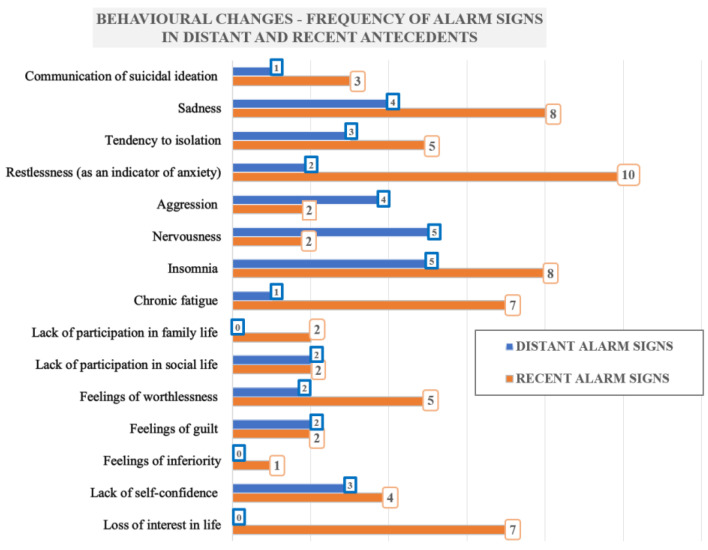
The COVID-19 pandemic is associated with suicide, as some data suggests. Our study aims to investigate the emergence of eleven completed suicide cases suspected to be linked to the COVID-19 pandemic during the restrictive measures imposed by the Romanian government, and to identify the consequences of mental health, suicidal motivation, and behavioral changes. To this end, we analyzed the deceased's medical records and applied the psychological autopsy method to the relatives/caregivers of the deceased for a suicidal investigation history, within conducted free-flow discussions. To highlight behavioral changes that occurred in the distant antecedents as well as immediately before the suicidal act, we used two sets of closed questions comprised of fifteen alarm signs, including depressive and/or anxiety symptoms. Our results showed that a deterioration of the mental status, especially concerning depressive and anxiety symptoms, was evident in people without or with pre-existing psychiatric pathology. The suicidal motivation proved to be complex including, in addition to the SARS-CoV-2 infection, social and economic consequences of the COVID-19 pandemic. We noted an intensification of the investigated alarm signs and even the emergence of new warning signs in the recent antecedents. Based on our findings, we reaffirmed the important role of the psychological autopsy method in suicide investigation, proving that it can detect the specific impact of the COVID-19 pandemic on people prone to suicide. This impact can be psycho-emotional, social, and/or economical, and thus we can state that the COVID-19 pandemic and its consequences can be, at least, a triggering factor that enhances completed suicide risk. Further studies are needed in this particular area because correlations between the COVID-19 pandemic and completed suicide do not appear to be accidental.
正如一些数据所示,新冠疫情与自杀有关。我们的研究旨在调查在罗马尼亚政府实施限制措施期间,疑似与新冠疫情相关的11起自杀既遂案件的出现情况,并确定心理健康、自杀动机和行为变化的后果。为此,我们分析了死者的病历,并在自由交流讨论中,对死者的亲属/照顾者采用心理解剖方法,以了解自杀调查史。为了突出在自杀行为发生前的遥远时期以及紧接自杀行为之前发生的行为变化,我们使用了两组包含15个警示信号的封闭式问题,包括抑郁和/或焦虑症状。我们的结果表明,无论有无既往精神病理状况,人们的精神状态恶化,尤其是抑郁和焦虑症状明显。自杀动机被证明是复杂的,除了新冠病毒感染外,还包括新冠疫情的社会和经济后果。我们注意到,在最近的时期内,所调查的警示信号有所增强,甚至出现了新的警示信号。基于我们的研究结果,我们重申了心理解剖方法在自杀调查中的重要作用,证明它可以检测出新冠疫情对易自杀人群的具体影响。这种影响可能是心理情感、社会和/或经济方面的,因此我们可以说,新冠疫情及其后果至少可以成为一个增加自杀既遂风险的触发因素。由于新冠疫情与自杀既遂之间的关联似乎并非偶然,因此在这一特定领域需要进一步开展研究。