Ilic Milena, Ilic Irena
Department of Epidemiology, Faculty of Medical Sciences, University of Kragujevac, Kragujevac 34000, Serbia.
Faculty of Medicine, University of Belgrade, Belgrade 11000, Serbia.
World J Psychiatry. 2022 Mar 19;12(3):505-520. doi: 10.5498/wjp.v12.i3.505.
Hanging is one of the most commonly used methods for suicide in both sexes worldwide. In a number of countries, hanging mortality has increased over the last decades. Nevertheless, there is a scarcity of studies that have explored the patterns and trends for mortality of suicide by hanging on global, regional and national levels, as most evaluations are limited to certain populations.
To assess the trends of suicide mortality by hanging, strangulation, and suffocation in Serbia, from 1991 to 2020.
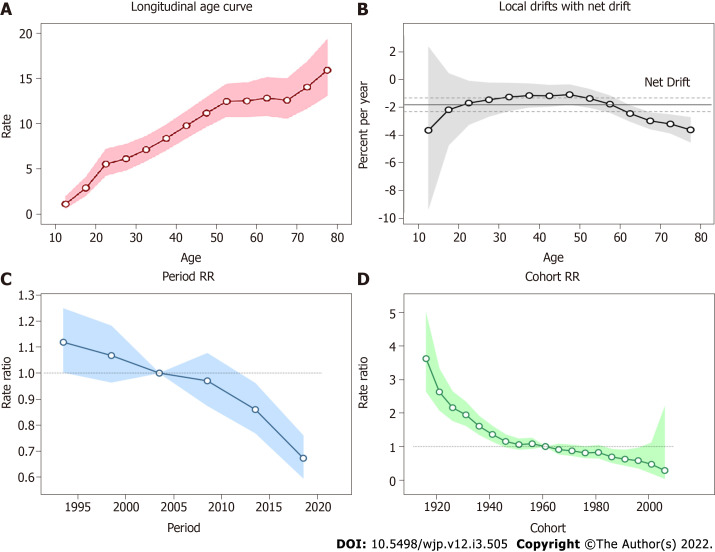
This nationwide study, with epidemiological descriptive study design, was carried out based on official data. The age-standardized rates (ASRs, expressed 100000 persons) were calculated by direct standardization, using the World Standard Population. Mortality trends from suicide by hanging were assessed using the joinpoint regression analysis: The average annual percent change (AAPC) with the corresponding 95% confidence interval (95%CI) was calculated. Age-period-cohort analysis was performed to address the possible underlying reasons for the observed suicide trends.
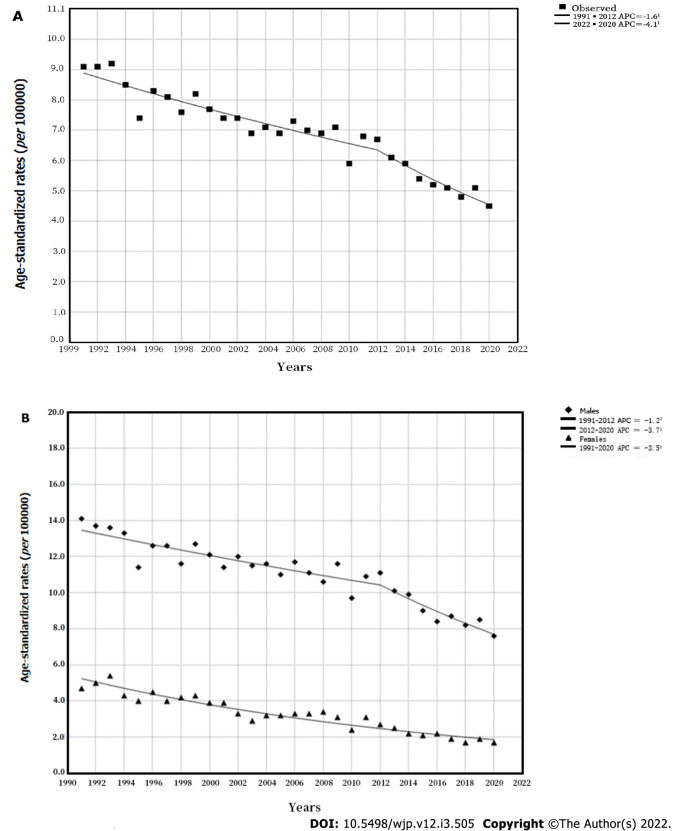
Over the 30-year period studied, there were 24340 deaths by hanging (17750 males and 6590 females) in Serbia. In 2020, the ASR of deaths by hanging was 4.5 100000 persons in both sexes together (7.6 in males 1.7 in females). The trends of suicide mortality by hanging decreased significantly between 1991 and 2020 in both males (AAPC = -1.7% year; 95%CI: -2.0 to -1.4) and females (AAPC = - 3.5% year; 95%CI: -3.9 to -3.1). Mortality rates of suicide by hanging had a continuously decreasing tendency in both sexes together in all age groups: The only exception was among males in 40-49 age group, with an increasing trend of suicide by hanging from 1991 to 2011 (by +0.3% year).
The trends in suicide mortality by hanging have been decreasing in Serbia in the last three decades in both sexes, but this was more pronounced in women than in men. Despite the decreasing trends observed in mortality of suicide by hanging, further research is needed for better clarification of trends and help in suicide prevention in the future.
在全球范围内,缢吊是男女最常用的自杀方式之一。在一些国家,过去几十年间缢吊死亡率有所上升。然而,由于大多数评估仅限于特定人群,因此在全球、区域和国家层面上,探索缢吊自杀死亡率模式和趋势的研究较为匮乏。
评估1991年至2020年塞尔维亚因缢吊、勒颈和窒息导致的自杀死亡率趋势。
本项全国性研究采用流行病学描述性研究设计,基于官方数据开展。通过直接标准化法,使用世界标准人口计算年龄标准化率(ASRs,每10万人)。采用Joinpoint回归分析评估缢吊自杀的死亡率趋势:计算平均年度百分比变化(AAPC)及其相应的95%置信区间(95%CI)。进行年龄-时期-队列分析,以探讨观察到的自杀趋势的潜在原因。
在研究的30年期间,塞尔维亚有24340例缢吊死亡(男性17750例,女性6590例)。2020年,男女因缢吊死亡的ASR合计为每10万人4.5例(男性为7.6例,女性为1.7例)。1991年至2020年期间,男性(AAPC = -1.7%/年;95%CI:-2.0至-1.4)和女性(AAPC = -3.5%/年;95%CI:-3.9至-3.1)因缢吊导致的自杀死亡率均显著下降。所有年龄组中,男女因缢吊导致的自杀死亡率均呈持续下降趋势:唯一的例外是40-49岁年龄组的男性,1991年至2011年期间因缢吊导致的自杀呈上升趋势(每年上升0.3%)。
在过去三十年中,塞尔维亚男女因缢吊导致的自杀死亡率均呈下降趋势,但女性下降更为明显。尽管观察到因缢吊导致的自杀死亡率呈下降趋势,但仍需要进一步研究,以更好地阐明趋势,并为未来的自杀预防提供帮助。