
通过将相关变量纳入加权风险评分,估算环境和遗传风险因素对不同衰老特征的相对贡献。
Estimating the Relative Contribution of Environmental and Genetic Risk Factors to Different Aging Traits by Combining Correlated Variables into Weighted Risk Scores.
机构信息
IUF-Leibniz Research Institute for Environmental Medicine, 40225 Duesseldorf, Germany.
Department of Epidemiology, Rollins School of Public Health, Emory University, Atlanta, GA 30322, USA.
出版信息
Int J Environ Res Public Health. 2022 Dec 13;19(24):16746. doi: 10.3390/ijerph192416746.
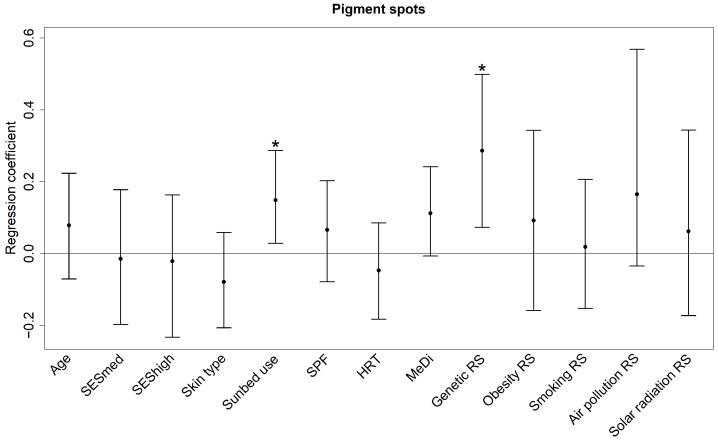
Genetic and exposomal factors contribute to the development of human aging. For example, genetic polymorphisms and exposure to environmental factors (air pollution, tobacco smoke, etc.) influence lung and skin aging traits. For prevention purposes it is highly desirable to know the extent to which each category of the exposome and genetic factors contribute to their development. Estimating such extents, however, is methodologically challenging, mainly because the predictors are often highly correlated. Tackling this challenge, this article proposes to use weighted risk scores to assess combined effects of categories of such predictors, and a measure of relative importance to quantify their relative contribution. The risk score weights are determined via regularized regression and the relative contributions are estimated by the proportion of explained variance in linear regression. This approach is applied to data from a cohort of elderly Caucasian women investigated in 2007-2010 by estimating the relative contribution of genetic and exposomal factors to skin and lung aging. Overall, the models explain 17% (95% CI: [9%, 28%]) of the outcome's variance for skin aging and 23% ([11%, 34%]) for lung function parameters. For both aging traits, genetic factors make up the largest contribution. The proposed approach enables us to quantify and rank contributions of categories of exposomal and genetic factors to human aging traits and facilitates risk assessment related to common human diseases in general. Obtained rankings can aid political decision making, for example, by prioritizing protective measures such as limit values for certain exposures.
遗传和外显子因素共同促成人类衰老。例如,遗传多态性和环境因素(空气污染、烟草烟雾等)暴露会影响肺部和皮肤衰老特征。为了预防目的,非常希望知道外显子和遗传因素的每种类别在多大程度上促进其发展。然而,估计这些程度在方法学上具有挑战性,主要是因为预测因子通常高度相关。为了解决这一挑战,本文提出使用加权风险评分来评估此类预测因子类别的综合效应,并使用相对重要性度量来量化其相对贡献。风险评分权重通过正则化回归确定,相对贡献通过线性回归中的解释方差比例来估计。该方法应用于 2007-2010 年对老年白种女性进行的队列研究数据,以估计遗传和外显子因素对皮肤和肺部衰老的相对贡献。总体而言,这些模型解释了皮肤老化的结果变量的 17%(95%CI:[9%,28%])和肺功能参数的 23%([11%,34%])的方差。对于这两种衰老特征,遗传因素的贡献最大。所提出的方法使我们能够量化和排名外显子和遗传因素的类别对人类衰老特征的贡献,并促进一般常见人类疾病的风险评估。获得的排名可以帮助政治决策,例如,通过优先考虑某些暴露的限值等保护措施。



 Zotero 插件