Department of Industrial and Environmental Microbiology, Institute of Biological Sciences, Faculty of Biology and Biotechnology, Maria Curie-Skłodowska University, 19 Akademicka, 20-033 Lublin, Poland.
Int J Mol Sci. 2022 Dec 8;23(24):15536. doi: 10.3390/ijms232415536.
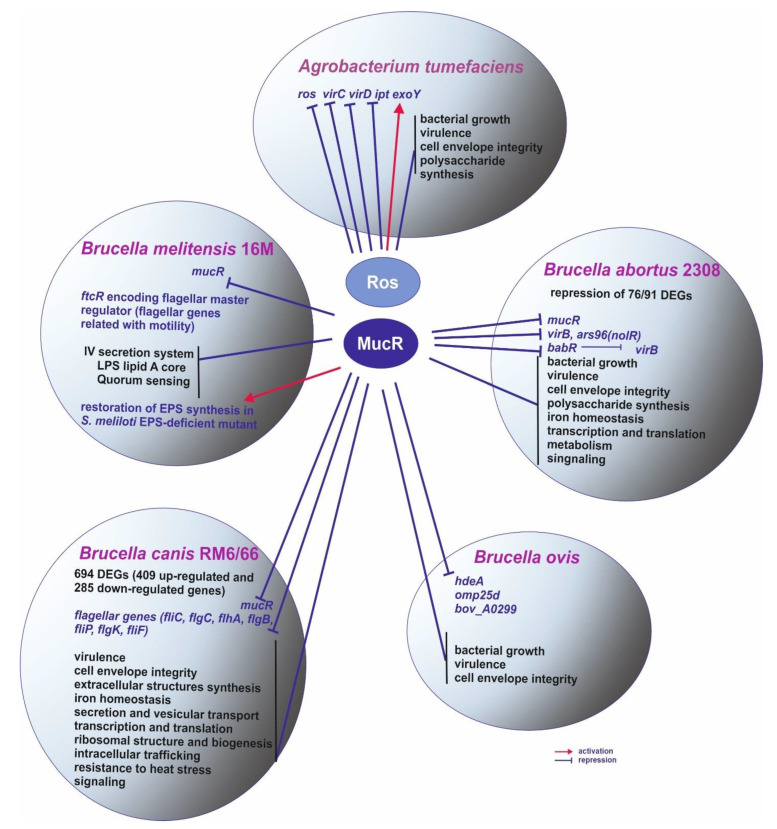
Ros/MucR is a widespread family of bacterial zinc-finger-containing proteins that integrate multiple functions, such as symbiosis, virulence, transcription regulation, motility, production of surface components, and various other physiological processes in cells. This regulatory protein family is conserved in bacteria and is characterized by its zinc-finger motif, which has been proposed as the ancestral domain from which the eukaryotic CH zinc-finger structure has evolved. The first prokaryotic zinc-finger domain found in the transcription regulator Ros was identified in . In the past decades, a large body of evidence revealed Ros/MucR as pleiotropic transcriptional regulators that mainly act as repressors through oligomerization and binding to AT-rich target promoters. The N-terminal domain and the zinc-finger-bearing C-terminal region of these regulatory proteins are engaged in oligomerization and DNA binding, respectively. These properties of the Ros/MucR proteins are similar to those of xenogeneic silencers, such as H-NS, MvaT, and Lsr2, which are mainly found in other lineages. In fact, a novel functional model recently proposed for this protein family suggests that they act as H-NS-'like' gene silencers. The prokaryotic zinc-finger domain exhibits interesting structural and functional features that are different from that of its eukaryotic counterpart (a βββα topology), as it folds in a significantly larger zinc-binding globular domain (a βββαα topology). Phylogenetic analysis of Ros/MucR homologs suggests an ancestral origin of this type of protein in α-. Furthermore, multiple duplications and lateral gene transfer events contributing to the diversity and phyletic distribution of these regulatory proteins were found in bacterial genomes.
罗斯/粘蛋白 R(Ros/MucR)是一种广泛存在于细菌中的锌指蛋白家族,整合了多种功能,如共生、毒力、转录调控、运动、表面成分的产生以及细胞中的各种其他生理过程。这个调节蛋白家族在细菌中是保守的,其特征是锌指基序,该基序被提议为真核 CH 锌指结构进化的祖先结构域。在转录调节剂 Ros 中发现的第一个原核锌指结构域是在 1990 年鉴定的。在过去的几十年中,大量证据表明 Ros/MucR 是多功能转录调节因子,主要通过寡聚化和与富含 AT 的靶启动子结合来发挥抑制作用。这些调节蛋白的 N 端结构域和带有锌指的 C 端结构域分别参与寡聚化和 DNA 结合。这些 Ros/MucR 蛋白的特性类似于异种沉默子,如 H-NS、MvaT 和 Lsr2,它们主要存在于其他谱系中。事实上,最近提出的这个蛋白家族的一个新的功能模型表明,它们作为 H-NS-样基因沉默子发挥作用。原核锌指结构域表现出有趣的结构和功能特征,与真核对应的结构域(βββα 拓扑结构)不同,它折叠成一个明显更大的锌结合球状结构域(βββαα 拓扑结构)。Ros/MucR 同源物的系统发育分析表明,这种蛋白类型的祖先起源于α-变形菌。此外,在细菌基因组中发现了多种重复和横向基因转移事件,这些事件导致了这些调节蛋白的多样性和系统发育分布。