Institute for Advanced Biosciences, University Grenoble Alpes, CNRS UMR5309, INSERM U1209, 38700 Grenoble, France.
Hepato-Gastroenterology and Digestive Oncology Department, CHU Grenoble Alpes, 38700 Grenoble, France.
Int J Mol Sci. 2022 Dec 19;23(24):16206. doi: 10.3390/ijms232416206.
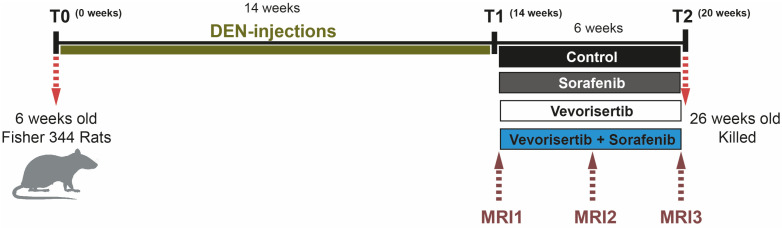
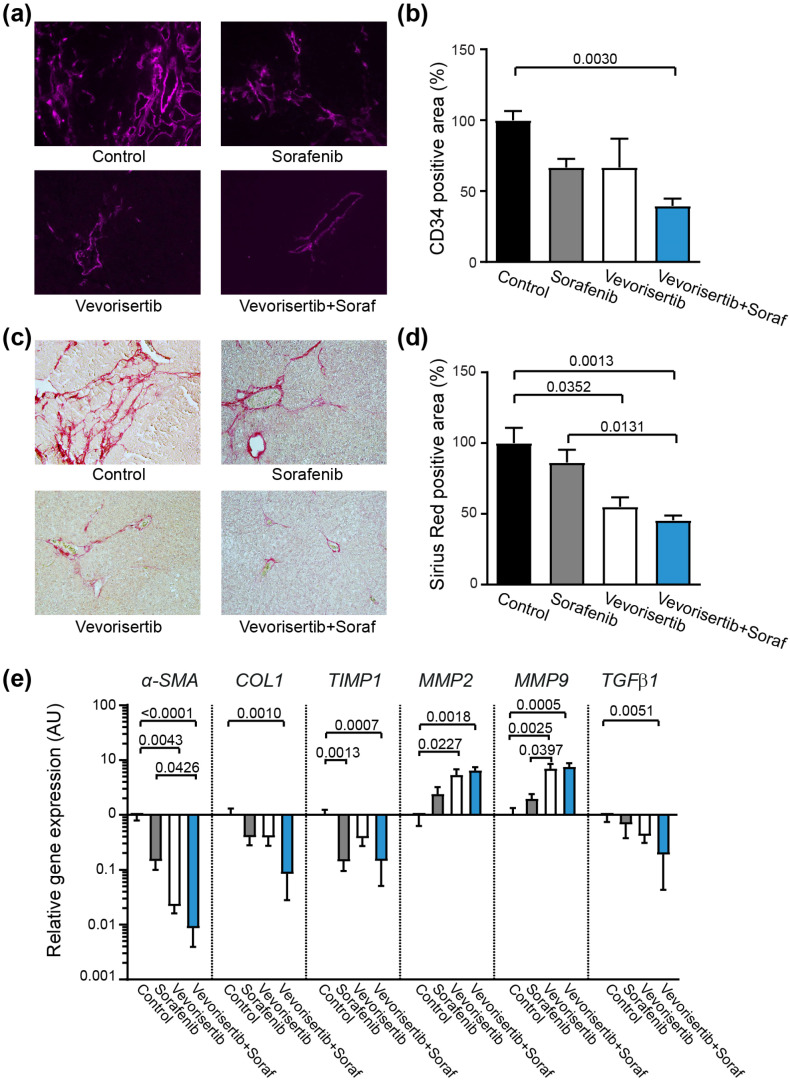
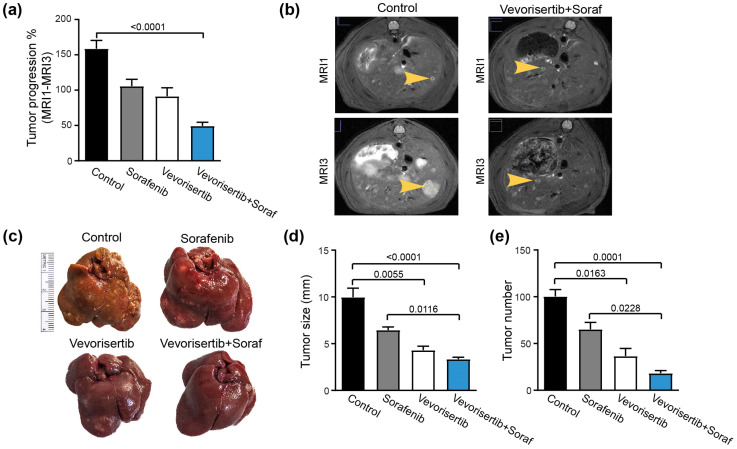
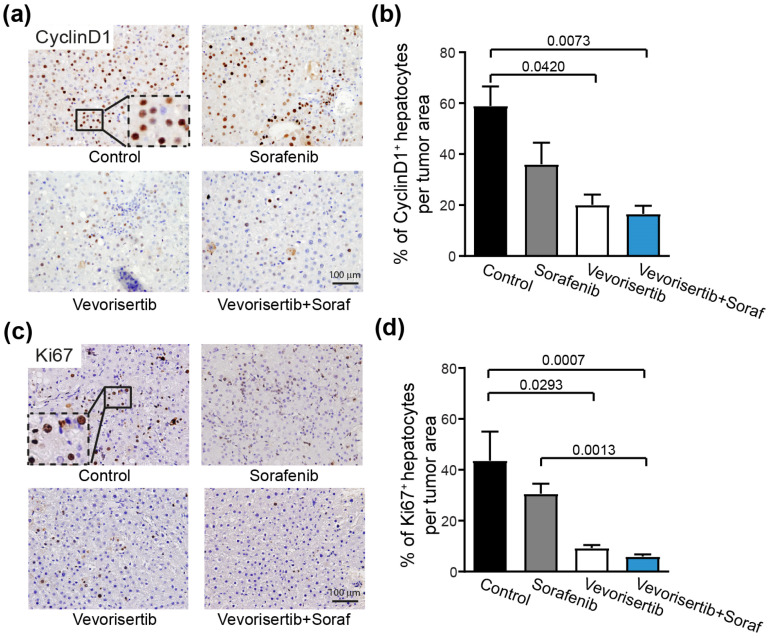
Hepatocellular carcinoma (HCC) is one of the leading causes of cancer-related mortality worldwide. The AKT pathway is often activated in HCC cases, and a longer exposure to tyrosine kinase inhibitors such as sorafenib may lead to over-activation of the AKT pathway, leading to HCC resistance. Here, we studied the efficacy of a new generation of allosteric AKT inhibitor, vevorisertib, alone or in combination with sorafenib. To identify specific adverse effects related to the background of cirrhosis, we used a diethylnitrosamine (DEN)-induced cirrhotic rat model. Vevorisertib was tested in vitro on Hep3B, HepG2, HuH7 and PLC/PRF cell lines. Rats were treated weekly with intra-peritoneal injections of DEN for 14 weeks to obtain cirrhosis with fully developed HCC. After that, rats were randomized into four groups (n = 7/group): control, sorafenib, vevorisertib and the combination of vevorisertib + sorafenib, and treated for 6 weeks. Tumor progression was followed by MRI. We demonstrated that the vevorisertib is a highly potent treatment, blocking the phosphorylation of AKT. The tumor progression in the rat liver was significantly reduced by treatment with vevorisertib + sorafenib (49.4%) compared to the control group (158.8%, p < 0.0001). Tumor size, tumor number and tumor cell proliferation were significantly reduced in both the vevorisertib group and vevorisertib + sorafenib groups compared to the control group. Sirius red staining showed an improvement in liver fibrosis by vevorisertib and the combination treatment. Moreover, vevorisertib + sorafenib treatment was associated with a normalization in the liver vasculature. Altogether, vevorisertib as a single agent and its combination with sorafenib exerted a strong suppression of tumor progression and improved liver fibrosis. Thus, results provide a rationale for testing vevorisertib in clinical settings and confirm the importance of targeting AKT in HCC.
肝细胞癌 (HCC) 是全球癌症相关死亡的主要原因之一。AKT 通路在 HCC 病例中经常被激活,而较长时间暴露于酪氨酸激酶抑制剂,如索拉非尼,可能导致 AKT 通路过度激活,从而导致 HCC 耐药。在这里,我们研究了新一代别构 AKT 抑制剂 vevorertib 单独或与索拉非尼联合应用的疗效。为了确定与肝硬化背景相关的特定不良反应,我们使用了二乙基亚硝胺 (DEN) 诱导的肝硬化大鼠模型。我们在 Hep3B、HepG2、HuH7 和 PLC/PRF 细胞系中对 vevorertib 进行了体外测试。大鼠每周接受腹腔注射 DEN 14 周,以获得完全发展的 HCC 的肝硬化。之后,大鼠随机分为四组 (n = 7/组):对照组、索拉非尼组、vevorertib 组和 vevorertib + 索拉非尼组,并治疗 6 周。通过 MRI 跟踪肿瘤进展。我们证明了 vevorertib 是一种高效的治疗药物,可阻断 AKT 的磷酸化。与对照组 (158.8%,p < 0.0001) 相比,vevorertib + 索拉非尼治疗显著降低了大鼠肝内肿瘤进展 (49.4%)。与对照组相比,vevorertib 组和 vevorertib + 索拉非尼组的肿瘤大小、肿瘤数量和肿瘤细胞增殖均显著降低。天狼星红染色显示 vevorertib 和联合治疗可改善肝纤维化。此外,vevorertib + 索拉非尼治疗与肝血管正常化相关。总之,vevorertib 作为单一药物及其与索拉非尼的联合应用对肿瘤进展具有强烈的抑制作用,并改善了肝纤维化。因此,这些结果为在临床环境中测试 vevorertib 提供了依据,并证实了靶向 AKT 在 HCC 中的重要性。