Chen Yu, Wang Shengkun, Liu Xiaojing, Wang Dongli, Liu Yunshan, Hu Lipan, Meng Sen
College of Biology and Food Engineering, Chongqing Three Gorges University, Chongqing 404100, China.
State Key Laboratory of Tree Genetics and Breeding, Research Institute of Tropical Forestry, Chinese Academy of Forestry, Guangzhou 510520, China.
Life (Basel). 2022 Nov 26;12(12):1980. doi: 10.3390/life12121980.
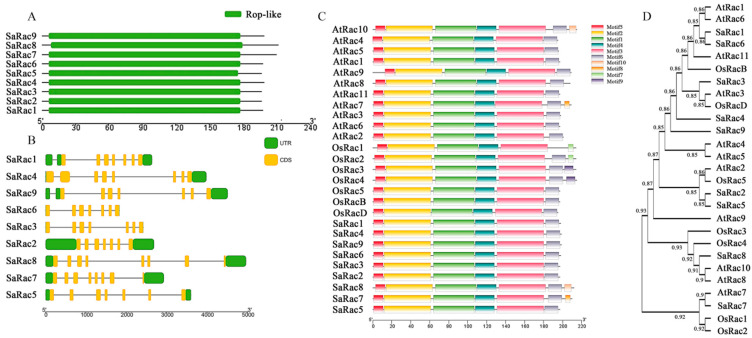
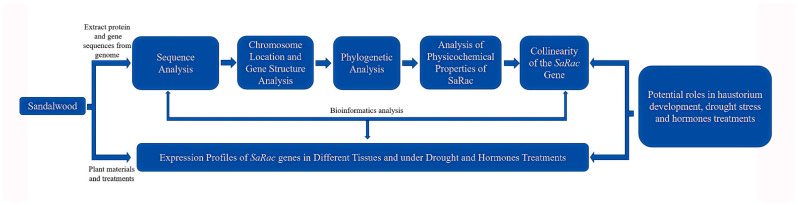
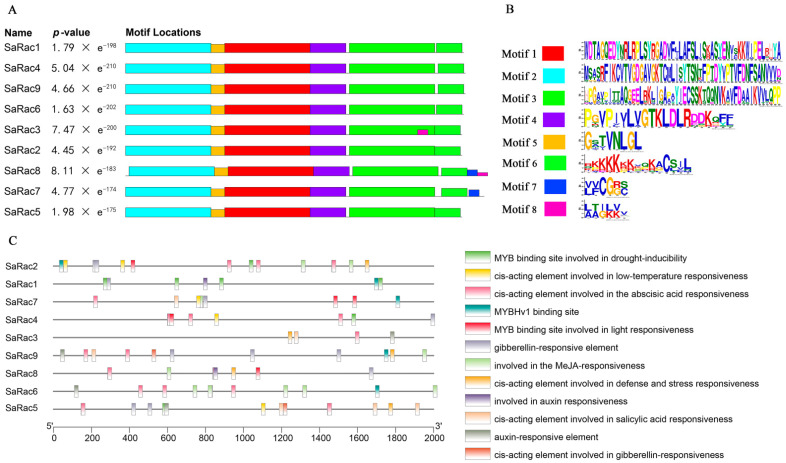
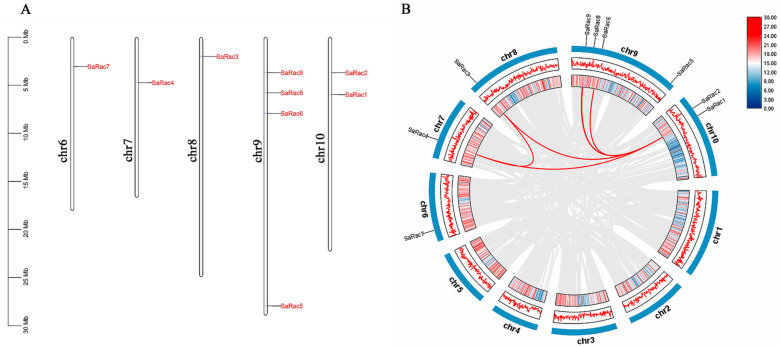
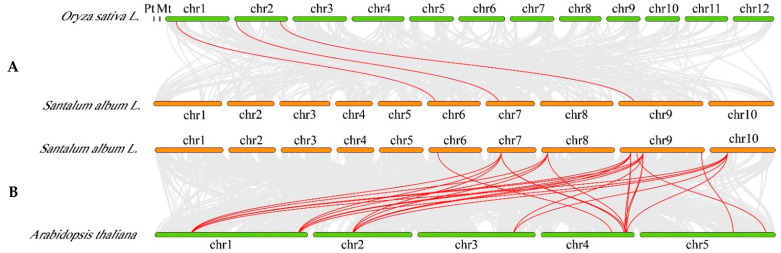
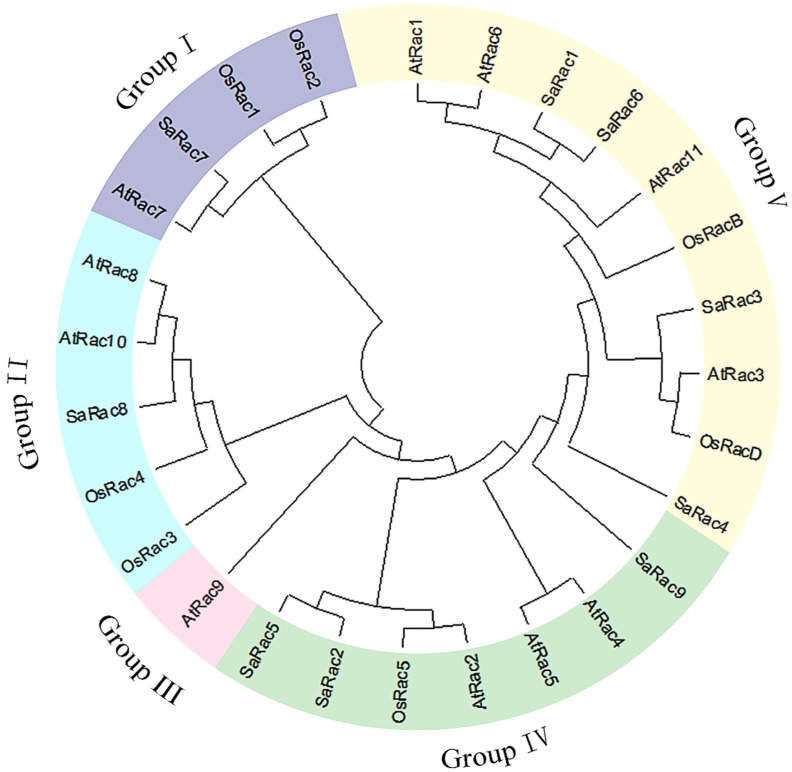
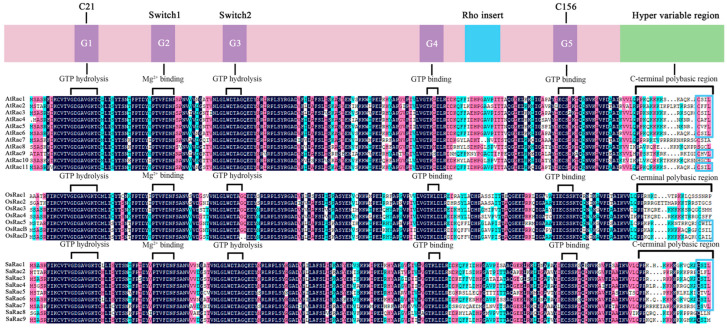
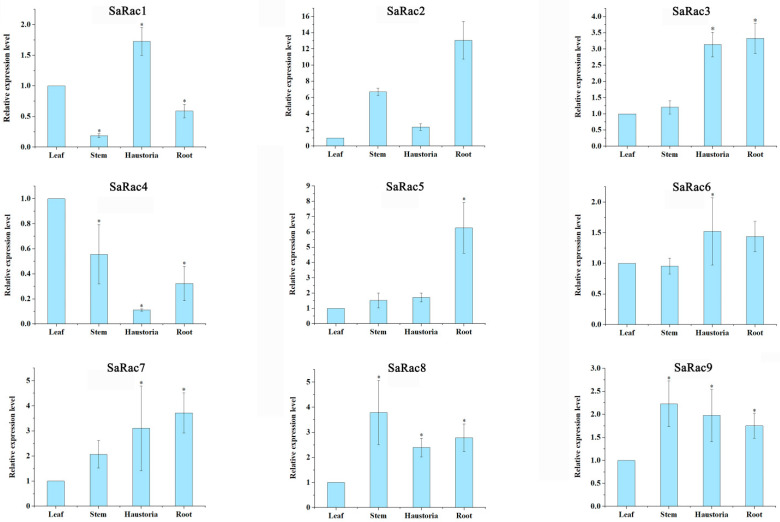
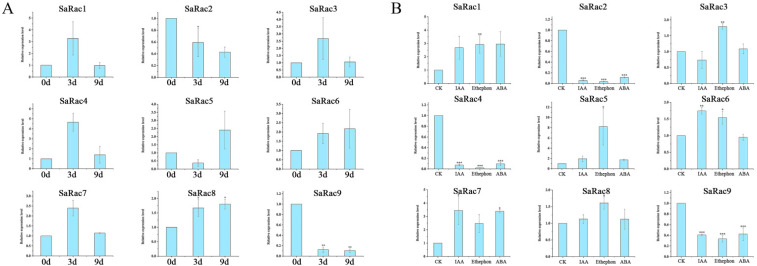
Plant-specific Rac/Rop small GTPases, also known as Rop, belong to the Rho subfamily. Rac proteins can be divided into two types according to their C-terminal motifs: Type I Rac proteins have a typical CaaL motif at the C-terminal, whereas type II Rac proteins lack this motif but retain a cysteine-containing element for membrane anchoring. The gene family participates in diverse signal transduction events, cytoskeleton morphogenesis, reactive oxygen species (ROS) production and hormone responses in plants as molecular switches. is a popular semiparasitic plant that absorbs nutrients from the host plant through the haustoria to meet its own growth and development needs. Because the whole plant has a high use value, due to the high production value of its perfume oils, it is known as the "tree of gold". Based on the full-length transcriptome data of , nine gene members were named , and we analyzed their physicochemical properties. Evolutionary analysis showed that SaRac1-7, AtRac1-6, AtRac9 and AtRac11 and OsRac5, OsRacB and OsRacD belong to the typical plant type I Rac/Rop protein, while SaRac8-9, AtRac7, AtRac8, AtRac10 and OsRac1-4 belong to the type II Rac/ROP protein. Tissue-specific expression analysis showed that nine genes were expressed in roots, stems, leaves and haustoria, and // expression in stems, haustoria and roots was significantly higher than that in leaves. The expression levels of , and in stems were very low, and the expression levels of and in roots and // in haustoria were very high, which indicated that these genes were closely related to the formation of haustoria. To further analyze the function of , nine genes in sandalwood were subjected to drought stress and hormone treatments. These results establish a preliminary foundation for the regulation of growth and development in by .
植物特有的Rac/Rop小GTP酶,也称为Rop,属于Rho亚家族。Rac蛋白根据其C端基序可分为两种类型:I型Rac蛋白在C端有一个典型的CaaL基序,而II型Rac蛋白缺乏该基序,但保留了一个含半胱氨酸的元件用于膜锚定。该基因家族作为分子开关参与植物中多种信号转导事件、细胞骨架形态发生、活性氧(ROS)产生和激素反应。檀香是一种常见的半寄生植物,通过吸器从寄主植物中吸收养分以满足自身生长发育需求。由于整株植物具有很高的利用价值,因其香精油的高产值,它被称为“黄金之树”。基于檀香的全长转录组数据,九个檀香Rac基因成员被命名为SaRac1-9,并且我们分析了它们的理化性质。进化分析表明,SaRac1-7、AtRac1-6、AtRac9和AtRac11以及OsRac5、OsRacB和OsRacD属于典型的植物I型Rac/Rop蛋白,而SaRac8-9、AtRac7、AtRac8、AtRac10和OsRac1-4属于II型Rac/ROP蛋白。组织特异性表达分析表明,九个基因在根、茎、叶和吸器中均有表达,并且SaRac1、SaRac2、SaRac3、SaRac4、SaRac5、SaRac6、SaRac7、SaRac8和SaRac9在茎、吸器和根中的表达明显高于叶中的表达。SaRac1、SaRac2和SaRac3在茎中的表达水平非常低,而SaRac4和SaRac5在根中以及SaRac6在吸器中的表达水平非常高,这表明这些基因与檀香吸器的形成密切相关。为了进一步分析檀香Rac基因的功能,对檀香中的九个Rac基因进行了干旱胁迫和激素处理。这些结果为檀香Rac基因调控檀香的生长发育奠定了初步基础。