Lacueva-Aparicio Alodia, Lindoso Rafael Soares, Mihăilă Silvia M, Giménez Ignacio
Renal and Cardiovascular Physiopathology (FISIOPREN), Aragon's Health Sciences Institute, Zaragoza, Spain.
Tissue Microenvironment Lab (TME Lab), I3A, University of Zaragoza, Zaragoza, Spain.
Front Physiol. 2022 Dec 7;13:1048738. doi: 10.3389/fphys.2022.1048738. eCollection 2022.
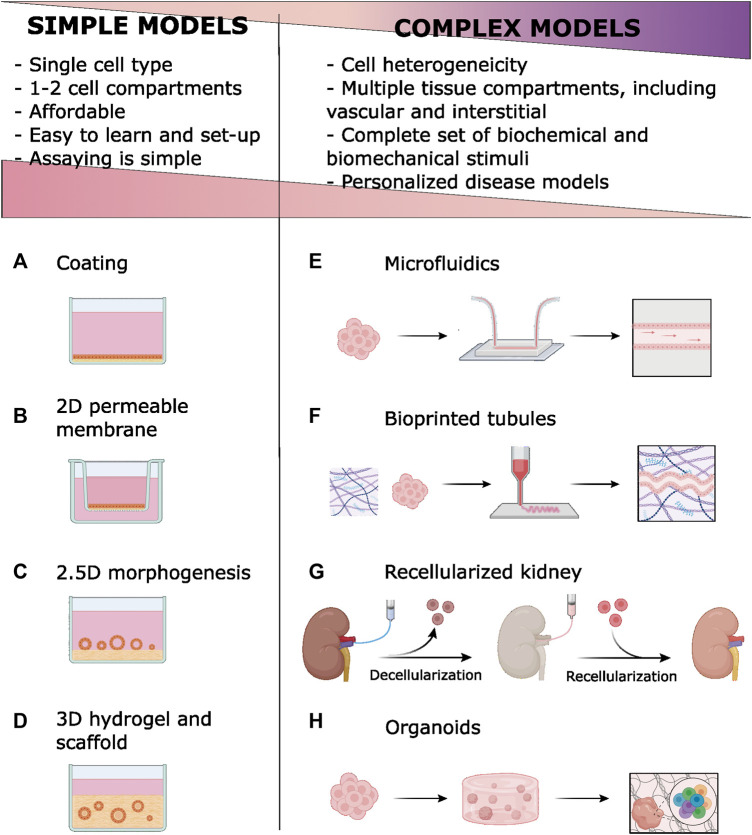
The extracellular matrix (ECM), a complex set of fibrillar proteins and proteoglycans, supports the renal parenchyma and provides biomechanical and biochemical cues critical for spatial-temporal patterning of cell development and acquisition of specialized functions. As models progress towards biomimicry, more attention is paid to reproducing ECM-mediated stimuli. ECM's role in models of renal function and disease used to investigate kidney injury and regeneration is discussed. Availability, affordability, and lot-to-lot consistency are the main factors determining the selection of materials to recreate ECM While simpler components can be synthesized , others must be isolated from animal or human tissues, either as single isolated components or as complex mixtures, such as Matrigel or decellularized formulations. Synthetic polymeric materials with dynamic and instructive capacities are also being explored for cell mechanical support to overcome the issues with natural products. ECM components can be used as simple 2D coatings or complex 3D scaffolds combining natural and synthetic materials. The goal is to recreate the biochemical signals provided by glycosaminoglycans and other signaling molecules, together with the stiffness, elasticity, segmentation, and dimensionality of the original kidney tissue, to support the specialized functions of glomerular, tubular, and vascular compartments. ECM mimicking also plays a central role in recent developments aiming to reproduce renal tissue or even in therapeutical strategies to regenerate renal function. Bioprinting of renal tubules, recellularization of kidney ECM scaffolds, and development of kidney organoids are examples. Future solutions will probably combine these technologies.
细胞外基质(ECM)是一组复杂的纤维状蛋白质和蛋白聚糖,它支撑着肾实质,并提供对细胞发育的时空模式形成以及获得特殊功能至关重要的生物力学和生化线索。随着模型向仿生学发展,人们越来越关注重现ECM介导的刺激。本文讨论了ECM在用于研究肾损伤和再生的肾功能及疾病模型中的作用。可用性、可承受性和批次间一致性是决定用于重建ECM的材料选择的主要因素。虽然较简单的成分可以合成,但其他成分必须从动物或人体组织中分离出来,既可以是单一分离成分,也可以是复杂混合物,如基质胶或脱细胞制剂。具有动态和指导能力的合成聚合物材料也正在被探索用于细胞机械支持,以克服天然产物的问题。ECM成分可以用作简单的二维涂层或结合天然和合成材料的复杂三维支架。目标是重现由糖胺聚糖和其他信号分子提供的生化信号,以及原始肾组织的硬度、弹性、分段和维度,以支持肾小球、肾小管和血管腔室的特殊功能。ECM模拟在旨在重现肾组织的最新进展甚至在恢复肾功能的治疗策略中也起着核心作用。肾小管的生物打印、肾ECM支架的再细胞化以及肾类器官的发育就是例子。未来的解决方案可能会将这些技术结合起来。