School of Biological Sciences, University of Nebraska-Lincoln, Lincoln, NE 68588.
Nebraska Center for Virology, University of Nebraska-Lincoln, Lincoln, NE 68583.
Proc Natl Acad Sci U S A. 2023 Jan 3;120(1):e2215000120. doi: 10.1073/pnas.2215000120. Epub 2022 Dec 27.
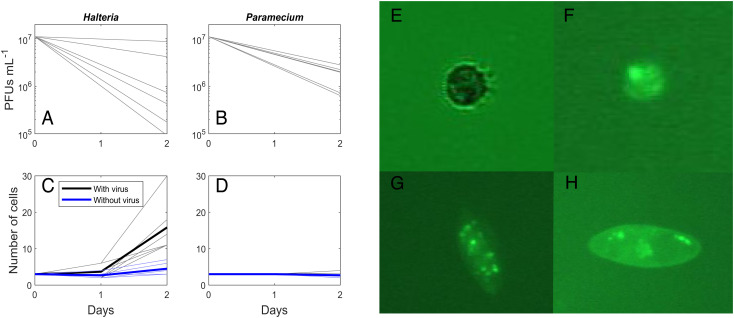
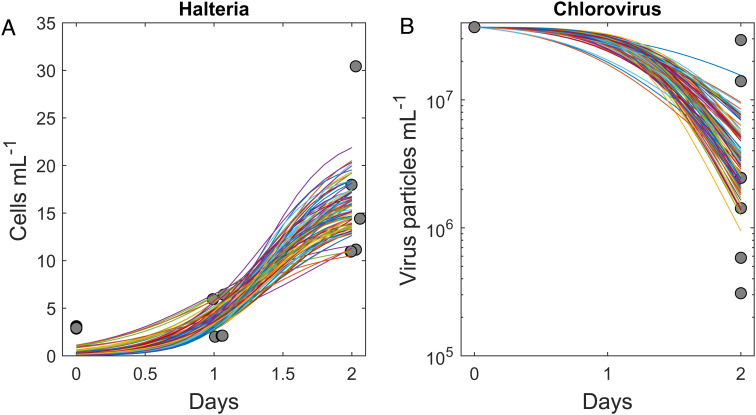
Viruses impact host cells and have indirect effects on ecosystem processes. Plankton such as ciliates can reduce the abundance of virions in water, but whether virus consumption translates into demographic consequences for the grazers is unknown. Here, we show that small protists not only can consume viruses they also can grow and divide given only viruses to eat. Moreover, the ciliate sp. foraging on chloroviruses displays dynamics and interaction parameters that are similar to other microbial trophic interactions. These results suggest that the effect of viruses on ecosystems extends beyond (and in contrast to) the viral shunt by redirecting energy up food chains.
病毒会对宿主细胞产生影响,并对生态系统过程产生间接影响。 纤毛虫等浮游生物可以减少水中病毒粒子的丰度,但病毒的消耗是否会对食草动物产生种群动态后果尚不清楚。 在这里,我们表明,小型原生动物不仅可以消耗病毒,而且在仅以病毒为食的情况下它们还可以生长和分裂。 此外,以噬藻体为食的纤毛虫表现出的动态和相互作用参数与其他微生物营养相互作用相似。 这些结果表明,病毒对生态系统的影响超出了(与)病毒分流通过将能量重新引导到食物链的范围。