Department of Psychiatry, National Health Insurance Service Ilsan Hospital, Goyang, Korea.
Institute of Behavioral Science in Medicine, Yonsei University College of Medicine, Seoul, South Korea.
PLoS One. 2022 Dec 28;17(12):e0279577. doi: 10.1371/journal.pone.0279577. eCollection 2022.
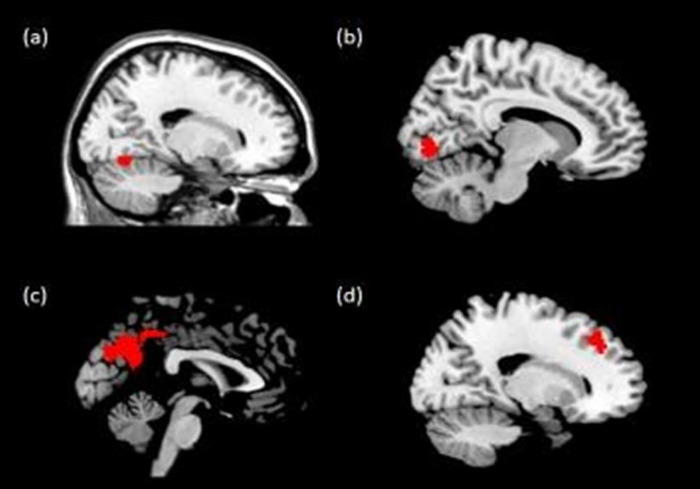
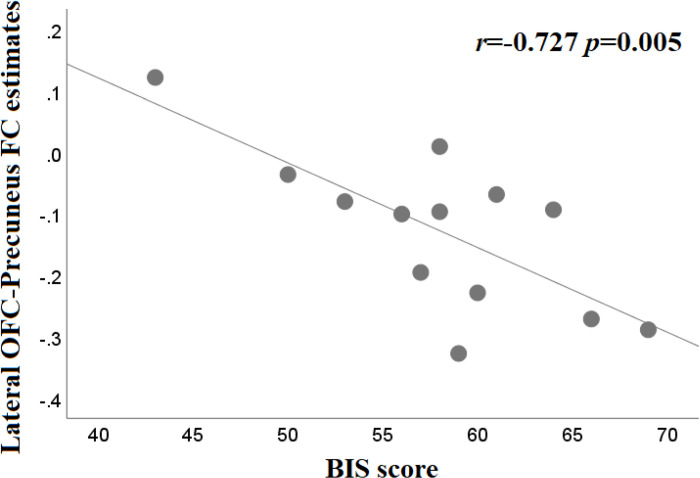
We aimed to define the shared and unshared functional neurobiological underpinnings of binge eating disorder (BED) and bulimia nervosa (BN). These disorders both involve loss of control over binge eating, but differ based on purging behavior and body image distortion. BED and BN have also been found to show differences in brain activation patterns in reward sensitivity. We enrolled 13 and 12 drug-naive and medication-free women with BED and BN, respectively, and 22 age- and sex-matched healthy controls. We performed an orbitofrontal cortex (OFC)-seeded resting-state whole brain functional connectivity (FC) analysis among the groups. In this study, BED patients exhibited significantly higher impulsivity than controls, whereas the difference in impulsivity between BN and controls was not significant. Participants with BED and BN showed weaker FC between the left lateral OFC and the right precuneus than controls. In the BED only group, the FC strength between these regions was negatively correlated with self-reported impulsivity. In both BED and BN, FC between the left lateral OFC and the right dorsolateral prefrontal cortex was weaker than that in controls. In BED, FC between the left medial OFC and the right cerebellar lobule IV was stronger than that of other groups. Our current results suggest similarities and differences between BED and BN in OFC-seeded FC with respect to reward processing. In particular, FC of the OFC in BED patients showed a significant correlation with their high impulsivity, which may reflect a decline in executive control over binge eating.
我们旨在定义暴食障碍(BED)和神经性贪食症(BN)共有的和特有的神经生物学基础。这两种疾病都涉及对暴食的失控,但由于清除行为和身体形象扭曲而有所不同。BED 和 BN 还被发现大脑在奖励敏感性方面的激活模式存在差异。我们分别招募了 13 名和 12 名未经药物治疗且未服用药物的 BED 和 BN 女性患者,以及 22 名年龄和性别匹配的健康对照者。我们在这些组之间进行了眶额皮层(OFC)种子静息状态全脑功能连接(FC)分析。在这项研究中,BED 患者表现出明显高于对照组的冲动性,而 BN 与对照组之间的冲动性差异不显著。与对照组相比,BED 和 BN 患者的左侧外侧 OFC 与右侧楔前叶之间的 FC 较弱。在仅 BED 组中,这些区域之间的 FC 强度与自我报告的冲动性呈负相关。在 BED 和 BN 中,左侧外侧 OFC 与右侧背外侧前额叶之间的 FC 弱于对照组。在 BED 中,左侧内侧 OFC 与右侧小脑小叶 IV 之间的 FC 强于其他组。我们目前的结果表明,BED 和 BN 在奖励处理方面的 OFC 种子 FC 具有相似性和差异性。特别是,BED 患者的 OFC 的 FC 与他们的高冲动性显著相关,这可能反映了对暴食的执行控制下降。