School of Psychology, University of Wollongong, Wollongong, New South Wales, Australia.
Illawarra Health and Medical Research Institute, University of Wollongong, Wollongong, New South Wales, Australia.
PLoS One. 2022 Dec 30;17(12):e0279015. doi: 10.1371/journal.pone.0279015. eCollection 2022.
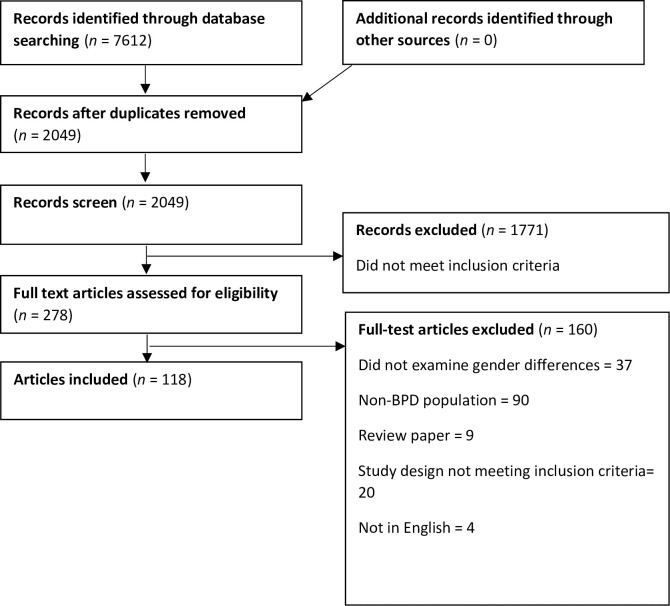
Borderline Personality Disorder (BPD) is often perceived to be a female-predominant disorder in both research and clinical contexts. Although there is growing recognition of possible sex differences, the current literature remains fragmented and inconclusive. This scoping review aimed to synthesize available research evidence on potential sex differences in BPD. PsycINFO, PubMed, Scopus and Web-of-Science were searched from January 1982 to July 2022 surrounding the key concepts of sex and BPD. Data searching and screening processes followed the Joanna Briggs Institute methodology involving two independent reviewers, and a third reviewer if necessary, and identified 118 papers. Data regarding BPD symptoms, comorbid disorders, developmental factors, biological markers, and treatment were extracted. Data was summarized using the vote counting method or narrative synthesis depending on the availability of literature. Males with BPD were more likely to present externalizing symptoms (e.g., aggressiveness) and comorbid disorders (e.g., substance use), while females with BPD were more likely to present internalizing symptoms (e.g., affective instability) and comorbid disorders (e.g., mood and eating disorders). This review also revealed that substantially more research attention has been given to overall sex differences in baseline BPD symptoms and comorbid disorders. In contrast, there is a dearth of sex-related research pertaining to treatment outcomes, developmental factors, and possible biological markers of BPD. The present scoping review synthesized current studies on sex differences in BPD, with males more likely to present with externalizing symptoms in contrast to females. However, how this might change the prognosis of the disorder or lead to modifications of treatment has not been investigated. Most studies were conducted on western populations, mainly North American (55%) or European (33%), and there is a need for future research to also take into consideration genetic, cultural, and environmental concomitants. As the biological construct of 'sex' was employed in the present review, future research could also investigate the social construct 'gender'. Longitudinal research designs are needed to understand any longer-term sex influence on the course of the disorder.
边缘型人格障碍(BPD)在研究和临床领域通常被认为是一种女性为主的疾病。尽管人们越来越认识到可能存在性别差异,但目前的文献仍然分散且没有定论。本范围综述旨在综合现有研究证据,探讨 BPD 中潜在的性别差异。我们在 1982 年 1 月至 2022 年 7 月期间,围绕性别和 BPD 的关键概念,在 PsycINFO、PubMed、Scopus 和 Web-of-Science 上进行了搜索。数据搜索和筛选过程遵循 Joanna Briggs 研究所的方法,涉及两名独立的审查员,如果需要,还会有第三名审查员,共确定了 118 篇论文。提取了与 BPD 症状、共病障碍、发育因素、生物标志物和治疗相关的数据。根据文献的可用性,使用投票计数法或叙述性综合法对数据进行总结。患有 BPD 的男性更有可能出现外化症状(例如,攻击性)和共病障碍(例如,物质使用障碍),而患有 BPD 的女性更有可能出现内化症状(例如,情感不稳定)和共病障碍(例如,心境和饮食障碍)。本综述还表明,更多的研究关注 BPD 患者在基线症状和共病障碍方面的总体性别差异。相比之下,与治疗结果、发育因素和 BPD 的可能生物学标志物相关的性别研究相对较少。本范围综述综合了当前关于 BPD 中性别差异的研究,结果表明男性更有可能出现外化症状,而女性则更有可能出现内化症状。然而,这如何改变疾病的预后或导致治疗的改变尚未得到研究。大多数研究都是在西方人群中进行的,主要是北美(55%)或欧洲(33%),因此需要进一步的研究来考虑遗传、文化和环境因素。由于本综述采用了“性别”的生物学概念,未来的研究也可以调查“性别”的社会概念。需要进行纵向研究设计,以了解性别对疾病进程的长期影响。