Im Nam-Gyu, Oh Kyung-Rok, Kim Min-Gil, Lee Young, Lim Na-Na, Cho Tae-Hwan, Ryu Su-Ra, Yoon Seo-Ra
Department of Rehabilitation Medicine, Gwangju Veterans Hospital, Gwangju, Korea.
Veterans Heath Service Medical Center, Seoul, Korea.
Ann Rehabil Med. 2022 Dec;46(6):275-283. doi: 10.5535/arm.22058. Epub 2022 Dec 31.
To investigate the effect of low frequency cerebellar repetitive transcranial magnetic stimulation (rTMS) on balance impairment in patients with cerebral infarction.
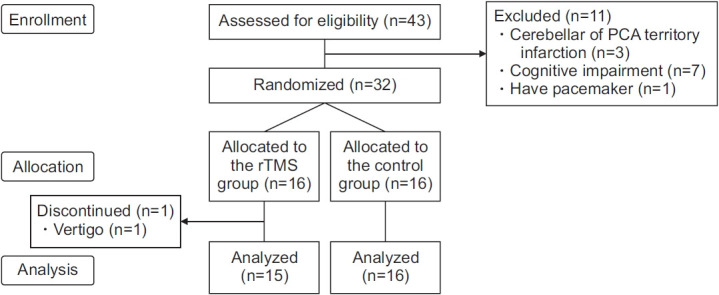
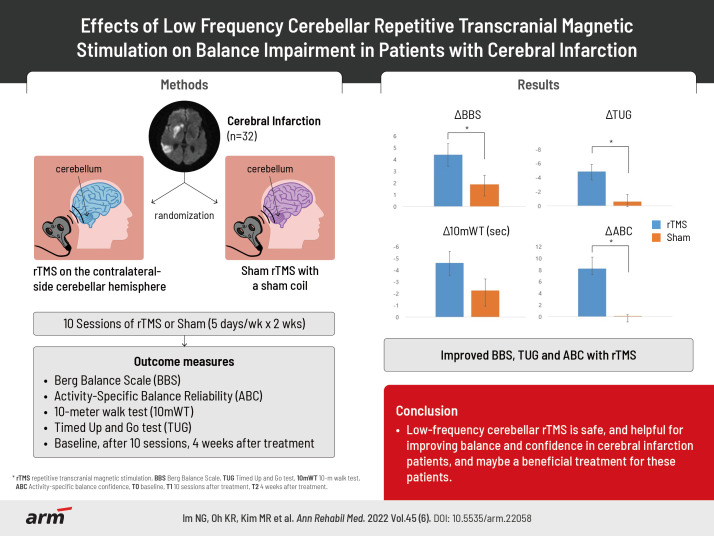
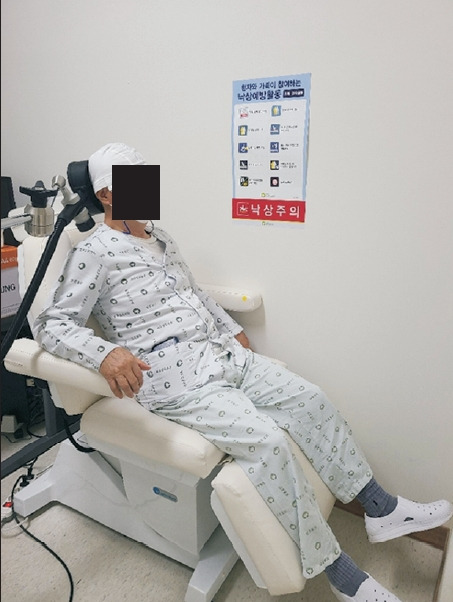
Thirty-two patients were randomly divided into two groups: rTMS group (n=16) and control (n=16). In the rTMS group, treatment was performed five times per week for 2 weeks (10 sessions), and in the control group, a sham coil was used with the sound and sensation of scalp similar to the rTMS coil. Patients in both groups underwent a conventional rehabilitation program. Berg Balance Scale (BBS) was used as the primary outcome measurement. Timed Up and Go test (TUG), 10-m walk test (10mWT), and Activity-specific Balance Confidence scale (ABC) were used as the secondary outcome measurement. All scales were measured at baseline (T0), after 10 sessions of rTMS (T1), and at 4 weeks after treatment completion (T2) by therapists with over 5 years of clinical experience.
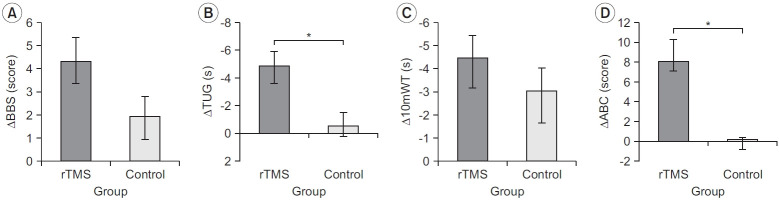
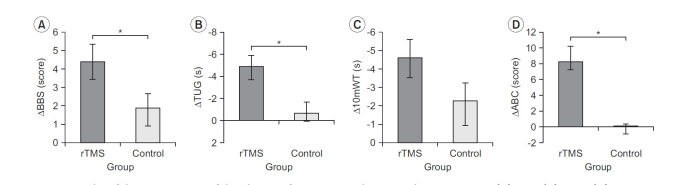
There were significant improvements between T0 and T1, and between T0 and T2, for all assessed items in the rTMS group. Whereas there were significant improvements between T0 and T1, and between T0 and T2, for the BBS and 10mWT in the control group. TUG (-4.87±5.05 vs. -0.50±2.97 seconds) and ABC score (8.10±8.33 vs. 0.16±0.97) were observed significant differences in comparison of the changes from T0 to T1 between the two group. BBS score (4.40±3.66 vs. 1.88±3.14), TUG (-4.87±4.56 vs. -0.62±2.96 seconds) and ABC score (8.22±7.70 vs. -0.09±0.86) differed significantly from T0 to T2 between the two groups.
Our findings suggest that low-frequency cerebellar rTMS is helpful for improving balance in patients with cerebral infarction, and maybe a beneficial treatment for these patients.
探讨低频小脑重复经颅磁刺激(rTMS)对脑梗死患者平衡功能障碍的影响。
将32例患者随机分为两组:rTMS组(n = 16)和对照组(n = 16)。rTMS组每周治疗5次,共2周(10次治疗),对照组使用伪线圈,其头皮的声音和感觉与rTMS线圈相似。两组患者均接受常规康复治疗。采用伯格平衡量表(BBS)作为主要疗效指标。采用定时起立行走测试(TUG)、10米步行测试(10mWT)和特定活动平衡信心量表(ABC)作为次要疗效指标。所有量表均由具有5年以上临床经验的治疗师在基线(T0)、rTMS治疗10次后(T1)和治疗结束后4周(T2)进行测量。
rTMS组所有评估项目在T0与T1之间以及T0与T2之间均有显著改善。而对照组的BBS和10mWT在T0与T1之间以及T0与T2之间有显著改善。两组在T0至T1的变化比较中,TUG(-4.87±5.05 vs. -0.50±2.97秒)和ABC评分(8.10±8.33 vs. 0.16±0.97)观察到显著差异。两组在T0至T2之间,BBS评分(4.40±3.66 vs. 1.88±3.14)、TUG(-4.87±4.56 vs. -0.62±2.96秒)和ABC评分(8.22±7.70 vs. -0.09±0.86)有显著差异。
我们的研究结果表明,低频小脑rTMS有助于改善脑梗死患者的平衡功能,可能是这些患者的一种有益治疗方法。