Dillon Hayley T, Foulkes Stephen, Horne-Okano Yuki A, Kliman David, Dunstan David W, Daly Robin M, Fraser Steve F, Avery Sharon, Kingwell Bronwyn A, La Gerche Andre, Howden Erin J
Clinical Research Domain, Baker Heart and Diabetes Institute, Melbourne, VIC, Australia.
Institute of Physical Activity and Nutrition, School of Exercise and Nutrition Sciences, Deakin University, Geelong, VIC, Australia.
Front Cardiovasc Med. 2022 Dec 15;9:926064. doi: 10.3389/fcvm.2022.926064. eCollection 2022.
Allogeneic hematopoietic cell transplantation (allo-HCT) offers a potential cure for high-risk hematological malignancy; however, long-term survivors experience increased cardiovascular morbidity and mortality. It is unclear how allo-HCT impacts cardiovascular function in the short-term. Thus, this 3-month prospective study sought to evaluate the short-term cardiovascular impact of allo-HCT in hematological cancer patients, compared to an age-matched non-cancer control group.
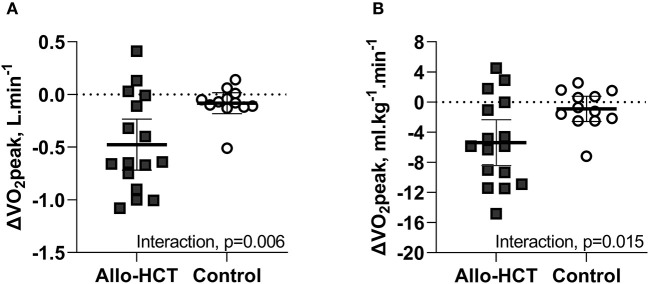
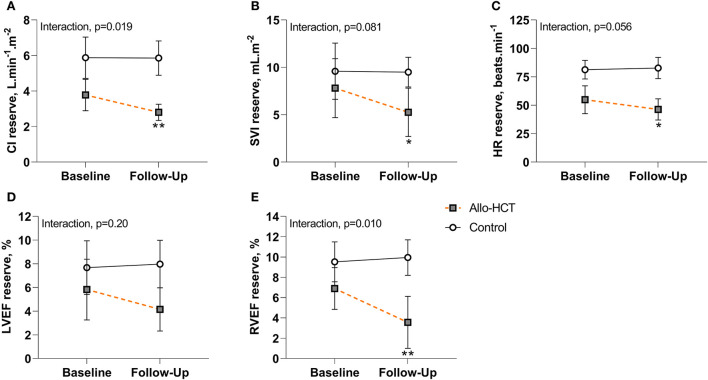
Before and ~3-months following allo-HCT, 17 hematological cancer patients (45 ± 18 years) underwent cardiopulmonary exercise testing to quantify peak oxygen uptake (VOpeak)-a measure of integrative cardiovascular function. Then, to determine the degree to which changes in VOpeak are mediated by cardiac vs. non-cardiac factors, participants underwent exercise cardiac MRI (cardiac reserve), resting echocardiography (left-ventricular ejection fraction [LVEF], global longitudinal strain [GLS]), dual-energy x-ray absorptiometry (lean [LM] and fat mass [FM]), blood pressure (BP) assessment, hemoglobin sampling, and arteriovenous oxygen difference (a-vOdiff) estimation the Fick equation. Twelve controls (43 ± 13 years) underwent identical testing at equivalent baseline and 3-month time intervals.
ignificant group-by-time interactions were observed for absolute VOpeak ( = 0.006), bodyweight-indexed VOpeak ( = 0.015), LM ( = 0.001) and cardiac reserve ( = 0.019), which were driven by 26, 24, 6, and 26% reductions in the allo-HCT group (all ≤ 0.001), respectively, as no significant changes were observed in the age-matched control group. No significant group-by-time interactions were observed for LVEF, GLS, FM, hemoglobin, BP or a-vOdiff, though a-vOdiff declined 12% in allo-HCT ( = 0.028).
In summary, allo-HCT severely impairs VOpeak, reflecting central and peripheral dysfunction. These results indicate allo-HCT rapidly accelerates cardiovascular aging and reinforces the need for early preventive cardiovascular intervention in this high-risk group.
异基因造血细胞移植(allo-HCT)为高危血液系统恶性肿瘤提供了潜在的治愈方法;然而,长期存活者的心血管发病率和死亡率有所增加。目前尚不清楚allo-HCT在短期内如何影响心血管功能。因此,这项为期3个月的前瞻性研究旨在评估allo-HCT对血液系统癌症患者的短期心血管影响,并与年龄匹配的非癌症对照组进行比较。
在allo-HCT前及术后约3个月,17例血液系统癌症患者(45±18岁)接受心肺运动测试,以量化峰值摄氧量(VOpeak)——一种综合心血管功能的指标。然后,为了确定VOpeak变化由心脏因素还是非心脏因素介导的程度,参与者接受了运动心脏磁共振成像(心脏储备)、静息超声心动图(左心室射血分数[LVEF]、整体纵向应变[GLS])、双能X线吸收法(瘦体重[LM]和脂肪量[FM])、血压(BP)评估、血红蛋白采样以及动静脉氧分压差(a-vOdiff)估计(采用Fick方程)。12名对照组(43±13岁)在相同的基线和3个月时间间隔接受相同的测试。
在绝对VOpeak(P = 0.006)、体重指数校正的VOpeak(P = 0.015)、LM(P = 0.001)和心脏储备(P = 0.019)方面观察到显著的组间时间交互作用,allo-HCT组分别下降了26%、24%、6%和26%(均P≤0.001),而年龄匹配的对照组未观察到显著变化。在LVEF、GLS、FM、血红蛋白、BP或a-vOdiff方面未观察到显著的组间时间交互作用,尽管allo-HCT组的a-vOdiff下降了12%(P = 0.028)。
总之,allo-HCT严重损害VOpeak,反映出中枢和外周功能障碍。这些结果表明allo-HCT迅速加速心血管衰老,并强化了对这一高危群体进行早期预防性心血管干预的必要性。