Chang Chun-Yu, Tu Yu-Kang, Kao Ming-Chang, Shih Ping-Cheng, Su I-Min, Lin Han-Yu, Chien Yung-Jiun, Wu Meng-Yu, Chen Chih-Hao, Chen Chu-Ting
Department of Anesthesiology, Taipei Tzu Chi Hospital, Buddhist Tzu Chi Medical Foundation, New Taipei City, Taiwan.
School of Medicine, Tzu Chi University, Hualien, Taiwan.
EClinicalMedicine. 2022 Dec 24;56:101787. doi: 10.1016/j.eclinm.2022.101787. eCollection 2023 Feb.
Post-caesarean section analgesia is important physiologically and psychologically for both mothers and infants. Patient-controlled analgesia is a well-established method of administering opioids for postoperative pain. However, to date, no study has systematically investigated the effects of opioids administered through intravenous patient-controlled analgesia (IVPCA) or patient-controlled epidural analgesia (PCEA) in parturients who have undergone caesarean section.
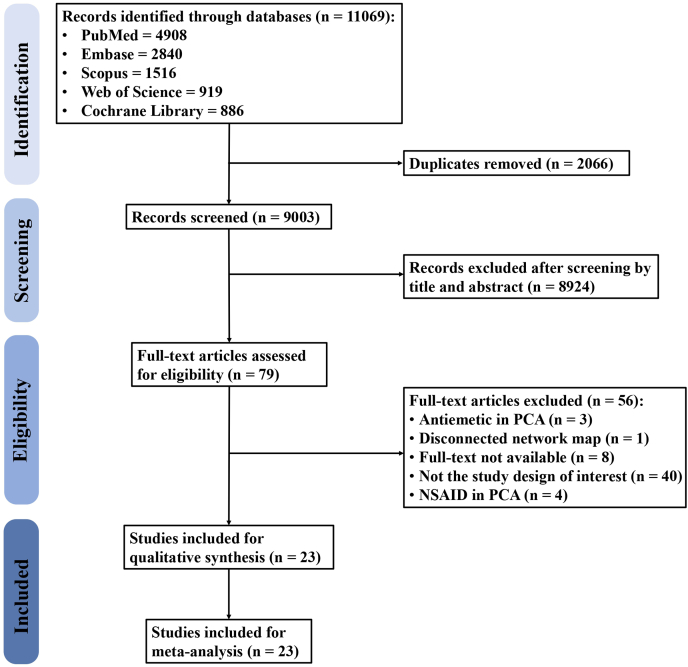
This systematic review and network meta-analysis aimed to evaluate the analgesic and adverse effects of opioids administered via IVPCA or PCEA in parturients who have undergone a caesarean section. PubMed, Embase, Scopus, Web of Science, and Cochrane Library were searched from inception through 02 10, 2022 for relevant records. Randomised controlled trials (RCTs) that compared opioids administered via IVPCA or PCEA and reported outcomes of interest were included. Studies were excluded if the solution for patient-controlled analgesia contained antiemetics and/or other analgesics in addition to opioids. The methodological quality of RCTs was assessed using the revised Cochrane Risk of Bias Tool. Summary data were extracted from each eligible study. The primary outcome was pain intensity, and the secondary outcomes were opioid-related adverse effects. Frequentist network meta-analyses were performed using a contrast-based random-effects model. This study is registered with PROSPERO, CRD42021254040.
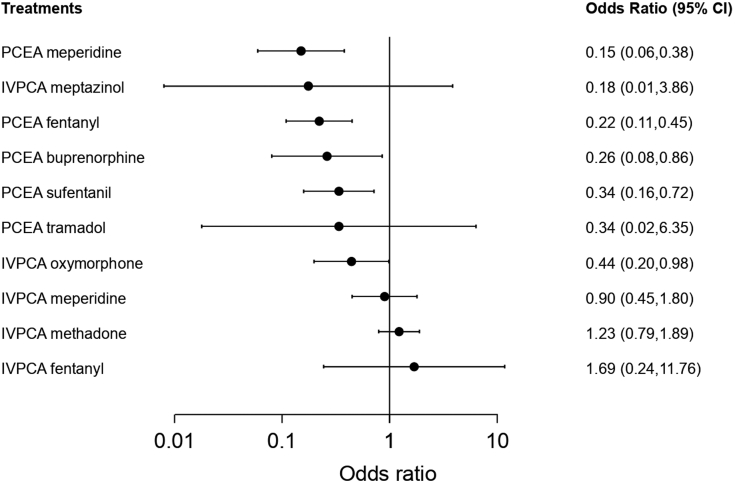
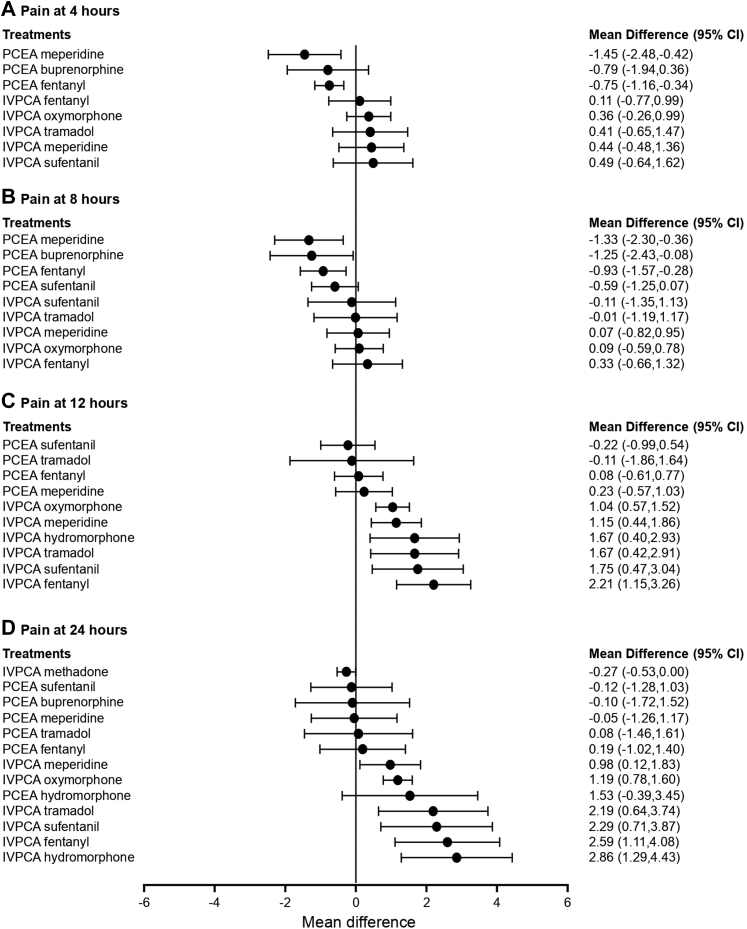
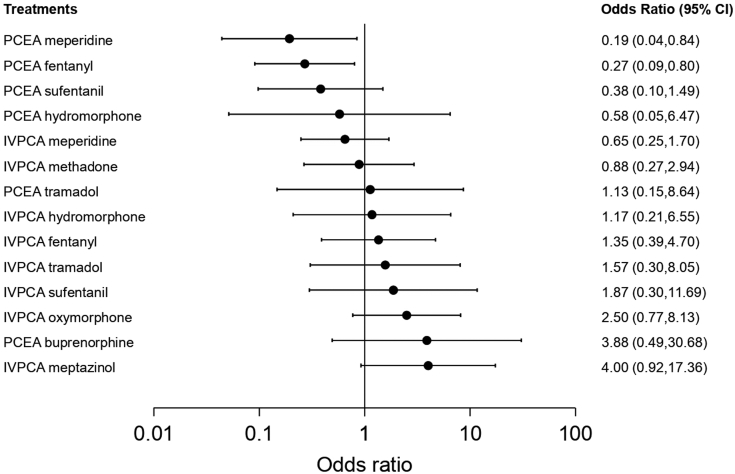
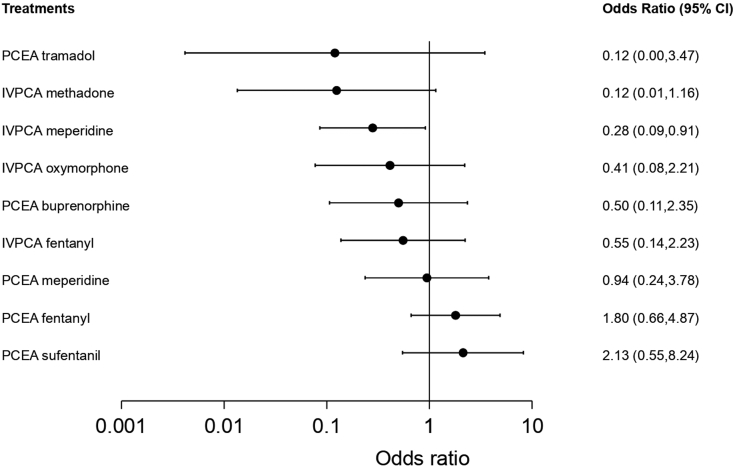
Twenty-three studies with 2589 parturients were included. Compared with IVPCA morphine as a reference treatment, PCEA fentanyl had better analgesic effects at 4 h (mean difference [MD] in the visual analogue scale score, -0.75; 95% confidence interval [CI] [-1.16, -0.34]) and 8 h (MD, -0.93; 95% CI [-1.57, -0.28]) and yielded lower odds of developing nausea/vomiting (odds ratio [OR], 0.27; 95% CI [0.09, 0.80]) and sedation/drowsiness (OR, 0.22; 95% CI [0.11, 0.45]). However, PCEA fentanyl may be more likely to cause pruritus than IVPCA treatments.
Considering the analgesic efficacy; opioid-induced nausea, vomiting, and sedation; and the well-being of breastfed infants, PCEA fentanyl may be the treatment of choice for post-caesarean section analgesia.
The Taipei Tzu Chi Hospital, Buddhist Tzu Chi Medical Foundation (TCRD-TPE-111-27).
剖宫产术后镇痛对母亲和婴儿在生理和心理方面都很重要。患者自控镇痛是一种成熟的术后疼痛阿片类药物给药方法。然而,迄今为止,尚无研究系统调查静脉自控镇痛(IVPCA)或硬膜外自控镇痛(PCEA)给予阿片类药物对剖宫产产妇的影响。
本系统评价和网状Meta分析旨在评估IVPCA或PCEA给予阿片类药物对剖宫产产妇的镇痛效果和不良反应。从数据库建库至2022年10月2日,检索了PubMed、Embase、Scopus、Web of Science和Cochrane图书馆以获取相关记录。纳入比较IVPCA或PCEA给予阿片类药物并报告感兴趣结局的随机对照试验(RCT)。如果患者自控镇痛溶液除阿片类药物外还含有止吐药和/或其他镇痛药,则排除该研究。使用修订的Cochrane偏倚风险工具评估RCT的方法学质量。从每项符合条件的研究中提取汇总数据。主要结局是疼痛强度,次要结局是阿片类药物相关不良反应。使用基于对比的随机效应模型进行频率学派网状Meta分析。本研究已在PROSPERO注册,注册号为CRD42021254040。
纳入23项研究,共2589名产妇。与以IVPCA吗啡作为对照治疗相比,PCEA芬太尼在4小时(视觉模拟量表评分的平均差[MD]为-0.75;95%置信区间[CI][-1.16,-0.34])和8小时(MD为-0.93;95%CI[-1.57,-0.28])时具有更好的镇痛效果,且发生恶心/呕吐(比值比[OR]为0.27;95%CI[0.09,0.80])和镇静/嗜睡(OR为0.22;95%CI[0.11,0.45])的几率更低。然而,PCEA芬太尼可能比IVPCA治疗更易引起瘙痒。
考虑到镇痛效果、阿片类药物引起的恶心、呕吐和镇静以及母乳喂养婴儿的健康状况,PCEA芬太尼可能是剖宫产术后镇痛的首选治疗方法。
佛教慈济医疗基金会台北慈济医院(TCRD-TPE-111-27)。