Suárez-Vega Aroa, Gutiérrez-Gil Beatriz, Toral Pablo G, Frutos Pilar, Loor Juan J, Arranz Juan-José, Hervás Gonzalo
Departamento de Producción Animal, Facultad de Veterinaria, Universidad de León, León, Spain.
Instituto de Ganadería de Montaña (CSIC-Universidad de León), León, Spain.
Front Vet Sci. 2022 Dec 15;9:1037764. doi: 10.3389/fvets.2022.1037764. eCollection 2022.
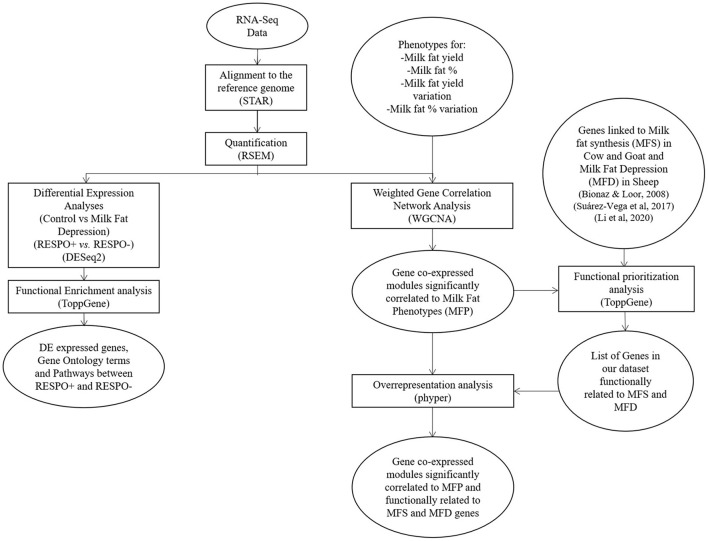
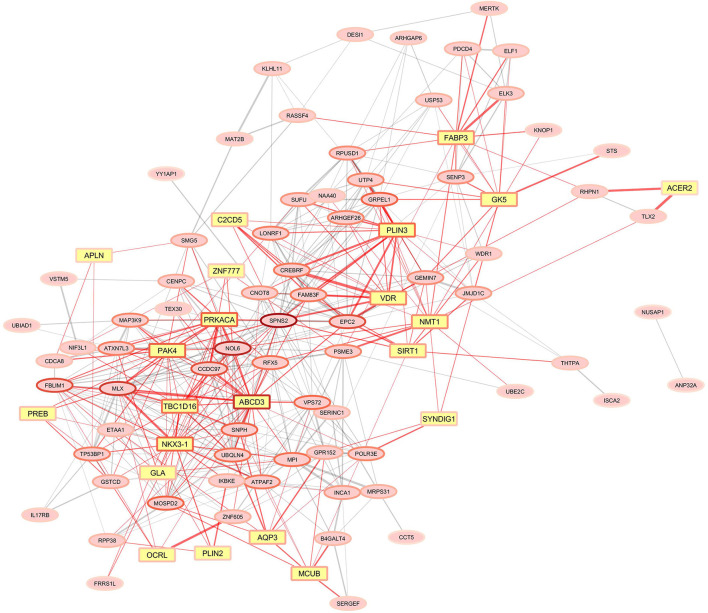
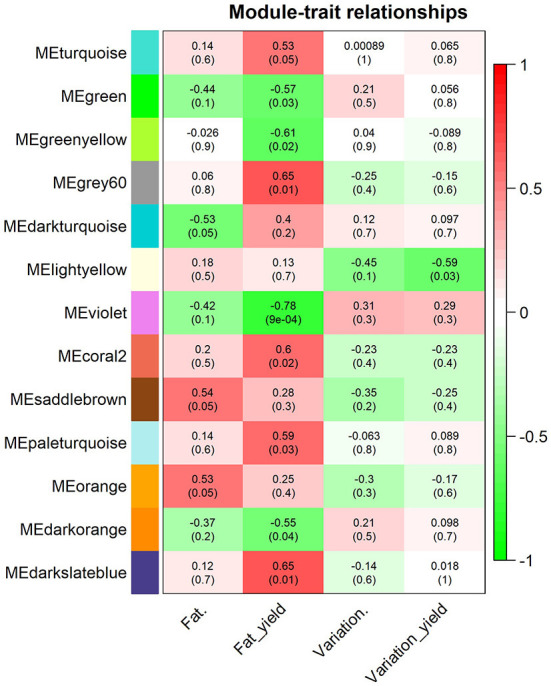
Dietary supplementation with marine lipids modulates ruminant milk composition toward a healthier fatty acid profile for consumers, but it also causes milk fat depression (MFD). Because the dairy goat industry is mainly oriented toward cheese manufacturing, MFD can elicit economic losses. There is large individual variation in animal susceptibility with goats more (RESPO+) or less (RESPO-) responsive to diet-induced MFD. Thus, we used RNA-Seq to examine gene expression profiles in mammary cells to elucidate mechanisms underlying MFD in goats and individual variation in the extent of diet-induced MFD. Differentially expression analyses (DEA) and weighted gene co-expression network analysis (WGCNA) of RNA-Seq data were used to study milk somatic cell transcriptome changes in goats consuming a diet supplemented with marine lipids. There were 45 differentially expressed genes (DEGs) between control (no-MFD, before diet-induced MFD) and MFD, and 18 between RESPO+ and RESPO-. Biological processes and pathways such as "RNA transcription" and "Chromatin modifying enzymes" were downregulated in MFD compared with controls. Regarding susceptibility to diet-induced MFD, we identified the "Triglyceride Biosynthesis" pathway upregulated in RESPO- goats. The WGCNA approach identified 9 significant functional modules related to milk fat production and one module to the fat yield decrease in diet-induced MFD. The onset of MFD in dairy goats is influenced by the downregulation of , other transcription factors and chromatin-modifying enzymes. A list of DEGs between RESPO+ and RESPO- goats (e.g., and ), and a co-related gene network linked to the decrease in milk fat (, and ) was uncovered. Results suggest that alterations in fatty acid transport may play an important role in determining individual variation. These candidate genes should be further investigated.
用海洋脂质进行膳食补充可调节反刍动物乳汁成分,使其脂肪酸谱对消费者而言更健康,但同时也会导致乳脂率下降(MFD)。由于奶山羊产业主要面向奶酪生产,乳脂率下降会引发经济损失。动物对饮食诱导的乳脂率下降的易感性存在很大的个体差异,有些山羊(RESPO+)对饮食诱导的乳脂率下降反应较大,而有些山羊(RESPO-)反应较小。因此,我们使用RNA测序来检测乳腺细胞中的基因表达谱,以阐明奶山羊乳脂率下降的潜在机制以及饮食诱导的乳脂率下降程度的个体差异。对RNA测序数据进行差异表达分析(DEA)和加权基因共表达网络分析(WGCNA),以研究食用添加海洋脂质日粮的奶山羊乳体细胞转录组变化。在对照(无MFD,饮食诱导的MFD之前)和MFD之间有45个差异表达基因(DEG),在RESPO+和RESPO-之间有18个差异表达基因。与对照相比,“RNA转录”和“染色质修饰酶”等生物学过程和途径在MFD中下调。关于对饮食诱导的MFD的易感性,我们发现“甘油三酯生物合成”途径在RESPO-山羊中上调。WGCNA方法确定了9个与乳脂产生相关的重要功能模块和1个与饮食诱导的MFD中脂肪产量下降相关的模块。奶山羊MFD的发生受其他转录因子和染色质修饰酶下调的影响。发现了RESPO+和RESPO-山羊之间的差异表达基因列表(例如,和),以及与乳脂减少相关的共相关基因网络(,和)。结果表明,脂肪酸转运的改变可能在决定个体差异中起重要作用。这些候选基因应进一步研究。