Ekinci Meliha, Dos Santos Clenilton Costa, Alencar Luciana Magalhães Rebelo, Akbaba Hasan, Santos-Oliveira Ralph, Ilem-Ozdemir Derya
Faculty of Pharmacy, Department of Radiopharmacy, Ege University, Bornova, 35040 Izmir, Turkiye.
Department of Physics, Federal University of Maranhão, São Luis 65080-805, Maranhão, Brazil.
ACS Omega. 2022 Dec 12;7(51):47956-47966. doi: 10.1021/acsomega.2c05834. eCollection 2022 Dec 27.
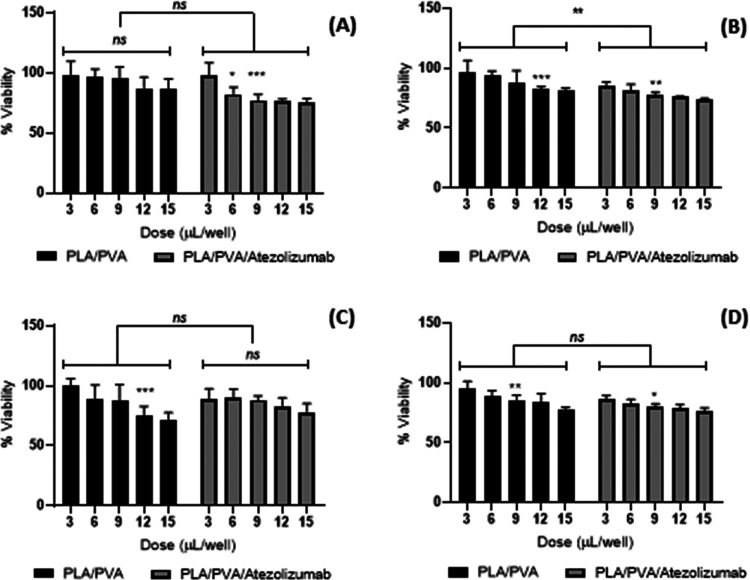
The necessity of new drugs for lung cancer therapy and imaging is increasing each day. The development of new drugs that are capable of reaching the tumor with specificity and selectivity is required. In this direction, the design of nanoparticles for tumor therapy represents an important alternative. The aim of this study was to develop, characterize, and evaluate target-specific atezolizumab-conjugated poly(lactic acid)/poly(vinyl alcohol) (PLA/PVA) nanoparticles as pharmaceutical fragment candidates for new radiopharmaceuticals. For this purpose, PLA/PVA nanoparticle formulations were prepared by the double emulsification/solvent evaporation method with a high-speed homogenizer. A special focus was oriented to the selection of a suitable method for modification of the nanoparticle surface with a monoclonal antibody. For this purpose, atezolizumab was bound to the nanoparticles during the preparation by solvent evaporation or either by adsorption or covalent binding. PLA/PVA/atezolizumab nanoparticles are characterized by dynamic light scattering, Raman spectroscopy, scanning electron microscopy, and atomic force microscopy. An assay was performed to evaluate the antibody binding efficiency, stability, and cytotoxicity [A549 (lung cancer cell) and L929 (healthy fibroblast cell)]. The results showed that a spherical nanoparticle with a size of 230.6 ± 1.768 nm and a ζ potential of -2.23 ± 0.55 mV was produced. Raman spectroscopy demonstrated that the monoclonal antibody was entrapped in the nanoparticle. The high antibody binding efficiency (80.58%) demonstrated the efficacy of the nanosystem. The cytotoxic assay demonstrated the safety of the nanoparticle in L929 and the effect on A549. In conclusion, PLA/PVA/atezolizumab nanoparticles can be used as drug delivery systems for lung cancer diagnosis and therapy.
肺癌治疗和成像对新药的需求与日俱增。开发能够特异性和选择性地抵达肿瘤的新药成为必要。在此方向上,用于肿瘤治疗的纳米颗粒设计是一个重要的选择。本研究的目的是开发、表征和评估靶向特异性阿替利珠单抗偶联聚乳酸/聚乙烯醇(PLA/PVA)纳米颗粒,作为新型放射性药物的候选药物片段。为此,采用高速匀浆器通过双乳化/溶剂蒸发法制备了PLA/PVA纳米颗粒制剂。特别关注选择一种合适的方法,用单克隆抗体修饰纳米颗粒表面。为此,在制备过程中,通过溶剂蒸发或吸附或共价结合将阿替利珠单抗与纳米颗粒结合。通过动态光散射、拉曼光谱、扫描电子显微镜和原子力显微镜对PLA/PVA/阿替利珠单抗纳米颗粒进行表征。进行了一项测定以评估抗体结合效率、稳定性和细胞毒性[A549(肺癌细胞)和L929(健康成纤维细胞)]。结果显示制备出了尺寸为230.6±1.768 nm、ζ电位为-2.23±0.55 mV的球形纳米颗粒。拉曼光谱表明单克隆抗体被包裹在纳米颗粒中。高抗体结合效率(80.58%)证明了该纳米系统的有效性。细胞毒性测定证明了纳米颗粒对L929的安全性以及对A549的作用。总之,PLA/PVA/阿替利珠单抗纳米颗粒可作为肺癌诊断和治疗的药物递送系统。