Graduate School of Hebei North University, Zhangjiakou, Hebei Province, China.
Department of Reproductive and Genetics, Hebei General Hospital, Shijiazhuang, Hebei Province, China.
Medicine (Baltimore). 2022 Dec 30;101(52):e32405. doi: 10.1097/MD.0000000000032405.
Although assisted reproductive technology (ART) is extensively used in couples with fertility problems, the risk of birth defects among infants conceived with ART is still a concern. Therefore, to more accurately assess the risk of birth defects after ART treatment, we performed a meta-analysis of all available cohort studies relating to birth defects among infants conceived with ART.
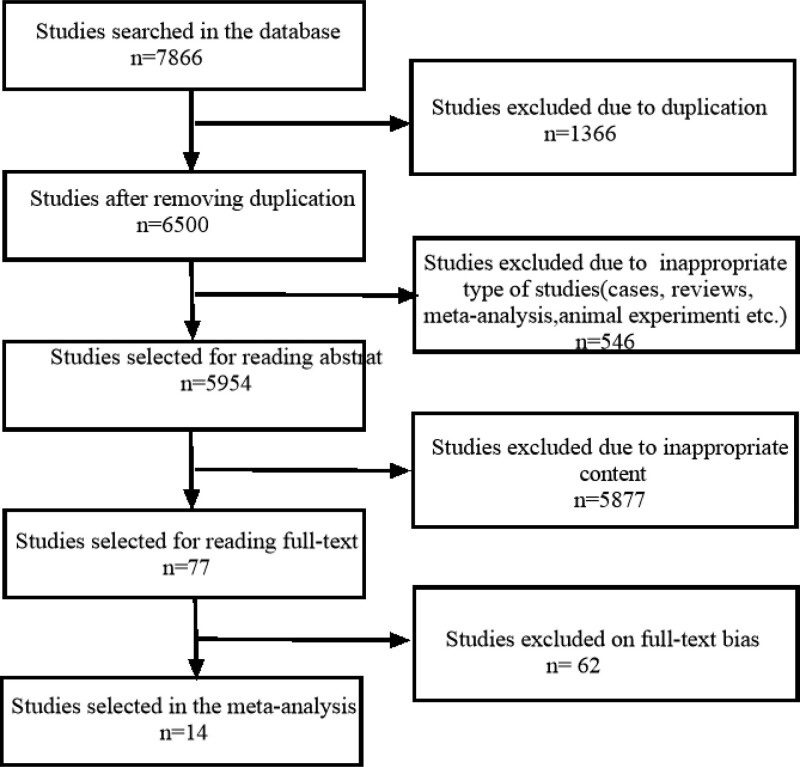
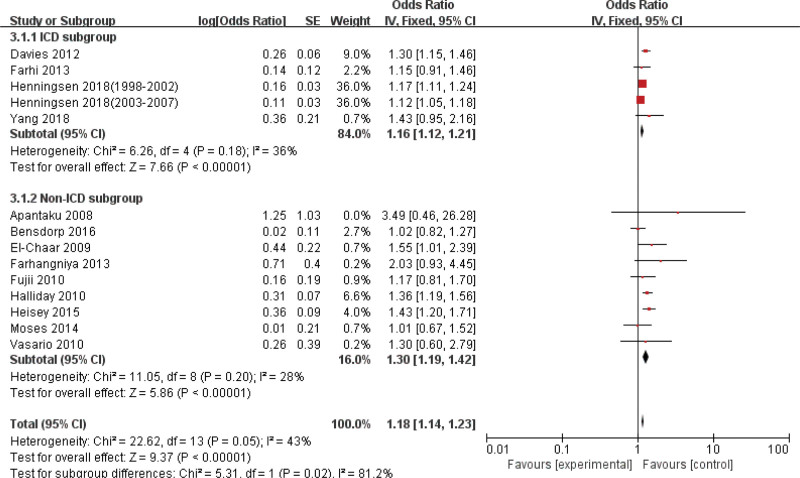
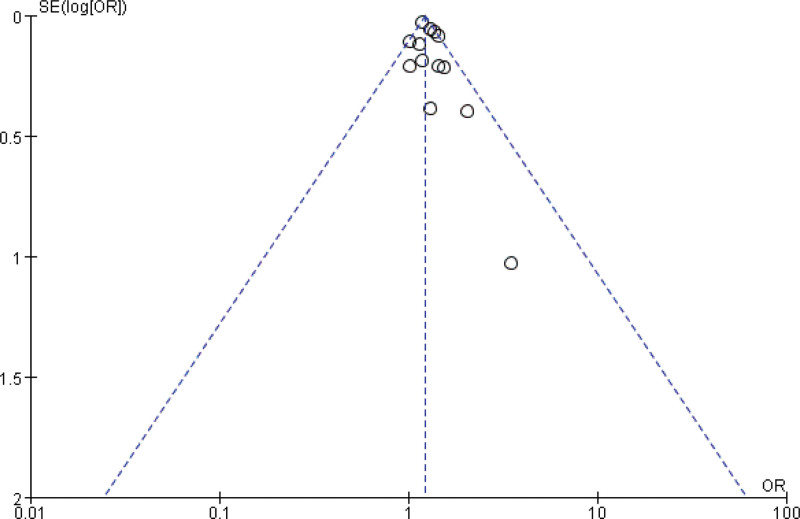
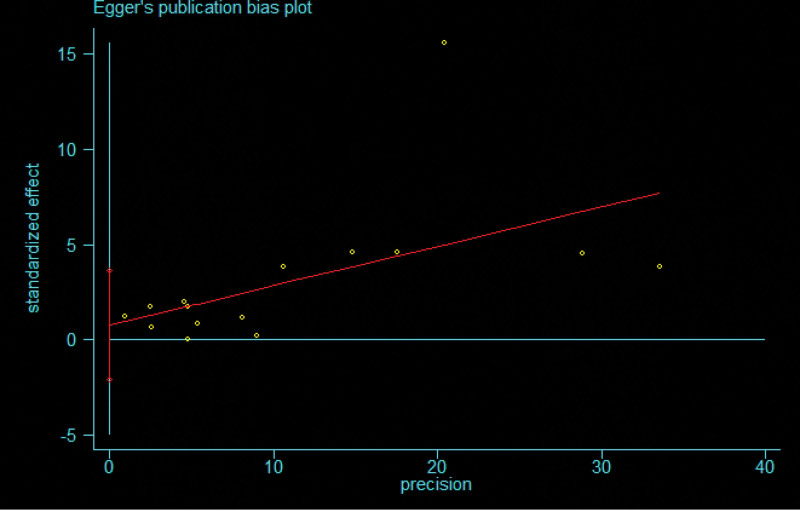
We used an established strategy to search the databases of PUBMED, EMBASE, COCHRANE, WEB OF SCIENCE, CNKI, CBM and VIP for studies published between 2008 and 2020. Subgroup analyses and sensitivity analyses were used to examine sources of heterogeneity. Pooled adjusted odds ratios (ORs) were calculated using a fixed effects model. RevMan5.3 was used to draw a forest plot, and Stata14.0 was used to test for publication bias.
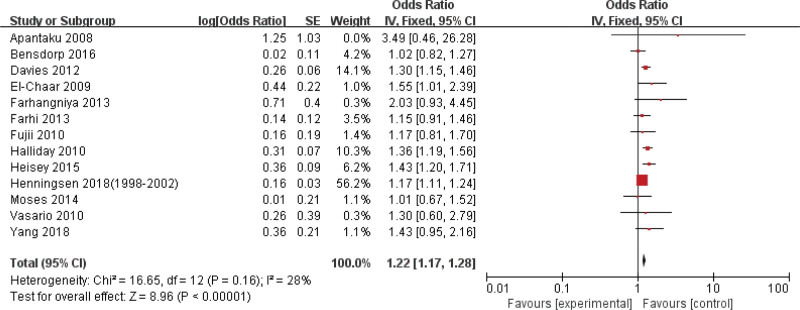
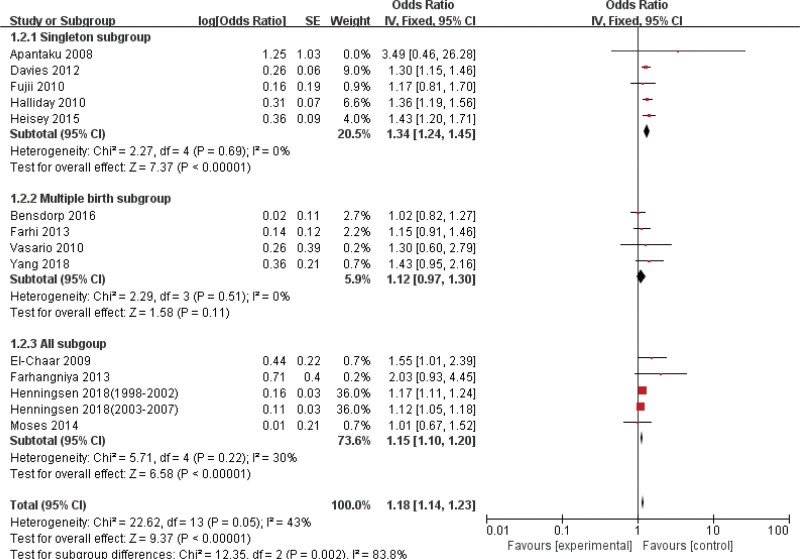
We included 14 cohort studies from different countries. The infants conceived with ART had a 1.22-fold higher likelihood of birth defects than children born after natural pregnancy(OR = 1.22, 95% CI [1.17, 1.28], P < .05). The prevalence of birth defects after ART treatment was higher in singleton births than in multiple births. In a meta-analysis of data from 6 studies, we found associations between ART and birth defects related to specifics organs: cardiovascular defects, OR = 1.51, 95% CI [1.34-1.69], P < .05; musculoskeletal defects, OR = 1.09, 95% CI [1.03-1.15], P < .05; urogenital defects, OR = 1.24, 95% CI [1.11-1.38], P < .05; central nervous system defects, OR = 1.33, 95% CI [1.14-1.55], P < .05; and orofacial defects, OR = 1.45, 95% CI [1.15-1.83], P < .05.
ART treatment does present an increased risk of birth defects. The prevalence of birth defects after ART treatment is lower in multiple births than in singleton births. Further research is required to examine the risks for birth defects after ART treatment.
尽管辅助生殖技术(ART)在有生育问题的夫妇中广泛应用,但通过 ART 受孕的婴儿出生缺陷的风险仍然令人担忧。因此,为了更准确地评估 ART 治疗后出生缺陷的风险,我们对所有与 ART 受孕婴儿出生缺陷相关的队列研究进行了荟萃分析。
我们使用一种既定的策略,在 2008 年至 2020 年期间,在 PUBMED、EMBASE、COCHRANE、WEB OF SCIENCE、CNKI、CBM 和 VIP 数据库中搜索研究。使用亚组分析和敏感性分析来检查异质性的来源。使用固定效应模型计算合并调整后的比值比(OR)。使用 RevMan5.3 绘制森林图,使用 Stata14.0 检验发表偏倚。
我们纳入了来自不同国家的 14 项队列研究。与自然受孕的婴儿相比,通过 ART 受孕的婴儿出生缺陷的可能性高 1.22 倍(OR=1.22,95%CI[1.17,1.28],P<0.05)。ART 治疗后,单胎出生的婴儿出生缺陷的发生率高于多胎出生。对 6 项研究的数据进行荟萃分析后,我们发现 ART 与特定器官的出生缺陷之间存在关联:心血管缺陷,OR=1.51,95%CI[1.34-1.69],P<0.05;肌肉骨骼缺陷,OR=1.09,95%CI[1.03-1.15],P<0.05;泌尿生殖系统缺陷,OR=1.24,95%CI[1.11-1.38],P<0.05;中枢神经系统缺陷,OR=1.33,95%CI[1.14-1.55],P<0.05;和口腔面部缺陷,OR=1.45,95%CI[1.15-1.83],P<0.05。
ART 治疗确实会增加出生缺陷的风险。ART 治疗后多胎出生的婴儿出生缺陷的发生率低于单胎出生。需要进一步研究 ART 治疗后出生缺陷的风险。