Artie McFerrin Department of Chemical Engineering, Texas A&M University, College Station, Texas, USA.
Department of Chemical Engineering, University of Michigan, Ann Arbor, Michigan, USA.
mBio. 2023 Feb 28;14(1):e0238422. doi: 10.1128/mbio.02384-22. Epub 2023 Jan 4.
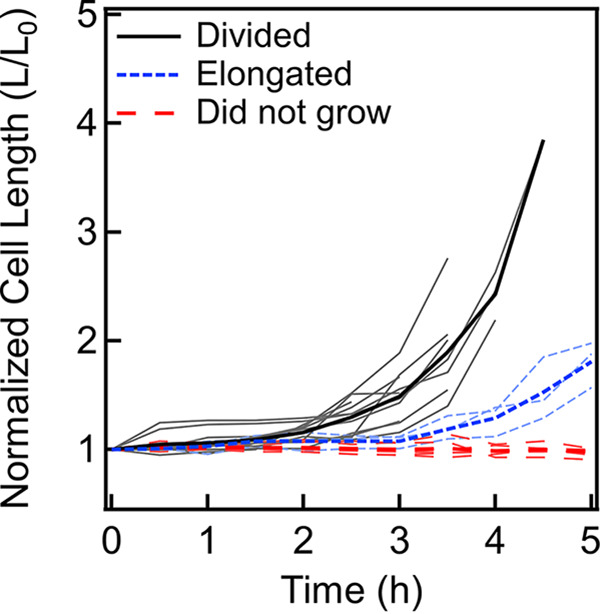
Bacterial infections that are difficult to eradicate are often treated by sequentially exposing the bacteria to different antibiotics. Although effective, this approach can give rise to epigenetic or other phenomena that may help some cells adapt to and tolerate the antibiotics. Characteristics of such adapted cells are dormancy and low energy levels, which promote survival without lending long-term genetic resistance against antibiotics. In this work, we quantified motility in cells of Escherichia coli that adapted and survived sequential exposure to lethal doses of antibiotics. In populations that adapted to transcriptional inhibition by rifampicin, we observed that ~1 of 3 cells continued swimming for several hours in the presence of lethal concentrations of ampicillin. As motility is powered by proton motive force (PMF), our results suggested that many adapted cells retained a high PMF. Single-cell growth assays revealed that the high-PMF cells resuscitated and divided upon the removal of ampicillin, just as the low-PMF cells did, a behavior reminiscent of persister cells. Our results are consistent with the notion that cells in a clonal population may employ multiple different mechanisms to adapt to antibiotic stresses. Variable PMF is likely a feature of a bet-hedging strategy: a fraction of the adapted cell population lies dormant while the other fraction retains high PMF to be able to swim out of the deleterious environment. Bacterial cells with low PMF may survive antibiotic stress due to dormancy, which favors nonheritable resistance without genetic mutations or acquisitions. On the other hand, cells with high PMF are less tolerant, as PMF helps in the uptake of certain antibiotics. Here, we quantified flagellar motility as an indirect measure of the PMF in cells of Escherichia coli that had adapted to ampicillin. Despite the disadvantage of maintaining a high PMF in the presence of antibiotics, we observed high PMF in ~30% of the cells, as evidenced by their ability to swim rapidly for several hours. These and other results were consistent with the idea that antibiotic tolerance can arise via different mechanisms in a clonal population.
难以根除的细菌感染通常通过依次暴露细菌于不同的抗生素来治疗。虽然有效,但这种方法可能会引起表观遗传或其他现象,使一些细胞能够适应和耐受抗生素。适应细胞的特征是休眠和低能量水平,这促进了生存,而不会长期产生对抗生素的遗传抗性。在这项工作中,我们量化了适应并在连续暴露于致死剂量抗生素后存活的大肠杆菌细胞的运动能力。在适应利福平转录抑制的群体中,我们观察到约 1/3 的细胞在存在致死浓度氨苄青霉素的情况下继续游动数小时。由于运动是由质子动力势(PMF)驱动的,我们的结果表明,许多适应细胞保留了高 PMF。单细胞生长测定显示,高 PMF 细胞在去除氨苄青霉素后复苏并分裂,就像低 PMF 细胞一样,这种行为类似于持久细胞。我们的结果与这样一种观点一致,即克隆群体中的细胞可能采用多种不同的机制来适应抗生素应激。可变 PMF 可能是一种赌注分散策略的特征:适应细胞群体的一部分处于休眠状态,而另一部分保留高 PMF 以能够游出有害环境。PMF 较低的细菌细胞可能由于休眠而在抗生素应激下存活,这有利于非遗传性耐药性,而无需基因突变或获得。另一方面,具有高 PMF 的细胞耐受性较低,因为 PMF 有助于某些抗生素的摄取。在这里,我们量化了适应氨苄青霉素的大肠杆菌细胞的鞭毛运动,作为 PMF 的间接测量。尽管在存在抗生素的情况下维持高 PMF 存在劣势,但我们观察到约 30%的细胞具有高 PMF,这表明它们能够快速游动数小时。这些和其他结果与这样一种观点一致,即在克隆群体中,抗生素耐受性可以通过不同的机制产生。