Banothu Kiran Kumar, Sankar Jhuma, Kumar U Vijaya, Gupta Priyanka, Pathak Mona, Jat Kana Ram, Kabra Sushil Kumar, Lodha Rakesh
Department of Pediatrics, All India Institute of Medical Sciences, New Delhi, India.
Research & Development Department, Kalinga Institute of Medical Sciences, Bhubaneswar, India.
Crit Care Explor. 2022 Dec 28;5(1):e0815. doi: 10.1097/CCE.0000000000000815. eCollection 2023 Jan.
Our objective was to compare norepinephrine plus dobutamine versus epinephrine as the first-line agent in children with fluid refractory cold septic shock.
Open-label randomized controlled study.
A single-center PICU from North India.
Children 2 months to less than 18 years old with fluid refractory cold septic shock.
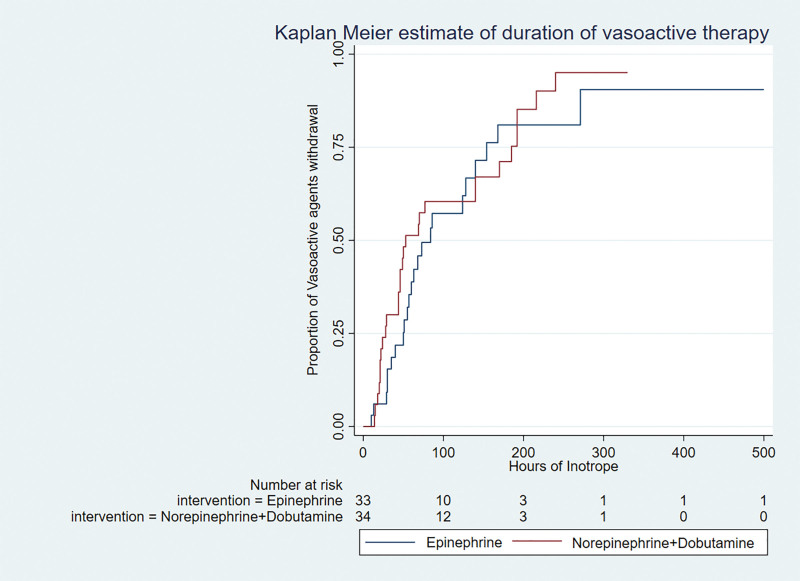
In the intervention group, norepinephrine and dobutamine were started and in the control group, epinephrine was started as the first-line vasoactive agent. The primary outcome was the proportion attaining shock resolution (attaining all the therapeutic endpoints) at 1 hour of therapy.
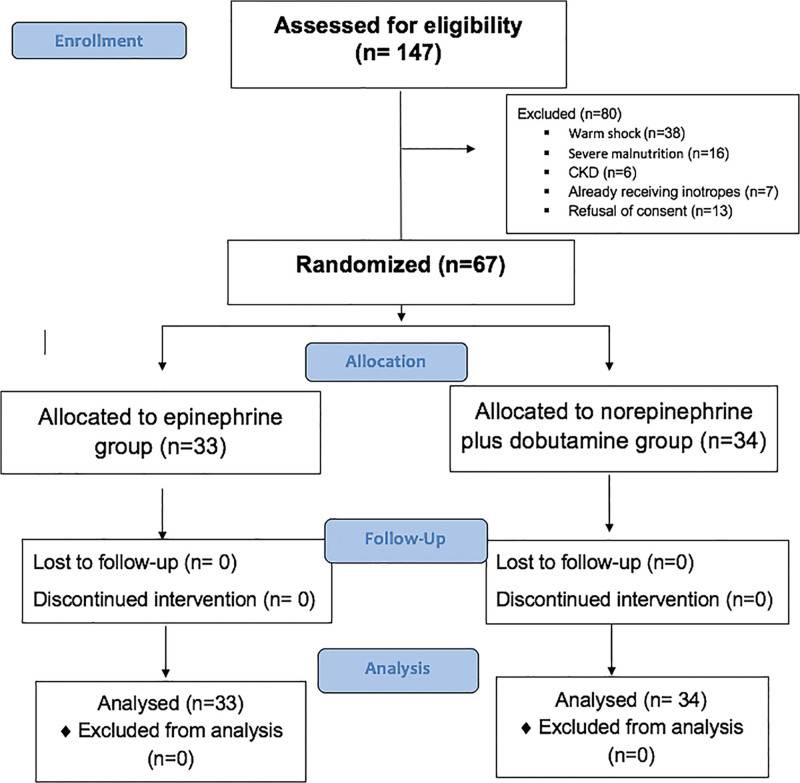
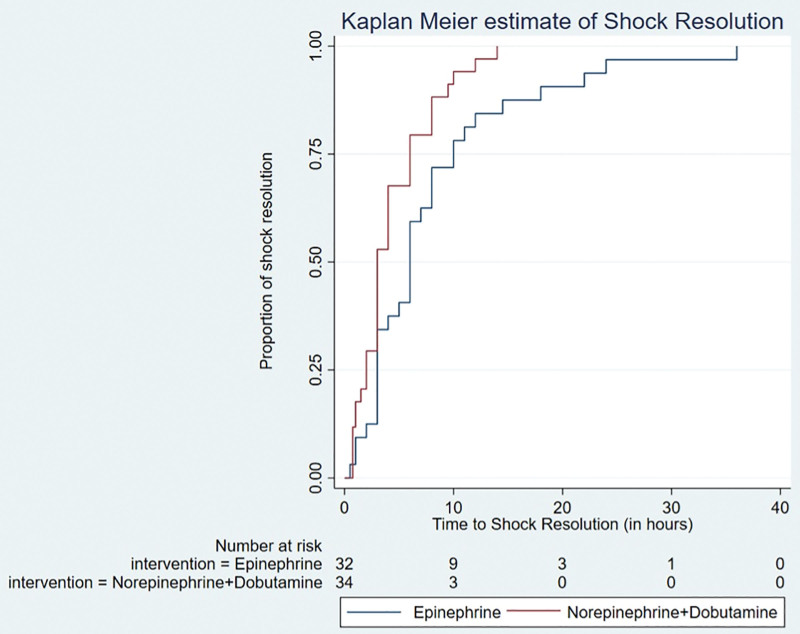
We enrolled 67 children: 34 in the norepinephrine plus dobutamine group (intervention) and 33 in the epinephrine group (control). There was no difference in shock resolution at 1 hour (17.6% vs 9%; risk ratio [RR], 2.0; 95% CI, 0.54-7.35; = 0.25), 6 hours (76.4% vs 54.5%; RR, 1.69; 95% CI, 0.92-3.13; = 0.06), and 24 hours between the intervention and control groups, respectively. Children in the norepinephrine plus dobutamine group attained shock resolution earlier (measured from starting of vasoactive agents to attaining all the therapeutic endpoints) (hazard ratio, 1.84 [1.1-3.08]). The difference in 28-day mortality was not significant (23.5% vs 39.3% in the intervention and control groups, respectively [RR, 0.59; 95% CI, 0.28-1.25]).
In children with fluid refractory cold septic shock, with use of norepinephrine plus dobutamine as first-line agents, the difference in the proportion of children attaining shock resolution at 1 hour between the groups was inconclusive. However, the time to shock resolution was earlier in the norepinephrine plus dobutamine group. Also, fewer children in the intervention group were refractory to treatment. Further studies powered to detect (or exclude) an important difference would be required to test this intervention.
我们的目的是比较去甲肾上腺素联合多巴酚丁胺与肾上腺素作为液体难治性冷休克儿童的一线用药。
开放标签随机对照研究。
印度北部的一家单中心儿科重症监护病房。
年龄在2个月至18岁以下的液体难治性冷休克儿童。
干预组开始使用去甲肾上腺素和多巴酚丁胺,对照组开始使用肾上腺素作为一线血管活性药物。主要结局是治疗1小时时达到休克缓解(达到所有治疗终点)的比例。
我们纳入了67名儿童:去甲肾上腺素联合多巴酚丁胺组(干预组)34名,肾上腺素组(对照组)33名。两组在治疗1小时(17.6%对9%;风险比[RR],2.0;95%置信区间,0.54 - 7.35;P = 0.25)、6小时(76.4%对54.5%;RR,1.69;95%置信区间,0.92 - 3.13;P = 0.06)和24小时时休克缓解情况无差异。去甲肾上腺素联合多巴酚丁胺组的儿童休克缓解更早(从开始使用血管活性药物到达到所有治疗终点测量)(风险比,1.84[1.1 - 3.08])。28天死亡率差异无统计学意义(干预组和对照组分别为23.5%对39.3%[RR,0.59;95%置信区间,0.28 - 1.25])。
在液体难治性冷休克儿童中,使用去甲肾上腺素联合多巴酚丁胺作为一线药物时,两组在治疗1小时时达到休克缓解的儿童比例差异尚无定论。然而,去甲肾上腺素联合多巴酚丁胺组休克缓解时间更早。此外,干预组中难治性治疗的儿童更少。需要进一步进行有足够检验效能以检测(或排除)重要差异的研究来验证这种干预措施。