Alghamdi Saad A, Alfares Mona A, Alsulami Raeid A, Alghamdi Abdullah F, Almalawi Asim M, Alghamdi Mohammed S, Hazazi Hassan A
Infectious Diseases, King Abdulaziz University Hospital, Jeddah, SAU.
Cureus. 2022 Nov 30;14(11):e32058. doi: 10.7759/cureus.32058. eCollection 2022 Nov.
The pandemic of the coronavirus disease 2019 (COVID-19) has caused a significant burden worldwide. The most common presentation of coronavirus disease is acute, and most patients recover completely. However, now a substantial proportion of patients experience long-term health effects. Post-COVID-19 syndrome (PCS) is defined as "signs and symptoms that develop after an infection consistent with COVID-19 that persist for more than 12 weeks and have not been explained yet by an alternative diagnosis." We faced a lack of studies regarding PCS in the Gulf area. Therefore, this study aimed to assess the incidence, risk factors, and most common persisting symptoms of PCS in confirmed COVID-19 patients who presented to King Abdulaziz University Hospital (KAUH) in Jeddah between June 1, 2020 and December 31, 2020.
This retrospective cohort study was conducted via telephone survey, which took place in June 2022 at KAUH. PCS was defined as the presence of one or more symptoms beyond 12 weeks from the onset of the illness. The inclusion criteria were patients aged 18 or above with laboratory-confirmed SARS-CoV-2 infection through positive RT-PCR in KAUH from June 1, 2020 to December 31, 2020, and both genders were included. The exclusion criteria were inability to provide informed consent, death, currently active COVID-19 infection (PCR +ve), and if they did not complete the interview. Medical records were obtained from patients diagnosed with COVID-19 through positive RT-PCR tests from June 1, 2020 to December 31, 2020.
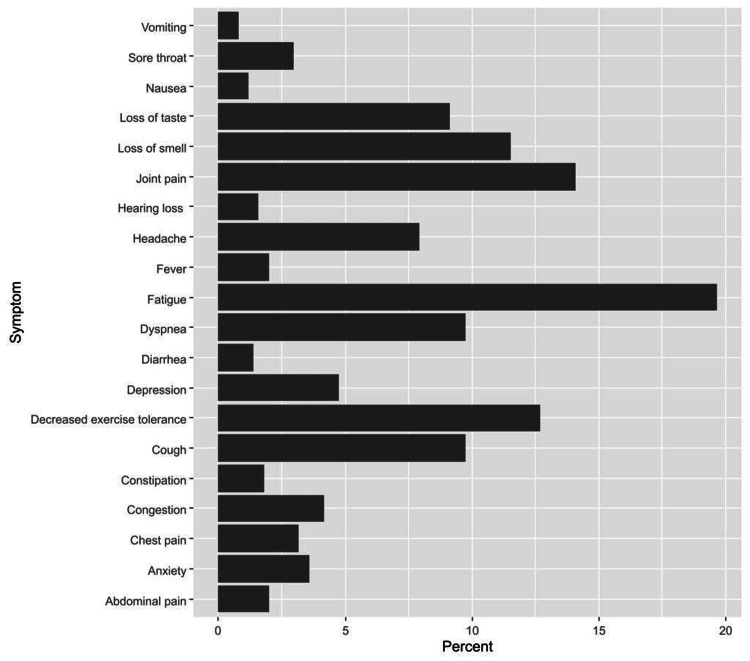
Data of 504 patients were analyzed. The incidence of PCS was 45.0% (95%CI, 40.7% to 49.5%). PCS was associated with female gender (OR = 1.71, 95%CI, 1.13 to 2.59, p = 0.011), having three or more co-morbid conditions (OR = 2.37, 95%CI, 1.19 to 4.75, p = 0.014), receiving steroids (OR = 2.13, 95%CI, 1.16 to 3.98, p = 0.016), also patients who experienced congestion (OR = 1.68, 95%CI, 1.05 to 2.71, p = 0.032) and depression (OR = 1.80, 95%CI, 1.03 to 3.18, p = 0.039) during acute COVID-19 infection. The most commonly reported symptoms beyond 12 weeks included fatigue (19.6%), joint pain (14.1%), and decreased exercise tolerance (12.7%).
In conclusion, the main risk factors to develop PCS are being female, having three or more co-morbidities, receiving steroids, or patients presenting with nasal congestion and/or depression.
2019年冠状病毒病(COVID-19)大流行给全球带来了巨大负担。冠状病毒病最常见的表现是急性的,大多数患者能完全康复。然而,现在相当一部分患者出现了长期健康问题。新冠后综合征(PCS)被定义为“在与COVID-19相符的感染后出现的症状和体征,持续超过12周且尚未被其他诊断解释”。我们发现海湾地区缺乏关于PCS的研究。因此,本研究旨在评估2020年6月1日至2020年12月31日期间在吉达阿卜杜勒阿齐兹国王大学医院(KAUH)就诊的确诊COVID-19患者中PCS的发病率、危险因素和最常见的持续症状。
这项回顾性队列研究通过电话调查进行,于2022年6月在KAUH开展。PCS被定义为疾病发作12周后出现一种或多种症状。纳入标准为2020年6月1日至2020年12月3日期间在KAUH通过逆转录聚合酶链反应(RT-PCR)检测呈阳性而实验室确诊感染严重急性呼吸综合征冠状病毒2(SARS-CoV-2)的18岁及以上患者,男女均纳入。排除标准为无法提供知情同意、死亡、当前正在感染COVID-19(PCR阳性)以及未完成访谈。从2020年6月1日至2020年12月31日通过RT-PCR检测呈阳性而被诊断为COVID-19的患者处获取病历。
分析了504例患者的数据。PCS的发病率为45.0%(95%置信区间,40.7%至49.5%)。PCS与女性(比值比[OR]=1.71,95%置信区间,1.13至2.59,p=0.011)、患有三种或更多合并症(OR=2.37,95%置信区间,1.19至4.75,p=0.014)、接受类固醇治疗(OR=2.13,95%置信区间,1.16至3.98,p=0.016)有关,急性COVID-19感染期间出现鼻塞(OR=1.68,95%置信区间,1.05至2.71,p=0.032)和抑郁(OR=1.80,95%置信区间,1.03至3.18,p=0.039)的患者也与之有关。12周后最常报告的症状包括疲劳(19.6%)、关节疼痛(14.1%)和运动耐力下降(12.7%)。
总之,发生PCS的主要危险因素是女性、患有三种或更多合并症、接受类固醇治疗,或出现鼻塞和/或抑郁的患者。