Department of Neurology, Dhaka Medical College, Dhaka, Bangladesh.
Department of Medicine, Dhaka Medical College, Dhaka, Bangladesh.
PLoS One. 2021 Apr 8;16(4):e0249644. doi: 10.1371/journal.pone.0249644. eCollection 2021.
Post-coronavirus disease (COVID-19) syndrome includes persistence of symptoms beyond viral clearance and fresh development of symptoms or exaggeration of chronic diseases within a month after initial clinical and virological cure of the disease with a viral etiology. We aimed to determine the incidence, association, and risk factors associated with development of the post-COVID-19 syndrome.
We conducted a prospective cohort study at Dhaka Medical College Hospital between June 01, 2020 and August 10, 2020. All the enrolled patients were followed up for a month after clinical improvement, which was defined according the World Health Organization and Bangladesh guidelines as normal body temperature for successive 3 days, significant improvement in respiratory symptoms (respiratory rate <25/breath/minute with no dyspnea), and oxygen saturation >93% without assisted oxygen inhalation.
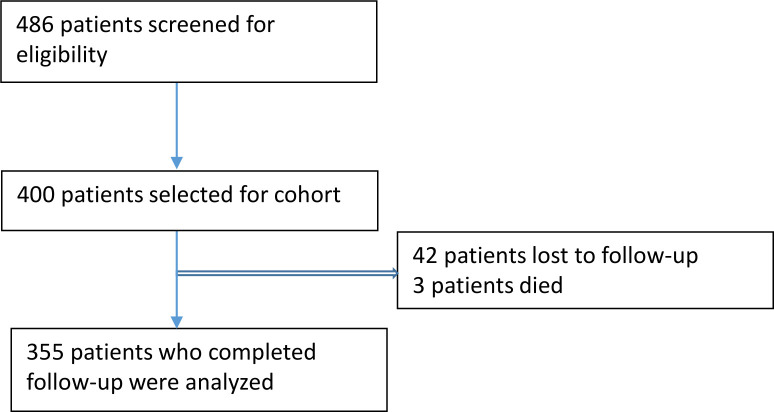
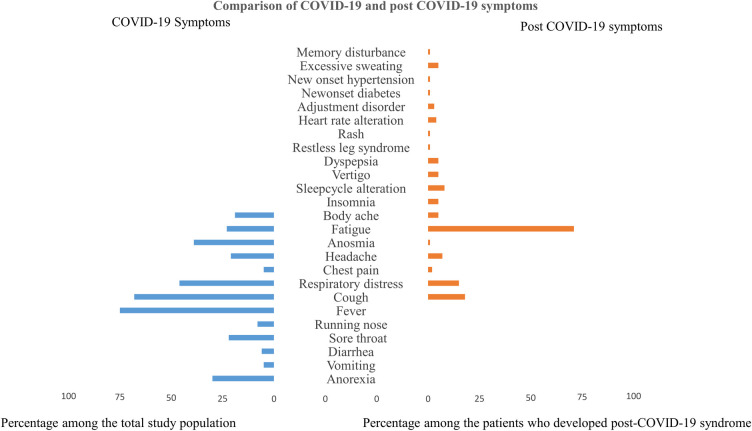
Among the 400 recruited patients, 355 patients were analyzed. In total, 46% patients developed post-COVID-19 symptoms, with post-viral fatigue being the most prevalent symptom in 70% cases. The post-COVID-19 syndrome was associated with female gender (relative risk [RR]: 1.2, 95% confidence interval [CI]: 1.02-1.48, p = 0.03), those who required a prolonged time for clinical improvement (p<0.001), and those showing COVID-19 positivity after 14 days (RR: 1.09, 95% CI: 1.00-1.19, p<0.001) of initial positivity. Patients with severe COVID-19 at presentation developed post-COVID-19 syndrome (p = 0.02). Patients with fever (RR: 1.5, 95% CI: 1.05-2.27, p = 0.03), cough (RR: 1.36, 95% CI: 1.02-1.81, p = 0.04), respiratory distress (RR: 1.3, 95% CI: 1.4-1.56, p = 0.001), and lethargy (RR: 1.2, 95% CI: 1.06-1.35, p = 0.003) as the presenting features were associated with the development of the more susceptible to develop post COVID-19 syndrome than the others. Logistic regression analysis revealed female sex, respiratory distress, lethargy, and long duration of the disease as risk factors.
Female sex, respiratory distress, lethargy, and long disease duration are critical risk factors for the development of post-COVID-19 syndrome.
新冠病毒疾病(COVID-19)后综合征包括在病毒清除后持续存在症状,以及在具有病毒病因的疾病初始临床和病毒学治愈后一个月内新出现症状或慢性病加重。我们旨在确定与 COVID-19 后综合征发展相关的发病率、关联和危险因素。
我们在 2020 年 6 月 1 日至 2020 年 8 月 10 日期间在达卡医学院医院进行了一项前瞻性队列研究。所有入组患者在临床改善后随访一个月,这是根据世界卫生组织和孟加拉国指南定义的,连续 3 天体温正常、呼吸症状明显改善(呼吸频率<25/分钟且无呼吸困难)和血氧饱和度>93%,无需辅助吸氧。
在招募的 400 名患者中,对 355 名患者进行了分析。共有 46%的患者出现了 COVID-19 后症状,其中 70%的患者最常见的症状是病毒后疲劳。COVID-19 后综合征与女性性别相关(相对风险 [RR]:1.2,95%置信区间 [CI]:1.02-1.48,p=0.03)、临床改善时间延长(p<0.001)以及初始阳性后 14 天出现 COVID-19 阳性(RR:1.09,95% CI:1.00-1.19,p<0.001)相关。出现 COVID-19 时病情严重的患者出现 COVID-19 后综合征(p=0.02)。发热(RR:1.5,95% CI:1.05-2.27,p=0.03)、咳嗽(RR:1.36,95% CI:1.02-1.81,p=0.04)、呼吸窘迫(RR:1.3,95% CI:1.4-1.56,p=0.001)和乏力(RR:1.2,95% CI:1.06-1.35,p=0.003)是发病时的主要表现,与更易发生 COVID-19 后综合征相关。逻辑回归分析显示,女性、呼吸窘迫、乏力和疾病持续时间长是发生 COVID-19 后综合征的危险因素。
女性、呼吸窘迫、乏力和疾病持续时间长是 COVID-19 后综合征发展的关键危险因素。