Department of Medicine, University of California, Irvine, Orange.
Unafilliliated Independent Contractor.
JAMA Netw Open. 2023 Jan 3;6(1):e2249674. doi: 10.1001/jamanetworkopen.2022.49674.
Merkel cell carcinoma (MCC) is a rare and highly aggressive cutaneous neuroendocrine carcinoma with increasing incidence. Cytotoxic chemotherapy and checkpoint inhibitors provide treatment options in the metastatic setting; however, there are no approved or standard of care targeted therapy treatment options.
To identify actionable alterations annotated by the OncoKB database therapeutic evidence level in association with tumor mutation burden (TMB).
DESIGN, SETTING, AND PARTICIPANTS: This is a retrospective, cross-sectional study using data from the American Association for Cancer Research Genomics Evidence Neoplasia Information Exchange, a multicenter international cancer consortium database. Patients with MCC were enrolled in participating institutions between 2017 and 2022. Data from version 11.0 of the database were released in January 2022 and analyzed from April to June 2022.
The main outcome was the percentage of patients with high TMB and OncoKB level 3B and 4 alterations.
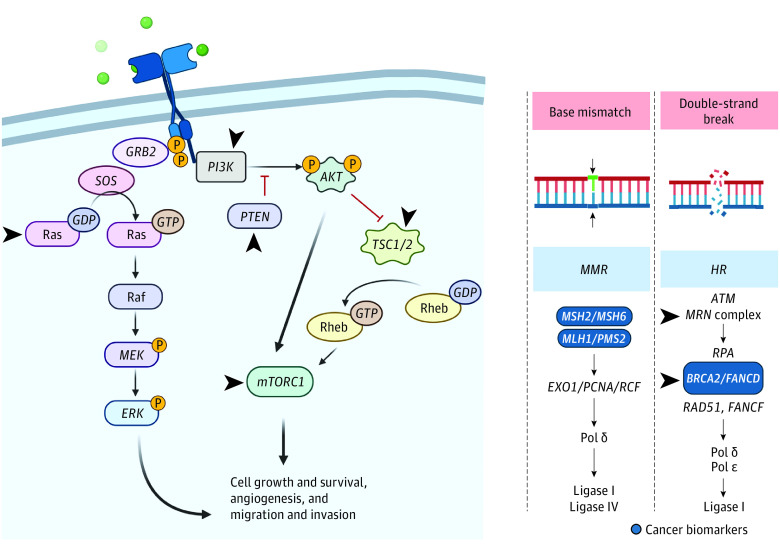
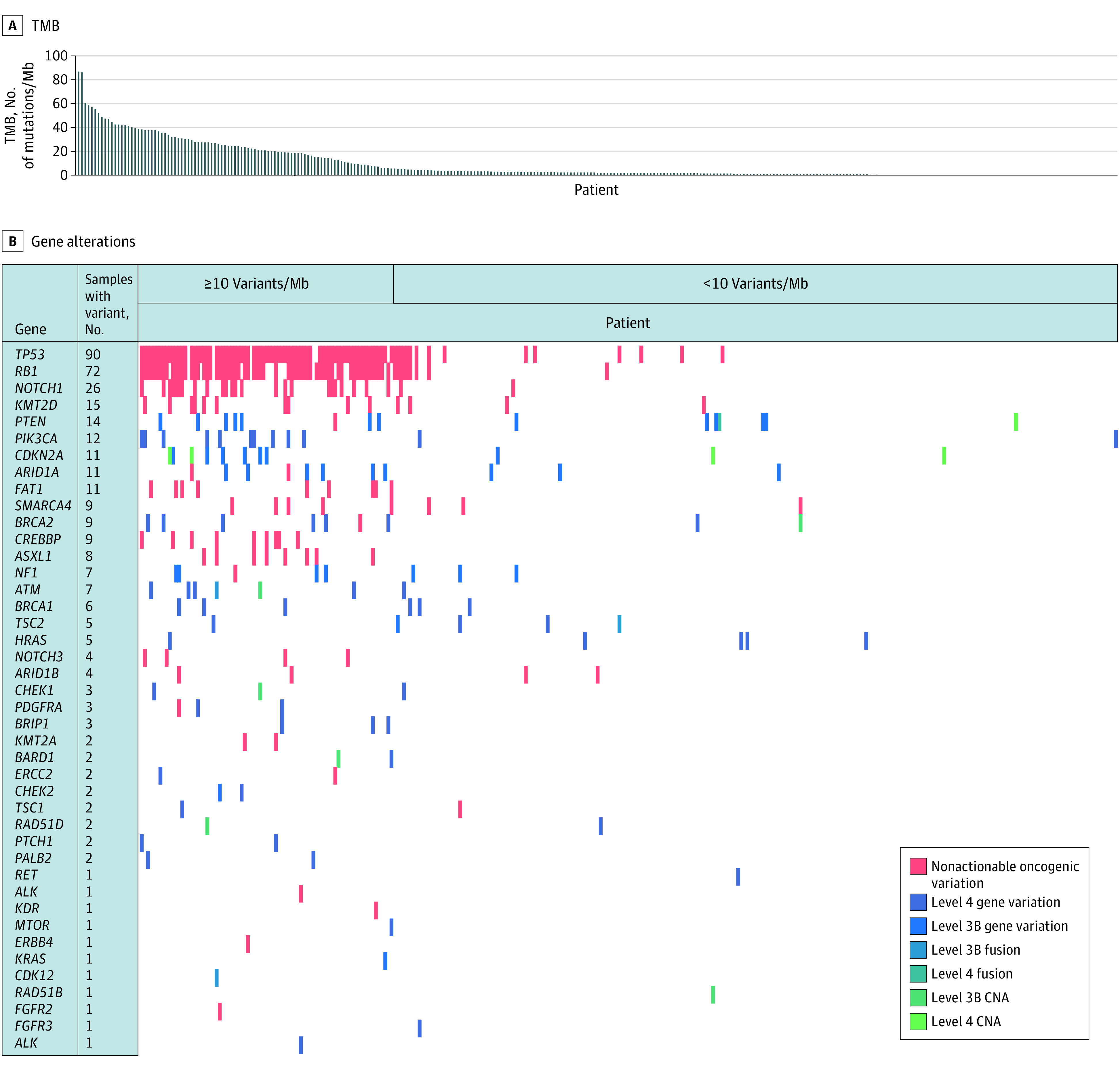
A total of 324 tumor samples from 313 patients with MCC (107 women [34.2%]; 287 White patients [91.7%]; 7 Black patients [2.2%]) were cataloged in the database. The median (range) number of alterations was 4.0 (0.0-178.0), with a mean (SD) of 13.6 (21.2) alterations. Oncogenic alterations represented 20.2% of all alterations (862 of 4259 alterations). Tissue originated from primary tumor in 55.0% of patients (172 patients) vs metastasis in 39.6% (124 patients). TMB-high (≥10 mutations per megabase) was present in 26.2% of cases (82 patients). Next-generation sequencing identified 55 patients (17.6%) with a level 3B variation for a Food and Drug Administration-approved drug for use in a biomarker-approved indication or approved drug in another indication. An additional 8.6% of patients (27 patients) had a level 4 variation. Actionable alterations were more common among high TMB cases, with 37 of 82 patients (45.1%) harboring level 3 alterations compared with only 18 of 231 patients (7.8%) with low TMB. The most common level 3B gene variants included PIK3CA (12 patients [3.8%]), BRCA1/2 (13 patients [4.2%]), ATM (7 patients [2.2%]), HRAS (5 patients [1.6%]), and TSC1/2 (6 patients [1.9%]). The most common level 4 variants include PTEN (13 patients [4.1%]), ARID1A (9 patients [2.9%]), NF1 (7 patients [2.2%]), and CDKN2A (7 patients [2.2%]). Copy number alterations and fusions were infrequent. In 61.0% of cases (191 cases), a PanCancer pathway was altered, and 39.9% (125 cases) had alterations in multiple pathways. Commonly altered pathways were RTK-RAS (119 patients [38.0%]), TP53 (103 patients [32.9%]), cell cycle (104 patients [33.2%]), PI3K (99 patients [31.6%]), and NOTCH (93 patients [29.7%]). In addition, oncogenic DNA mismatch repair gene alterations were present in 8.0% of cases (25 patients).
In this cross-sectional retrospective study of alterations and TMB in MCC, a minority of patients had potentially actionable alterations. These findings support the investigation of targeted therapies as single agent or in combination with immunotherapy or cytotoxic chemotherapy in selected MCC populations.
Merkel 细胞癌(MCC)是一种罕见且高度侵袭性的皮肤神经内分泌癌,其发病率正在上升。细胞毒性化疗和检查点抑制剂为转移性疾病提供了治疗选择;然而,目前尚无批准或标准护理的靶向治疗选择。
确定与肿瘤突变负担(TMB)相关的 OncoKB 数据库治疗证据水平注释的可操作改变。
设计、设置和参与者: 这是一项回顾性、横断面研究,使用了美国癌症研究协会基因组证据肿瘤学信息交换的多中心国际癌症联盟数据库的数据。2017 年至 2022 年间,在参与机构中招募了 MCC 患者。数据库版本 11.0 的数据于 2022 年 1 月发布,并于 2022 年 4 月至 6 月进行分析。
主要结果是高 TMB 和 OncoKB 水平 3B 和 4 改变的患者比例。
数据库中共有 313 名 MCC 患者的 324 个肿瘤样本(107 名女性[34.2%];287 名白人患者[91.7%];7 名黑人患者[2.2%])。数据库中记录的中位数(范围)改变数量为 4.0(0.0-178.0),平均(SD)改变数量为 13.6(21.2)。致癌改变占所有改变的 20.2%(862 个改变中的 20.2%)。组织来源于原发肿瘤的患者占 55.0%(172 名患者),转移瘤的患者占 39.6%(124 名患者)。TMB-高(≥10 个每兆碱基突变)占 26.2%(82 名患者)。下一代测序确定了 55 名(17.6%)患者存在 level 3B 变化,这些变化与 Food and Drug Administration 批准的药物用于生物标志物批准的适应症或另一种适应症的批准药物有关。另外 8.6%的患者(27 名)存在 level 4 变化。在 TMB 高的病例中,可操作改变更为常见,37 名患者(45.1%)携带 level 3 改变,而 TMB 低的患者中只有 18 名(7.8%)。最常见的 level 3B 基因突变包括 PIK3CA(12 名患者[3.8%])、BRCA1/2(13 名患者[4.2%])、ATM(7 名患者[2.2%])、HRAS(5 名患者[1.6%])和 TSC1/2(6 名患者[1.9%])。最常见的 level 4 变异包括 PTEN(13 名患者[4.1%])、ARID1A(9 名患者[2.9%])、NF1(7 名患者[2.2%])和 CDKN2A(7 名患者[2.2%])。拷贝数改变和融合较为罕见。在 61.0%的病例(191 例)中,一种 PanCancer 通路发生改变,39.9%(125 例)的病例存在多种通路的改变。常见的改变通路包括 RTK-RAS(119 名患者[38.0%])、TP53(103 名患者[32.9%])、细胞周期(104 名患者[33.2%])、PI3K(99 名患者[31.6%])和 NOTCH(93 名患者[29.7%])。此外,8.0%的病例(25 名患者)存在致癌性 DNA 错配修复基因突变。
在这项关于 MCC 中改变和 TMB 的横断面回顾性研究中,少数患者存在潜在的可操作改变。这些发现支持在选定的 MCC 人群中,对靶向治疗作为单一药物或与免疫疗法或细胞毒性化疗联合进行研究。