van Stolk-Cooke Katherine, Wielgosz Joseph, Hallenbeck Haijing Wu, Chang Andrew, Rosen Craig, Owen Jason, Kuhn Eric
Department of Psychiatry & Behavioral Sciences, Stanford University School of Medicine, Palo Alto, CA, United States.
National Center for PTSD, Veteran Affairs Palo Alto Healthcare System, Palo Alto, CA, United States.
JMIR Form Res. 2023 Jan 5;7:e42053. doi: 10.2196/42053.
Posttraumatic stress disorder (PTSD) among US military veterans can adversely impact their concerned significant others (CSOs; eg, family members and romantic partners). Mobile apps can be tailored to support CSO mental health through psychoeducation, coping skills, and stress monitoring.
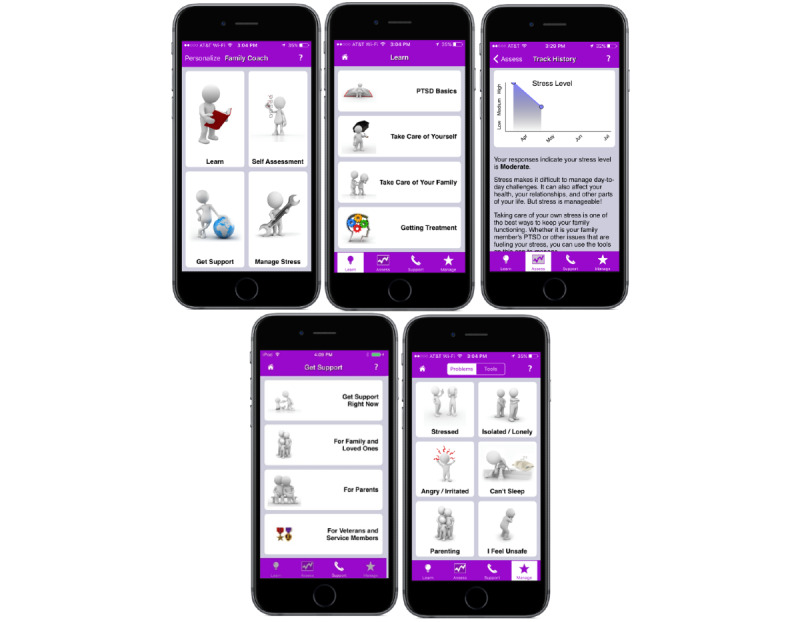
This study assessed the feasibility, acceptability, and potential efficacy of PTSD Family Coach 1.0, a free, publicly available app that includes psychoeducation, stress management tools, self-assessments, and features for connecting to alternative supports, compared with a psychoeducation-only version of the app for cohabitating CSOs of veterans with PTSD.
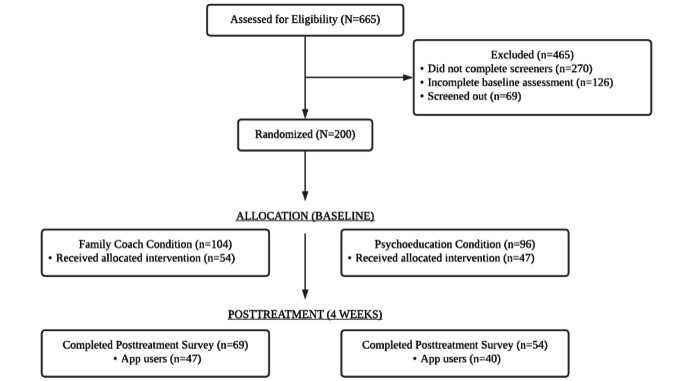
A total of 200 participants with an average age of 39 (SD 8.44) years, primarily female (193/200, 97%), and White (160/200, 80%) were randomized to self-guided use of either PTSD Family Coach 1.0 (n=104) or a psychoeducation-only app (n=96) for 4 weeks. Caregiver burden, stress, depression, anxiety, beliefs about treatment, CSO self-efficacy, and relationship functioning assessed using measures of dyadic adjustment, social constraints, and communication danger signs were administered via a web survey at baseline and after treatment. User satisfaction and app helpfulness were assessed after treatment. Data were analyzed using linear mixed methods.
Overall, 50.5% (101/200) of randomized participants used their allocated app. Participants found PTSD Family Coach 1.0 somewhat satisfying (mean 4.88, SD 1.11) and moderately helpful (mean 2.99, SD 0.97) to use. Linear mixed effects models revealed no significant differences in outcomes by condition for caregiver burden (P=.45; Cohen d=0.1, 95% CI -0.2 to 0.4), stress (P=.64; Cohen d=0.1, 95% CI -0.4 to 0.6), depression (P=.93; Cohen d= 0.0, 95% CI -0.3 to 0.3), anxiety (P=.55; Cohen d=-0.1, 95% CI -0.4 to 0.2), beliefs about treatment (P=.71; Cohen d=0.1, 95% CI -0.2 to 0.3), partner self-efficacy (P=.59; Cohen d=-0.1, 95% CI -0.4 to 0.2), dyadic adjustment (P=.08; Cohen d=-0.2, 95% CI -0.5 to 0.0), social constraints (P=.05; Cohen d=0.3, 95% CI 0.0-0.6), or communication danger signs (P=.90; Cohen d=-0.0, 95% CI -0.3 to 0.3). Post hoc analyses collapsing across conditions revealed a significant between-group effect on stress for app users versus nonusers (β=-3.62; t=-2.27; P=.02).
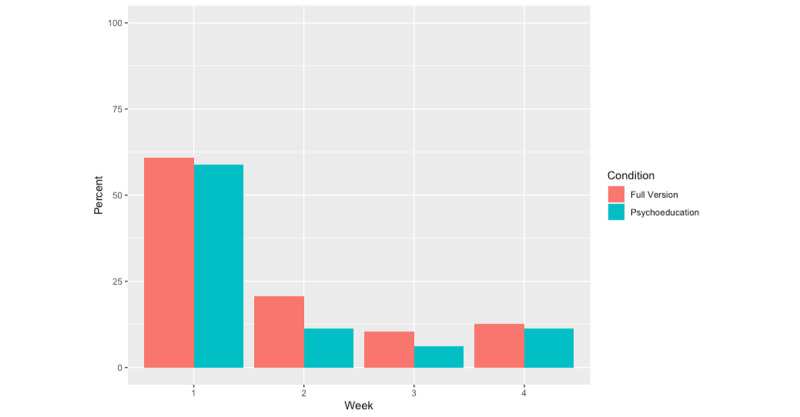
Approximately half of the randomized participants never used their allocated app, and participants in the PTSD Family Coach 1.0 condition only opened the app approximately 4 times over 4 weeks, suggesting limitations to this app version's feasibility. PTSD Family Coach 1.0 users reported moderately favorable impressions of the app, suggesting preliminary acceptability. Regarding efficacy, no significant difference was found between PTSD Family Coach 1.0 users and psychoeducation app users across any outcome of interest. Post hoc analyses suggested that app use regardless of treatment condition was associated with reduced stress. Further research that improves app feasibility and establishes efficacy in targeting the domains most relevant to CSOs is warranted.
ClinicalTrials.gov NCT02486705; https://clinicaltrials.gov/ct2/show/NCT02486705.
美国退伍军人中的创伤后应激障碍(PTSD)会对其相关重要他人(CSO,如家庭成员和浪漫伴侣)产生不利影响。移动应用程序可以通过心理教育、应对技巧和压力监测来进行定制,以支持CSO的心理健康。
本研究评估了PTSD家庭教练1.0(一款免费的公开可用应用程序,包括心理教育、压力管理工具、自我评估以及连接其他支持的功能)与仅提供心理教育的应用程序版本相比,对于患有PTSD退伍军人的同居CSO的可行性、可接受性和潜在疗效。
共有200名平均年龄为39(标准差8.44)岁的参与者,主要为女性(193/200,97%),白人(160/200,80%),被随机分配自行使用PTSD家庭教练1.0(n = 104)或仅提供心理教育的应用程序(n = 96),为期4周。通过二元调整、社会约束和沟通危险信号等测量方法,在基线和治疗后通过网络调查对照顾者负担、压力、抑郁、焦虑、对治疗的信念、CSO自我效能感和关系功能进行评估。治疗后评估用户满意度和应用程序的帮助程度。使用线性混合方法分析数据。
总体而言,50.5%(101/200)的随机参与者使用了分配给他们的应用程序。参与者发现PTSD家庭教练1.0在使用上有点令人满意(平均4.88,标准差1.11)且有一定帮助(平均2.99,标准差0.97)。线性混合效应模型显示,在照顾者负担(P = 0.45;科恩d = 0.1,95%置信区间 -0.2至0.4)、压力(P = 0.64;科恩d = 0.1,95%置信区间 -0.4至0.6)、抑郁(P = 0.93;科恩d = 0.0,95%置信区间 -0.3至0.3)、焦虑(P = 0.55;科恩d = -0.1,95%置信区间 -0.4至0.2)、对治疗的信念(P = 0.71;科恩d = 0.1,95%置信区间 -0.2至0.3)、伴侣自我效能感(P = 0.59;科恩d = -0.1,95%置信区间 -0.4至0.2)、二元调整(P = 0.08;科恩d = -0.2,95%置信区间 -0.5至0.0)、社会约束(P = 0.05;科恩d = 0.3,95%置信区间0.0 - 0.6)或沟通危险信号(P = 0.90;科恩d = -0.0,95%置信区间 -0.3至0.3)方面,不同条件下的结果没有显著差异。跨条件的事后分析显示,应用程序使用者与非使用者之间在压力方面存在显著的组间效应(β = -3.62;t = -2.27;P = 0.02)。
大约一半的随机参与者从未使用分配给他们的应用程序,PTSD家庭教练1.0组的参与者在4周内仅打开应用程序约4次,这表明该应用程序版本的可行性存在局限性。PTSD家庭教练1.0的用户对该应用程序的评价中等偏上,表明初步具有可接受性。关于疗效,在任何感兴趣的结果方面,PTSD家庭教练1.0的用户与心理教育应用程序的用户之间均未发现显著差异。事后分析表明,无论治疗条件如何,使用应用程序都与压力减轻有关。有必要进行进一步的研究,以提高应用程序的可行性,并确定其在针对与CSO最相关领域方面的疗效。
ClinicalTrials.gov NCT02486705;https://clinicaltrials.gov/ct2/show/NCT02486705