Facharztforum Fürth, 90762, Fürth, Germany.
Pulmonary Department, Mainz University Hospital, 55131, Mainz, Germany.
Respir Res. 2023 Jan 5;24(1):2. doi: 10.1186/s12931-023-02311-x.
There is an interest in the role of blood eosinophils for predicting inhaled corticosteroid (ICS) response in chronic obstructive pulmonary disease (COPD). Most data are from interventional clinical studies; data from unselected real-world populations may help better inform treatment decisions. DACCORD is a non-interventional real-world study. Cohort 3 recruited patients with COPD who had received triple therapy for ≥ 6 months; prior to entry patients either continued triple therapy, or switched to a long-acting muscarinic antagonist/long-acting beta-agonist (LABA/LAMA), and were followed for 12 months.
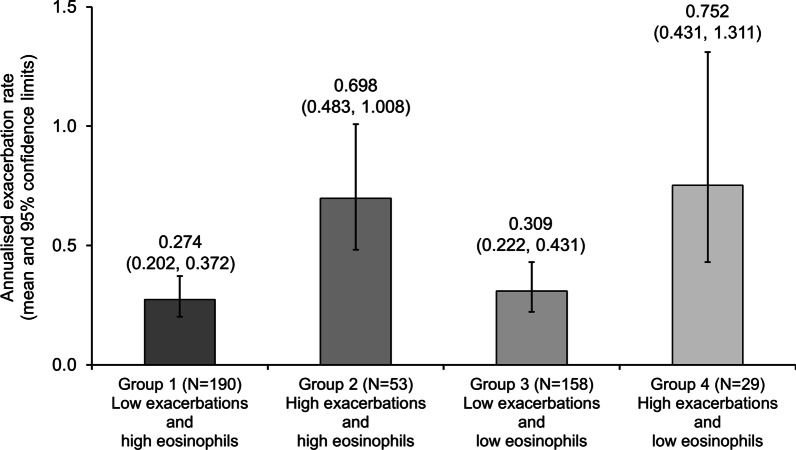
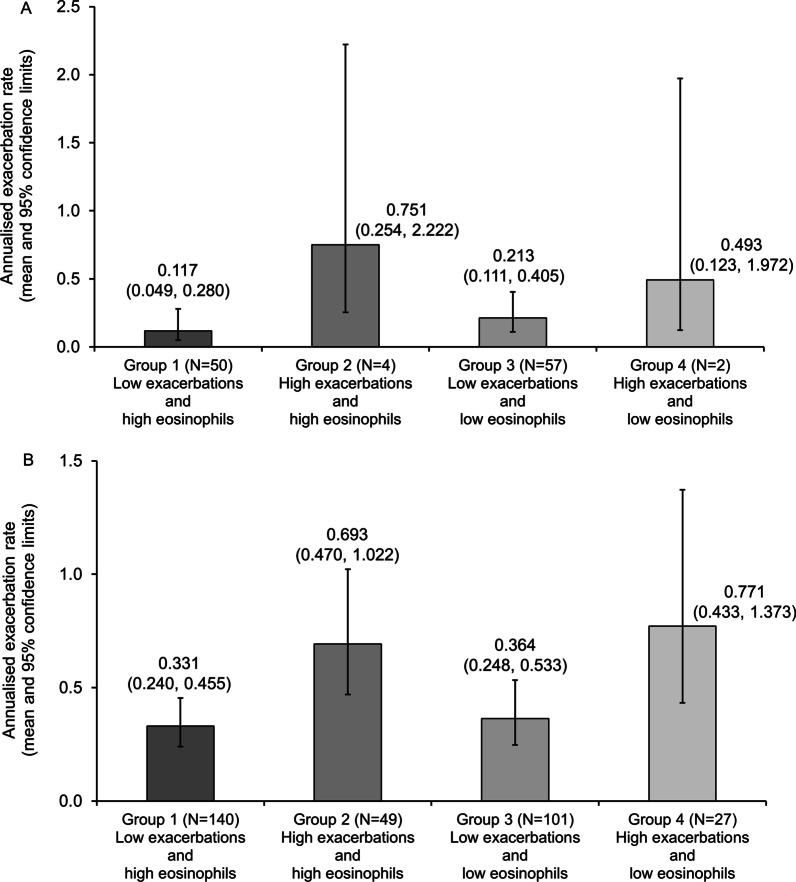
For these post-hoc analyses, patients were divided into four groups based on exacerbation history and baseline blood eosinophil count (< 100 vs. > 300 cells/µL). Exacerbation rates were calculated overall and for the two treatments.
Among the 430 patients in the current analyses, the largest groups had low exacerbation history with high (44.2%) or low eosinophils (36.7%). Most patients did not exacerbate during follow-up (68.8% overall; 83.2% and 63.7% with LABA/LAMA and triple therapy). The highest exacerbation rates were in groups with high exacerbation history, differing significantly in the overall analyses from those with low exacerbation history (matched by eosinophil count); rates did not differ when grouped by eosinophil count (matched by exacerbation history).
Although most patients in these analyses did not exacerbate during follow-up, whereas exacerbation history is a predictor of future exacerbations, blood eosinophil count is not. This suggests that although eosinophil count may help to guide ICS initiation, this is less of a consideration when 'stepping-down' from triple therapy to a LABA/LAMA.
人们对血液嗜酸性粒细胞在预测慢性阻塞性肺疾病(COPD)患者吸入性皮质类固醇(ICS)反应中的作用很感兴趣。大多数数据来自干预性临床研究;来自未经选择的真实世界人群的数据可能有助于更好地为治疗决策提供信息。DACCORD 是一项非干预性真实世界研究。第 3 队列招募了接受三联疗法治疗≥6 个月的 COPD 患者;入组前,患者要么继续三联疗法,要么转为长效抗毒蕈碱/长效β-激动剂(LABA/LAMA),并随访 12 个月。
这些事后分析中,根据既往加重史和基线血液嗜酸性粒细胞计数(<100 与>300 细胞/µL)将患者分为四组。计算了总体和两种治疗方法的加重率。
在当前分析的 430 名患者中,最大的两组具有低加重史和高(44.2%)或低嗜酸性粒细胞(36.7%)。大多数患者在随访期间未加重(总体 68.8%;LABA/LAMA 和三联疗法分别为 83.2%和 63.7%)。高加重史组的加重率最高,与低加重史组相比,在总体分析中差异显著(通过嗜酸性粒细胞计数匹配);当按嗜酸性粒细胞计数分组时(通过加重史匹配),差异无统计学意义。
尽管在这些分析中大多数患者在随访期间未加重,但既往加重史是未来加重的预测因素,而嗜酸性粒细胞计数不是。这表明,尽管嗜酸性粒细胞计数可能有助于指导 ICS 的启动,但当从三联疗法转为 LABA/LAMA 时,这并不是一个重要的考虑因素。