USAID Tanzania Vector Control Activity, Tropical Health, Baltimore, MD, USA.
USAID Tanzania Vector Control Activity, Tropical Health, New Orleans, LA, USA.
Malar J. 2023 Jan 5;22(1):4. doi: 10.1186/s12936-022-04432-y.
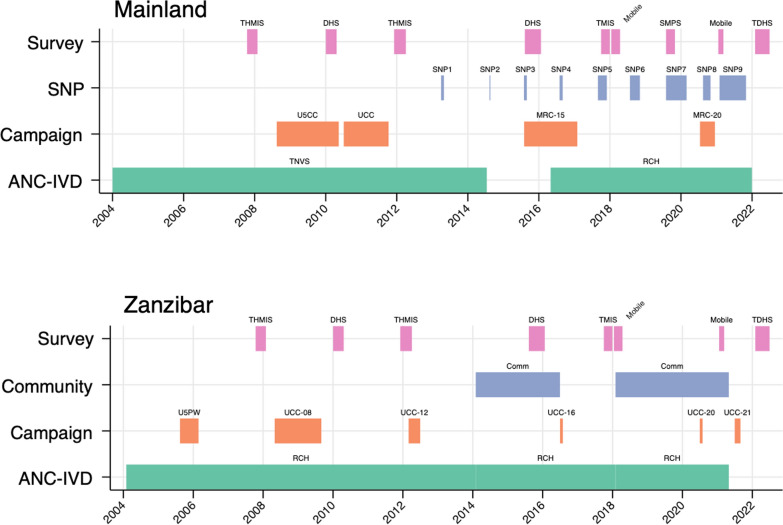
Since 2013, the National Malaria Control Programme in mainland Tanzania and the Zanzibar Malaria Elimination Programme have implemented mass insecticide-treated net (ITN) distribution campaigns, routine ITN distribution to pregnant women and infants, and continuous distribution through primary schools (mainland) and community leaders (Zanzibar) to further malaria control efforts. Mass campaigns are triggered when ITN access falls below 40%. In this context, there is a need to monitor ITN access annually to assess whether it is below threshold and inform quantification of ITNs for the following year. Annual estimates of access are needed at the council level to inform programmatic decision-making.
An age-structured stock and flow model was used to predict annual net crops from council-level distribution data in Tanzania from 2012 to 2020 parameterized with a Tanzania-specific net median lifespan of 2.15 years. Annual nets-per-capita (NPC) was calculated by dividing each annual net crop by mid-year council projected population. A previously fit nonparametric conditional quantile function for the proportion of the population with access to an ITN (ITN access) as a function of NPC was used to predict ITN access at the council level based on the predicted NPC value. These estimates were compared to regional-level ITN access from large household surveys.
For regions with the same ITN strategy for all councils, predicted council-level ITN access was consistent with regional-level survey data for 79% of councils. Regions where ITN strategy varied by council had regional estimates of ITN access that diverged from the council-specific estimates. Predicted ITN access reached 60% only when "nets issued as a percentage of the council population" (NPP) exceeded 15%, and approached 80% ITN access when NPP was at or above 20%.
Modelling ITN access with country-specific net decay rates, council-level population, and ITN distribution data is a promising approach to monitor ITN coverage sub-regionally and between household surveys in Tanzania and beyond.
自 2013 年以来,坦桑尼亚国家疟疾控制规划和桑给巴尔消除疟疾规划实施了大规模杀虫剂处理蚊帐(ITN)分发运动,向孕妇和婴儿常规分发 ITN,并通过小学(大陆)和社区领导人(桑给巴尔)持续分发,以进一步控制疟疾。当 ITN 普及率低于 40%时,就会启动大规模运动。在这种情况下,需要每年监测 ITN 的普及率,以评估是否低于阈值,并为下一年量化 ITN 提供信息。需要在县一级估计普及率,以便为方案决策提供信息。
使用年龄结构的存量和流量模型,根据坦桑尼亚特有的蚊帐平均寿命 2.15 年,从 2012 年至 2020 年的县一级分发数据中预测年度蚊帐产量。每年的人均蚊帐数(NPC)通过将每年的蚊帐产量除以年中县预计人口来计算。使用之前拟合的、作为 NPC 函数的人口中获得 ITN 的比例(ITN 普及率)的非参数条件分位数函数,根据预测的 NPC 值预测县一级的 ITN 普及率。这些估计值与来自大型家庭调查的区域一级 ITN 普及率进行了比较。
对于所有县采用相同 ITN 策略的地区,预测的县一级 ITN 普及率与区域一级调查数据在 79%的县中一致。ITN 策略因县而异的地区,其区域 ITN 普及率与县一级的估计值存在差异。只有当“按县人口计算的发放蚊帐比例”(NPP)超过 15%时,预测的 ITN 普及率才达到 60%,当 NPP 达到或高于 20%时,ITN 普及率才接近 80%。
使用国家特定的蚊帐衰减率、县一级人口和 ITN 分发数据来模拟 ITN 普及率是一种很有前途的方法,可以在坦桑尼亚及其他地区进行次区域和家庭调查之间监测 ITN 覆盖率。