USAID Tanzania Vector Control Activity, Tropical Health, Baltimore, MD, USA.
USAID Tanzania Vector Control Activity, Tropical Health, New Orleans, LA, USA.
Malar J. 2022 Aug 26;21(1):246. doi: 10.1186/s12936-022-04272-w.
Since 2013, the National Malaria Control Programme in mainland Tanzania has deployed annual distributions of insecticide-treated nets (ITNs) through primary schools to maintain ITN access and use. This School Net Programme (SNP) is slated to be used throughout mainland Tanzania by 2023. This modelling study projects ITN access under different ITN distribution strategies and quantification approaches.
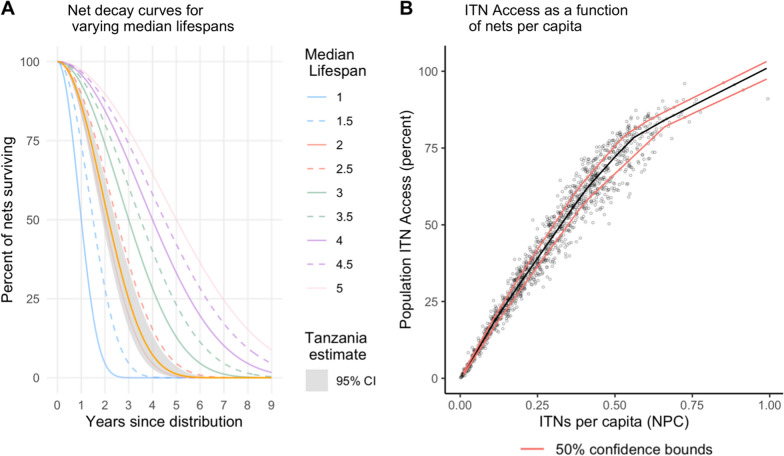
A stock and flow model with a Tanzania-specific ITN decay rate was used to calculate annual net crops for four different ITN distribution strategies, varying quantification approaches within each strategy. Annual nets-per-capita (NPC) was derived from net crop and a standardized population projection. Nonparametric conditional quartile functions for the proportion of the population with access to an ITN (ITN access) as a function of NPC were used to predict ITN access and its variability. The number of ITNs required under the varying quantification approaches for the period 2022-2030 was calculated.
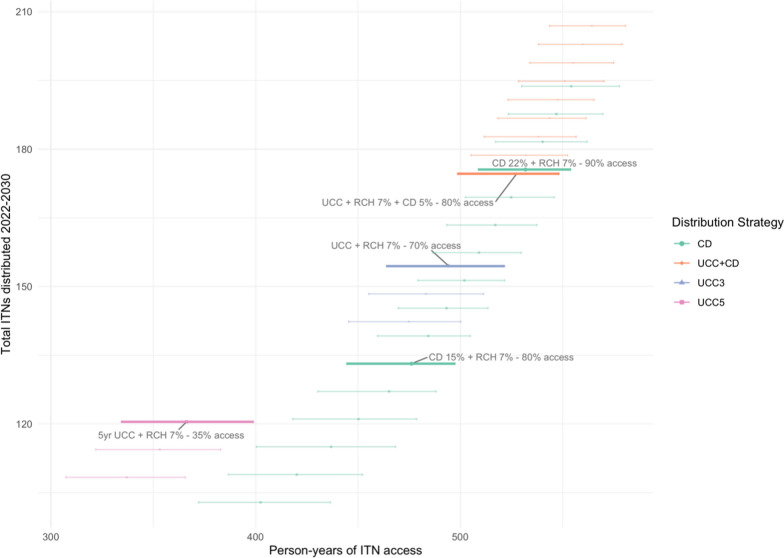
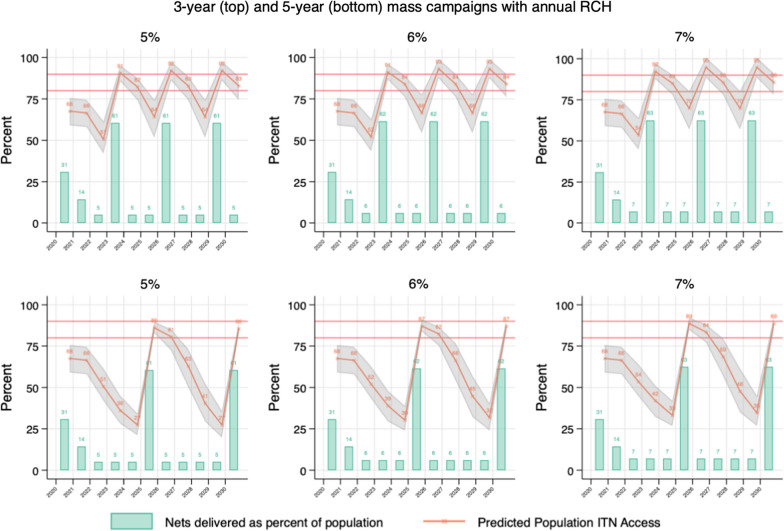
Annual SNP quantified using a "population times 15%" approach maintained ITN access between 80 and 90%, when combined with reproductive and child health (RCH) ITN distribution, requiring 133.2 million ITNs. The same strategy quantified with "population times 22%" maintained ITN access at or above 90%, requiring 175.5 million ITNs. Under 5-year mass campaigns with RCH distribution for pregnant women and infants, ITN access reached 90% post-campaign and fell to 27-35% in the 4th year post-campaign, requiring 120.5 million ITNs over 8 years. 3-yearly mass campaigns with RCH reached 100% ITN access post-campaign and fell to 70% in the 3rd year post-campaign, requiring 154.4 million ITNs.
Given an ITN retention time in Tanzania of 2.15 years, the model predicts that mass campaigns conducted every 3 years in mainland Tanzania will not maintain ITN access at target levels of 80%, even with strong RCH channels. Mainland Tanzania can however expect to maintain ITN access at 80% or above by quantifying SNP using "population × 15%", in addition to RCH ITN delivery. This strategy requires 14% fewer ITNs than a 3-year campaign strategy while providing more consistent ITN coverage. Meeting the targets of 80% ITN use would require maintaining 90% ITN access, achievable using a "population times 22%" quantification approach for SNP.
自 2013 年以来,坦桑尼亚国家疟疾控制规划通过小学分发年度驱虫蚊帐(ITN)以维持 ITN 的获取和使用。该学校蚊帐计划(SNP)计划在 2023 年之前在坦桑尼亚大陆使用。本建模研究预测了不同 ITN 分配策略和量化方法下的 ITN 可及性。
使用具有坦桑尼亚特定 ITN 衰减率的存量和流量模型来计算四种不同 ITN 分配策略的年度蚊帐作物,每种策略内都有不同的量化方法。从蚊帐作物和标准化人口预测中得出人均蚊帐数(NPC)。非参数条件四分位函数用于预测作为 NPC 函数的获得 ITN 的人口比例(ITN 可及性)及其可变性。使用不同的量化方法在 2022-2030 年期间计算所需的 ITN 数量。
使用“人口乘以 15%”的方法量化的年度 SNP 与生殖健康和儿童健康(RCH)ITN 分配相结合,保持了 80%至 90%的 ITN 可及性,需要 1.332 亿个 ITN。相同的策略用“人口乘以 22%”进行量化,保持了 ITN 可及性在 90%或以上,需要 1.755 亿个 ITN。在针对孕妇和婴儿的 5 年 RCH 大规模运动中,运动后的 ITN 可及性达到 90%,但在运动后的第 4 年下降到 27-35%,8 年内需要 1.205 亿个 ITN。每 3 年进行一次 RCH 大规模运动,运动后的 ITN 可及性达到 100%,运动后的第 3 年下降到 70%,需要 1.544 亿个 ITN。
鉴于坦桑尼亚 ITN 的保留时间为 2.15 年,该模型预测,即使有强大的 RCH 渠道,在坦桑尼亚大陆每 3 年进行一次的大规模运动也无法将 ITN 可及性维持在 80%的目标水平。然而,坦桑尼亚大陆可以通过使用“人口×15%”来量化 SNP,再加上 RCH ITN 交付,从而有望将 ITN 可及性维持在 80%或更高水平。与 3 年运动策略相比,该策略需要的 ITN 数量减少 14%,同时提供更一致的 ITN 覆盖范围。要达到 80%的 ITN 使用目标,需要保持 90%的 ITN 可及性,这可以通过 SNP 的“人口乘以 22%”量化方法来实现。